
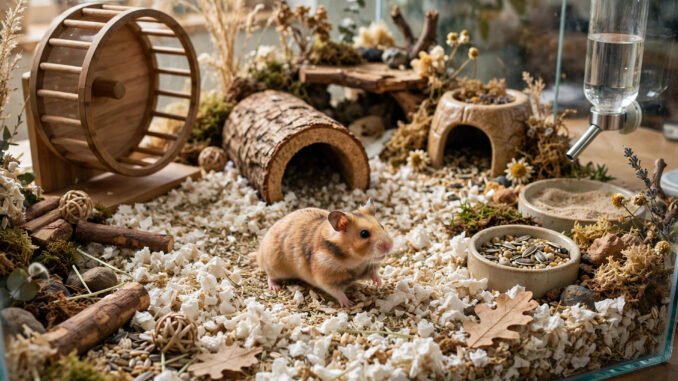
Hamsters are the starter pet of legend — small, cute, cheap. And then the new owner brings home a tiny barred cage from the pet store, a wheel that squeaks, and a hamster that bites, bar-chews all night, and looks miserable. Here is what the pet industry will not tell you: the standard “hamster starter kit” is inadequate in almost every way, and hamsters are not the low-maintenance pets they are marketed as. But choose the right cage — which costs less than most people expect — and hamsters become the delightful, low-cost companions they are supposed to be.
Why Cage Size Matters More Than Anything
In the wild, hamsters roam territories of up to several miles nightly. The minimum humane floor space recommended by welfare organizations is now 100 × 50 cm (approximately 775+ square inches) of unbroken floor space — roughly four times the size of the typical pet-store “starter cage.” Small cages cause the classic misery behaviors: bar chewing, cage climbing, repetitive pacing, and biting. Owners interpret these as “hamsters are boring/mean”; they are actually symptoms of an environment roughly equivalent to a human living in a closet.
The good news: adequate housing is cheap. The expensive-looking barred cages ($60–$120) are worse than a $25 DIY bin cage. Price and quality are inversely correlated in hamster housing — the industry profits from selling small, pretty, inadequate cages with expensive replacement accessories. The ASPCA’s small-pet care resources and the RSPCA’s hamster welfare guidance both emphasize floor space as the primary welfare factor.
The Best Cage Options, Ranked
1. DIY bin cage: $25–$40 (best value)
A 105–200 quart clear storage bin (IKEA Samla 57L or similar large bins) with a mesh ventilation panel cut into the lid. Cost: bin ($15–$25) + wire mesh ($8–$12) + zip ties. Offers 800–1,000+ square inches, deep bedding capacity (hamsters burrow — 6+ inches of bedding is a welfare essential most cages cannot fit), easy cleaning, and excellent visibility. The one downside: aesthetics (it is a storage bin). Total build time: 30 minutes with a box cutter and a steady hand.
2. Large tank/aquarium: $80–$150 used
A 40-gallon breeder tank (36″ × 18″ footprint = 648 sq in — acceptable for dwarf species; 75-gallon for Syrians) with a mesh lid. Superb visibility, holds deep bedding, draft-free. Buy used on marketplace sites for half retail. Weight is the drawback — a bedded 40-gallon tank is not easily moved.
3. Detolf-style glass cabinets: $70–$100
The IKEA Detolf glass cabinet laid on its side (a beloved hamster-community hack) offers ~950 square inches for around $70 — enormous space per dollar. Requires a DIY mesh lid. Availability varies as IKEA updates lines; check the hamster community for current equivalents.
4. Commercial cages that actually qualify: $100–$200
A few manufacturers now make adequately sized cages (Niteangel, Bucatstate, and similar) — large, well-designed, and expensive. Worth it if DIY is not your thing, but verify the unbroken floor space meets the 100×50 cm standard; many “large” commercial cages achieve size through levels, which do not count (hamsters are ground dwellers — levels are decoration, not space).
Avoid
Tiny barred starter cages, colorful modular tube systems (poor ventilation, hard to clean, too small), wire-floor cages (cause bumblefoot), and anything marketed primarily on cuteness. If the cage costs more than $60 and is smaller than a storage bin, you are paying for the inadequacy.
What Goes Inside (The Other Half of the Equation)
A big empty cage is barely better than a small one. Essentials: Bedding: 6+ inches of paper-based or aspen bedding ($15–$20/month) — burrowing is a core hamster behavior; shallow bedding is a welfare failure. Avoid pine/cedar shavings (respiratory irritants). Wheel: 8″+ for dwarfs, 11–12″ for Syrians ($15–$30) — undersized wheels cause spinal curvature; the silent spinner types are worth the premium for your sleep. Hideouts: At least two ($5–$15 each) — coconut hides, ceramic houses, cardboard boxes (free and beloved). Water: Bottle or bowl ($5–$10); bowls are more natural but get bedded. Food: Quality seed mix plus fresh veg ($10–$15/month). Enrichment: Cork logs, grapevine wood, sand bath ($8–$12 — hamsters bathe in sand, never water), and cardboard creations (free).
Realistic setup cost: $60–$120 total for a bin cage with proper furnishings. Monthly cost: $25–$35 (bedding + food). Track these small recurring costs in a budget you can actually stick to so they never surprise you. Hamsters are genuinely cheap pets after correct setup — the “cheap pet” myth fails only because the setup advice is wrong. If you are weighing pet options generally, our guide to low-maintenance pets for apartment living compares hamsters against the alternatives honestly.
Species Matters: Syrian vs. Dwarf
Syrians (golden hamsters): Larger (5–7″), strictly solitary — they will fight to the death if housed together — and generally calmer with handling. Need the full 100×50 cm minimum and 12″ wheels. Best for children (with supervision) due to sturdier size and calmer temperament. Dwarf species (Campbell’s, Winter White, Roborovski): Smaller, faster, more skittish; Roborovskis are watch-don’t-touch pets. Some dwarf pairs can cohabit if same-sex littermates in huge enclosures, but splitting is common — have a backup cage plan. Dwarfs need 8″+ wheels and the same floor-space standards scaled slightly down (but bigger is still better).
Buy from ethical breeders or rescues, not pet-store impulse bins — pet-store hamsters are often very young, stressed, and poorly socialized, which is where the biting reputation comes from. A well-bred, properly housed hamster is a gentle, entertaining, crepuscular companion — most active at dawn and dusk, which suits working owners perfectly.
Setting Up: The First Week
Set up the complete cage before bringing the hamster home. On arrival, place the hamster in the cage and leave it alone for 2–3 days — no handling, minimal disturbance. Let it burrow, explore, and scent-mark in peace. Then begin taming: offer treats from your hand, then brief handling sessions, building gradually. Rushing this process creates the biter; patience creates the pet. Spot-clean soiled bedding every few days, full clean monthly (never all at once — retain some old bedding to preserve familiar scent). And place the cage in a quiet room away from direct sunlight, drafts, and the vibrations of speakers or TVs — hamsters hear far better than we do.
Conclusion
Choosing the right hamster cage without wasting money means ignoring the pet-store starter kits entirely: build or buy 100×50 cm+ of unbroken floor space (a $25–$40 DIY bin cage beats every $80 tiny barred cage), fill it with 6+ inches of bedding, a properly sized silent wheel, and multiple hides, and match the setup to the species. Total setup: $60–$120. Monthly: $25–$35. Do this and the “boring, bitey” hamster of legend becomes what hamsters actually are — busy, funny, low-cost companions that thrive on the simplest thing of all: enough room to be a hamster.
Frequently Asked Questions
What size cage does a hamster need?
Minimum 100 × 50 cm (775+ square inches) of unbroken floor space — roughly 4x the size of typical pet-store starter cages. Levels do not count toward floor space since hamsters are ground dwellers.
What is the cheapest good hamster cage?
A DIY bin cage: a large clear storage bin ($15–$25) with a mesh ventilation lid ($8–$12 in materials). It offers more space than commercial cages costing three times as much.
Are hamsters good pets for kids?
Syrian hamsters can be, with adult supervision — they are sturdier and calmer than dwarfs. But hamsters are crepuscular (active dawn/dusk), fragile, and need correct housing; they are not the “easy” pets marketing suggests.
How much does it cost to keep a hamster per month?
About $25–$35/month for bedding and food after the initial $60–$120 setup. Veterinary costs are the wildcard — find an exotic vet before you need one.
Can two hamsters live together?
Syrians: never — they are strictly solitary and will fight. Some same-sex dwarf littermates can cohabit in very large enclosures, but always have a backup cage ready in case of conflict.
Leave a Reply