
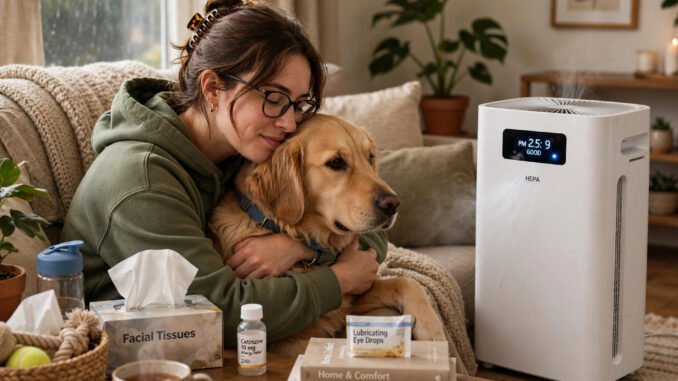
You love your dog. Your eyes, nose, and skin have filed a formal complaint. Pet allergies affect up to 20% of the population, and in Austin — where cedar fever already torments residents every winter — adding a pet dander allergy on top can make home feel like a hazmat zone. The good news: very few people need to rehome their pets. With the right combination of environmental controls, grooming, and medical management, most allergic pet owners live comfortably with their animals. The costs range from nearly free to significant, and knowing where the money actually helps (versus where it is wasted) is the whole game.
What You Are Actually Allergic To
Contrary to myth, pet allergies are rarely about fur. The allergens are proteins in dander (dead skin flakes), saliva (deposited during grooming, then flaking off dried), and urine. Cat allergen (Fel d 1) is notoriously sticky and lightweight — it stays airborne for hours and clings to walls, fabrics, and clothing. Dog allergens (Can f 1) are heavier and settle faster but still saturate soft furnishings. No breed is truly hypoallergenic — “low-shedding” breeds produce less airborne dander but still produce allergens. Anyone selling you a $3,000 “hypoallergenic” puppy as an allergy cure is selling marketing.
Austin’s specific challenge: the city’s high pollen counts (mountain cedar in winter, oak in spring, ragweed in fall) mean many residents have both seasonal and pet allergies, each amplifying the other. Managing both simultaneously is the Austin reality — and the CDC’s allergy resources confirm that reducing total allergen load across sources is the effective strategy.
The Real Cost Breakdown in Austin (2026)
Environmental controls: $50–$400
HEPA air purifier for the bedroom: $80–$200 for a quality unit sized to the room — the single highest-impact purchase. Run it 24/7 in the bedroom with the door closed; the bedroom must become the low-allergen sanctuary. HEPA vacuum: $150–$300 if your current vacuum is not sealed-HEPA (non-HEPA vacuums blast fine allergens back into the air). Allergen-proof bedding encasements: $40–$80 for mattress and pillows — blocks the dander reservoir you sleep on. Hard flooring transition: The expensive one — replacing bedroom carpet with hard flooring ($500–$2,000) removes the largest dander reservoir in the home. Worth it for severe sufferers; optional for mild ones.
Grooming and cleaning: $20–$60/month
Weekly pet bathing with allergen-reducing shampoo ($12–$15/bottle) measurably reduces dander load — studies show weekly bathing cuts airborne allergens significantly. Frequent laundering of pet bedding, throws, and your bedding in hot water. Non-pet household member handling the brushing (outdoors) if possible — or wearing a mask ($0.50 each) during grooming.
Medical management: $10–$200/month
OTC antihistamines (cetirizine, loratadine): $5–$15/month — effective for mild symptoms. Nasal corticosteroid sprays (fluticasone): $10–$20/month — often more effective than antihistamines for congestion; takes 1–2 weeks of daily use to reach full effect. Allergy shots (immunotherapy): $20–$100/month with insurance in Austin ($1,000–$4,000/year without) — the only treatment that modifies the allergy itself rather than masking symptoms, with 3–5 years of treatment producing lasting benefit. Sublingual tablets: newer option for some allergens, $100–$300/month, taken at home.
Realistic annual budgets: Mild: ~$200–$400/year (OTC meds + basic cleaning). Moderate: ~$800–$1,500/year (purifier + encasements + prescriptions). Severe: ~$2,000–$5,000/year (full environmental overhaul + immunotherapy). An allergist visit ($150–$350 without insurance, often covered) to confirm the diagnosis and build a plan is money well spent before buying anything.
The Free Strategies That Matter Most
Bedroom ban: Keeping pets out of the bedroom — permanently — is the single most effective free intervention. It gives your immune system 8 hours of recovery nightly. Hard for the first week; transformative thereafter. Hand hygiene: Wash hands after handling pets, and stop touching your face — trivial, surprisingly impactful. Hard-surface cleaning rhythm: Damp-mopping hard floors weekly (dry sweeping launches dander airborne), wiping down walls seasonally in heavy-dander homes. Grooming delegation: If anyone non-allergic lives with you, all brushing and litter-box duty is theirs. HVAC filters: Upgrade to MERV-11+ filters ($15–$25 each, changed quarterly) — cheap whole-house filtration improvement.
For the home environment more broadly, our guides to flooring options for homes with pets and pet-friendly hotels for road trips help you design a life that accommodates both the pet and the allergies.
What Wastes Money
“Hypoallergenic” breed premiums: Paying thousands extra for a supposedly allergy-free breed — no such thing exists; dander production varies by individual animal more than by breed. Air purifiers for every room: One good unit in the bedroom beats three mediocre units scattered around. Expensive “pet allergy” sprays and wipes: Marginal evidence, recurring cost — weekly bathing does more. Ionizers and ozone generators: Ozone irritates airways (worsening symptoms) and ionizers without HEPA filtration just settle particles onto surfaces. Rehoming as a first resort: The emotional cost is enormous and usually unnecessary — fewer than 10% of allergic owners who implement the full protocol still cannot cope.
The Asthma and Allergy Foundation of America provides evidence-based guidance on pet allergy management — a trustworthy counterweight to product marketing.
When to See an Allergist (Austin Has Good Ones)
See a board-certified allergist if: OTC treatments do not control symptoms after 2–4 weeks, you have asthma symptoms (wheezing, chest tightness) alongside allergies — pet allergens are a significant asthma trigger — or you want immunotherapy. Austin’s allergy clinics are experienced with the region’s brutal pollen-plus-pet combinations. Testing ($200–$400, often insured) distinguishes pet allergy from dust-mite or pollen allergy, which changes the treatment plan entirely — do not spend thousands on pet interventions for what turns out to be a dust-mite problem.
Austin Seasonal Calendar: When Allergies Peak
Timing your interventions to Austin’s pollen calendar multiplies their effect: December–February: Mountain cedar season — the city’s infamous allergen; keep windows closed, run the bedroom purifier on high, and shower before bed to remove pollen from hair and skin. March–May: Oak and grass pollen; this is peak season for combination sufferers — stay on daily nasal steroids without gaps. June–August: Relative reprieve (heat suppresses most pollen); a good window to deep-clean the house and reassess what worked. September–November: Ragweed and fall elm; resume full protocol. Pet dander is constant year-round, so the environmental controls (bedroom ban, purifier, encasements) never take a season off — but layering pollen-season discipline on top during peaks is what separates comfortable from miserable.
Conclusion
Dealing with pet allergies in Austin really costs $200–$400/year for mild cases (OTC meds, cleaning discipline, bedroom ban) scaling to $2,000–$5,000 for severe cases (purifiers, encasements, flooring changes, immunotherapy). Start free — bedroom ban, hand hygiene, grooming delegation, MERV filters — then spend where evidence points: one good HEPA purifier in the bedroom, allergen-proof bedding, weekly pet bathing, and nasal steroids before antihistamines. Confirm the diagnosis with an allergist before major spending. The vast majority of allergic pet owners keep their animals comfortably; the ones who struggle are usually the ones who bought gadgets instead of following the protocol.
Frequently Asked Questions
How much does it cost to manage pet allergies?
Mild cases: $200–$400/year (OTC medications, cleaning supplies). Moderate: $800–$1,500/year (add air purifier, bedding encasements, prescriptions). Severe: $2,000–$5,000/year (environmental overhaul plus immunotherapy).
Are there really hypoallergenic dog or cat breeds?
No. All dogs and cats produce allergens in dander, saliva, and urine. Low-shedding breeds spread less airborne dander, but individual animals vary more than breeds do.
What is the most effective free remedy for pet allergies?
Banning pets from the bedroom permanently — it gives your immune system 8 hours of low-allergen recovery every night, with transformative effects for most sufferers within a week.
Do air purifiers help with pet allergies?
Yes — one quality HEPA purifier running 24/7 in the bedroom (door closed) is among the highest-impact purchases. Whole-house purifiers matter less than the bedroom sanctuary.
When should I see an allergist for pet allergies?
If OTC treatments fail after 2–4 weeks, if you have asthma symptoms, or if you are considering immunotherapy. Testing distinguishes pet allergy from dust-mite/pollen allergies, which changes the plan.
Leave a Reply