
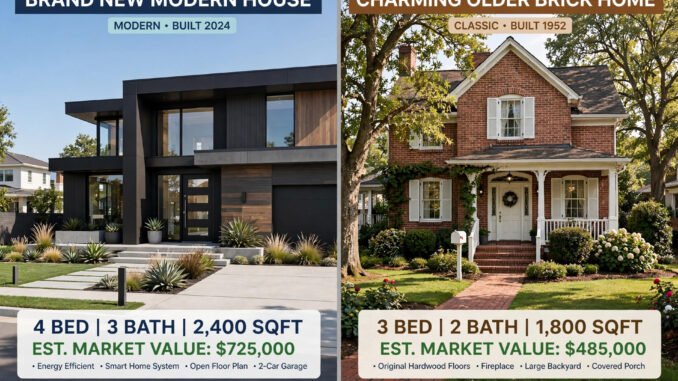
Two houses, same price, same neighborhood. One was built last year — gleaming kitchen, smart thermostat, builder warranty. The other was built in 1962 — plaster walls, mature oaks, hardwood floors with sixty years of patina. Choosing between new-build and older homes feels like choosing between the future and the past, but the real decision is about money, risk, and what kind of homeowner you want to be. Here is how to choose without wasting money on the wrong kind of charm — or the wrong kind of shiny.
New-Build Homes: The Honest Pros and Cons
Advantages
Warranties: Most builders offer 1-year workmanship, 2-year systems, and 10-year structural warranties — years of predictable costs. Energy efficiency: Modern insulation, windows, and HVAC cut utility bills 20–40% versus older homes; the Department of Energy’s efficiency resources detail what current codes deliver. Modern layouts: Open plans, ensuite bathrooms, walk-in closets, home offices — designed for how people live now. Low immediate maintenance: Everything is new; budget years before major repairs. Smart-home ready: Wiring and infrastructure for automation built in.
Disadvantages
The new-build premium: Typically 10–20% above comparable resale — you pay for newness, and it depreciates like a car in year one. Smaller lots, closer neighbors: Modern developments maximize density; yards shrink and privacy with it. Builder-grade finishes: That gleaming kitchen often uses the cheapest cabinets and fixtures that photograph well — budget for upgrades. Construction defects: Rushed builds produce real problems (poor grading, HVAC issues, settling cracks) — the warranty helps only if the builder honors it. Soulless uniformity: Some buyers never warm to neighborhoods where twelve floor plans repeat infinitely. HOAs and Mello-Roos: New developments disproportionately carry both — price them in.
Older Homes: The Honest Pros and Cons
Advantages
Character and craftsmanship: Plaster walls, real hardwood, solid-core doors, architectural detail — materials and craft that would cost a fortune to replicate. Established neighborhoods: Mature trees, walkable streets, known schools, settled communities — the location value is proven, not promised. Bigger lots: Pre-1980 lots are often substantially larger. Price: Older homes typically cost 10–20% less than new-build equivalents — the discount funds renovations you choose. Negotiability: Individual sellers negotiate; corporate builders discount less.
Disadvantages
Deferred maintenance: Roofs, plumbing, electrical, HVAC — any of these can demand $10,000–$30,000. A thorough inspection is non-negotiable; our guide to home inspection costs explains what to check and why skipping it is the costliest mistake in homebuying. Energy inefficiency: Drafty windows, minimal insulation, aging furnaces — utility bills run high until upgraded. Outdated systems: Knob-and-tube wiring, galvanized plumbing, and old panels may need full replacement ($8,000–$20,000+). Layout compromises: Small closets, one bathroom, closed-off kitchens — renovation can fix some, not all. Surprises: Asbestos, lead paint (pre-1978), foundation issues — budget a 15–20% contingency on any renovation.
Watch for the big-ticket aging items specifically: signs your roof needs replacing is essential reading before offering on any home over 20 years old.
The Money Comparison: 10-Year Cost of Ownership
Take two $500,000 homes — one new, one 1960s resale at a 15% discount ($425,000):
New-build: Higher purchase price and mortgage, but minimal maintenance for years (~0.5%/year initially), lower utilities, warranty coverage. 10-year maintenance: ~$25,000–$40,000. Older home: Lower purchase price saves ~$75,000 upfront plus interest on that amount (~$60,000+ over the loan), but maintenance runs 1.5–2%/year: roof ($15,000), HVAC ($10,000), plus ongoing repairs — 10-year maintenance: ~$75,000–$120,000.
The math often roughly equalizes over a decade — which means the decision hinges on non-financial factors: your tolerance for projects, your DIY skills, and which lifestyle you actually want. The financial tiebreaker: older homes in appreciating, established neighborhoods often appreciate faster than new builds in developing areas (location scarcity beats newness), while new builds offer cost certainty that has real psychological and budgeting value.
HUD’s homebuyer resources offer worksheets for comparing total ownership costs — use them with honest maintenance estimates, not optimistic ones.
How to Choose: A Decision Framework
Choose new-build if: you want predictable costs and minimal maintenance, energy efficiency matters to you, you prefer modern layouts, you are buying from afar (warranties substitute for local knowledge), or you lack the time/skills for renovations. Choose older if: you value character and established neighborhoods, you have DIY skills or a trusted contractor, you want a larger lot, you are comfortable managing projects, or the price discount funds renovations that build equity on your terms.
Red flags for new-builds: Builder with poor reviews or warranty disputes, HOA still under developer control, tiny lots with no privacy, upgrade options that double the base price. Red flags for older homes: Foundation issues, unpermitted additions, aluminum wiring, polybutylene plumbing, inspection reports with structural concerns, or a price that leaves no renovation budget.
Either way, the inspection is sacred: new-builds deserve independent inspections too (yes, even brand-new — municipal inspectors miss things, and builder warranties have gaps). Never waive it, whatever the market pressure.
Negotiating Each Type: Different Leverage
New-build negotiation: Builders rarely cut base prices (it hurts their comparable sales), but they deal generously in other currencies: free or discounted upgrades ($10,000–$20,000 in design-center credits), closing-cost contributions, rate buydowns (a 2-1 buydown can save more than a price cut in early years), and included appliances or landscaping. Negotiate at month-end or quarter-end when sales teams chase quotas, and always tour with your own agent — builder reps represent the builder. Get an independent inspection despite the “it’s new” reassurance, and research the builder’s warranty-claim reputation in online reviews before signing.
Older-home negotiation: Here price itself moves. Lead with the inspection report: every major defect is a credit or repair request backed by contractor quotes, not opinions. In balanced markets, asking for closing-cost assistance (2–3%) is standard; in buyer’s markets, push harder on price itself. Older sellers often value certainty (flexible closing dates, waived minor contingencies) as much as dollars — a clean, fast offer can beat a higher messy one. And never fall in love before the inspection: emotional attachment destroys negotiating leverage faster than anything else in real estate.
Conclusion
Choosing between new-build and older homes without wasting money means comparing 10-year ownership costs honestly (the new-build premium versus the older home’s maintenance load roughly equalize), then deciding on lifestyle: cost certainty and modern efficiency versus character, location, and renovation equity. Inspect everything regardless of age, budget maintenance at realistic rates (0.5% for new, 1.5–2% for older), and beware the specific traps — builder-grade finishes and HOAs on one side, deferred maintenance and outdated systems on the other. The right house is the one whose trade-offs you chose deliberately.
Frequently Asked Questions
Are new-build homes a good investment?
They offer cost certainty and efficiency but carry a 10–20% newness premium that depreciates early. Older homes in established neighborhoods often appreciate faster due to location scarcity. Compare 10-year total ownership costs, not just purchase prices.
What should I watch for when buying an older home?
Foundation issues, roof condition, electrical (knob-and-tube, aluminum wiring), plumbing (galvanized, polybutylene), and unpermitted additions. A thorough professional inspection is non-negotiable.
Do new-build homes need inspections?
Yes. Municipal inspections miss defects, and builder warranties have gaps. An independent inspection ($300–$500) on a new build routinely finds issues worth far more than its cost.
How much maintenance does an older home need?
Budget 1.5–2% of home value annually for homes over 20 years old (versus ~0.5–1% for newer homes), plus a 15–20% contingency on any planned renovation for surprises.
Which appreciates faster: new or old homes?
It depends on location more than age. Older homes in established, supply-constrained neighborhoods often appreciate faster; new builds in developing areas depend on the area’s trajectory. Location dominates the appreciation equation.
Leave a Reply