
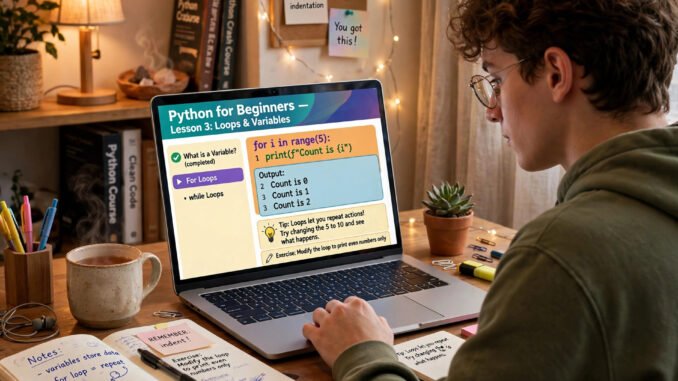
Every year, millions of people decide to learn coding — and most quit within a month. Not because coding is too hard, but because they start wrong: they buy a $2,000 bootcamp before writing a line of code, bounce between fifteen tutorials without finishing one, or try to learn five languages simultaneously. Learning to code from scratch without wasting money is entirely possible — the best resources are free — but it requires a ruthlessly simple plan that most beginners never get. Here it is.
Step 1: Pick ONE Language (and Make It Python or JavaScript)
The language wars are noise for beginners. Python is the best first language for most people: readable syntax, massive for data/automation/AI, and the gentlest learning curve. JavaScript is the best first language if you want to build websites and web apps — it runs in every browser, no setup needed. Pick one based on your goal (automation/data → Python; websites → JavaScript) and ignore everything else for six months. The second language takes a tenth of the time once you understand programming concepts; the first is where all the learning happens.
What not to pick first: C++, Rust, or anything marketed as “powerful” — they punish beginners with complexity that teaches nothing about thinking like a programmer. And do not learn from AI-generated code alone: AI assistants are fantastic accelerators after you understand fundamentals, but copying AI output before you can read code builds nothing. Our guide to writing better AI prompts is useful once you are ready to use AI as a coding tutor rather than a crutch.
Step 2: The Free Curriculum That Actually Works
You need exactly three free resources, used in order:
1. One structured course (freeCodeCamp or CS50)
freeCodeCamp (free, self-paced, project-based) for JavaScript/web or Python paths — its interactive exercises and certifications are genuinely respected. Harvard’s CS50 (free via edX) for a deeper computer-science foundation — harder, but the best free intro to how computers actually work. Pick one and finish it. “Finishing” is the differentiator: 90% of learners never complete their first course.
2. Daily practice (30–60 minutes)
Code every day, even briefly — consistency beats intensity. Sites like Exercism (free, mentor-reviewed exercises) and LeetCode’s easy problems build fluency. The rule: never go two days without writing code. Momentum is the entire game in months 1–3.
3. Documentation and search skills
Learn to read official documentation and to search error messages effectively. Professional developers spend huge portions of their day reading docs and debugging — this is the job, not a obstacle to it. Getting comfortable with “I don’t know, let me look it up” is the real graduation.
This mirrors the broader principles of learning any new skill as an adult — small daily reps, one resource at a time, projects over passive consumption.
Step 3: Build Things (The Portfolio Is the Resume)
At the 2–3 month mark, shift from tutorials to building. Tutorial hell — endlessly following along without creating independently — is where beginners go to stall. The escape: project-based learning. Build five small projects that solve real problems in your life: a budget tracker, a workout logger, a script that organizes your downloads, a personal website, a simple game. Ugly and working beats elegant and theoretical.
Put everything on GitHub from day one. A GitHub profile with consistent commits and five real projects outweighs most certificates in hiring — it is proof of work. Document each project with a README explaining what it does and what you learned. By month 6–9, aim for 2–3 polished projects you can demo in an interview. This portfolio-first approach is also the most AI-resilient career strategy: our breakdown of jobs least likely to be replaced by AI notes that applied builders with proof of work fare far better than credential-only candidates.
What NOT to Spend Money On
Bootcamps ($7,000–$20,000) before month six. Many are excellent — but enrolling before you know you enjoy coding is the most expensive beginner mistake. Prove the habit free first; consider paid programs only with a track record and only after 6+ months of consistent self-study. Expensive courses and “complete” bundles. A $15 Udemy course on sale teaches the same content as the $200 version — and freeCodeCamp teaches it for $0. New hardware. Any laptop from the last decade runs Python and JavaScript fine. Certifications early on. Entry-level certs carry little hiring weight compared to projects; skip them until an employer asks. Paid AI coding subscriptions before fundamentals — a $20/month tool cannot substitute for understanding loops and functions.
The Bureau of Labor Statistics projects strong continued demand for software developers with median pay around $130,000 — but note the fine print: the market rewards demonstrable skill, and junior hiring is the most competitive tier. The free path described here is exactly how thousands of career-changers break in annually; the Department of Labor’s tech apprenticeship programs are another legitimate low-cost entry route worth exploring.
A Realistic Timeline
Months 1–3: Fundamentals — syntax, loops, functions, basic data structures. Daily 30–60 min. Months 4–6: Projects — build 5+ small things, GitHub active, finish one structured course. Months 7–9: Depth — one framework (React for JS, Django/Flask for Python), 2–3 polished portfolio projects, start applying to internships and junior roles. Months 9–12+: Job search or freelancing while continuing to build. Total spent: $0. Total time: 300–500 focused hours. People who follow this consistently get hired; people who bounce between resources for a year do not. The variable was never talent or money — it was finishing.
Conclusion
Learning to code from scratch without wasting money means: pick one language (Python or JavaScript), follow one free structured course to completion, code daily for 30–60 minutes, escape tutorial hell by building real projects early, and put everything on GitHub as your proof of work. Spend $0 until six months of consistency prove the habit — then invest selectively only in what accelerates a working trajectory. The developers earning six figures started exactly where you are: with a free tutorial, a cheap laptop, and the discipline to finish.
Frequently Asked Questions
What is the best programming language for beginners?
Python for most beginners (readable, versatile, strong in data/AI/automation) or JavaScript if you want to build websites. Pick one and stick with it for six months.
Can I learn coding for free?
Yes — completely. freeCodeCamp, Harvard’s CS50, Exercism, and official documentation are all free and sufficient to reach job-ready skill. Do not pay for anything until you have six months of consistent free learning behind you.
How long does it take to learn coding from scratch?
About 9–12 months of consistent daily practice (30–60 min/day, ~300–500 hours total) to reach junior-developer or freelance-ready skill, assuming project-based learning rather than passive tutorials.
Do I need a computer science degree to get a coding job?
No. Skills-based hiring is the norm in tech: a GitHub portfolio with real projects plus interview performance outweighs degrees for most junior roles, though CS degrees still help for certain specialized fields.
Should I use AI to learn coding?
As a tutor after learning fundamentals — yes, it is excellent for explaining errors and concepts. As a replacement for writing code yourself while learning — no; copying AI output before you can read code builds no skill.
Leave a Reply