
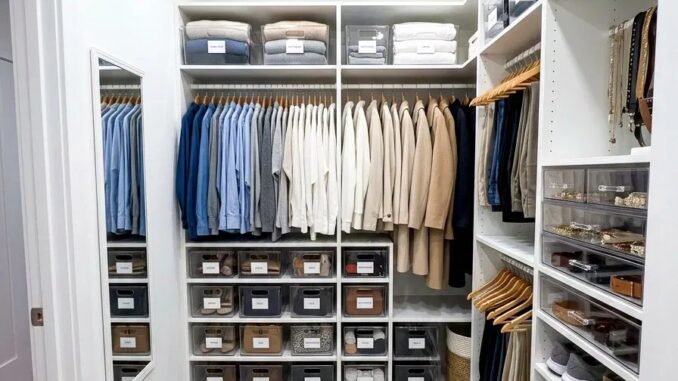
You open the closet and it’s a wall of fabric — things fall when you pull one item, you can’t see what you own, and getting dressed feels like archaeology. What is the best way to organize a small closet? Here’s the truth: small closets aren’t the problem. Cluttered closets are. I’ve organized closets in 400-square-foot apartments that functioned better than walk-ins three times their size, because organization is a system, not square footage. The method below has four phases — declutter, zone, maximize, maintain — and it works in any closet, including the dreaded single-rod rental special.
What Is the Best Way to Organize a Small Closet? Phase 1: The Ruthless Declutter
You cannot organize clutter. Before buying a single hanger or bin, empty the entire closet. Every item gets sorted:
- Love + wear regularly: stays.
- Love but don’t wear: why? Wrong size? Needs repair? Doesn’t match anything? Fix the reason or let it go.
- Wear but don’t love (the “meh” pile): these are closet filler — they take space without giving joy or style. Let most of them go.
- Haven’t worn in a year: goes (except true occasion wear and seasonal items).
- Damaged beyond reasonable repair: rag bin / textile recycle.
Be honest about aspirational sizes, “someday” occasions, and guilt-keeps (gifts you hate, expensive mistakes). Most people remove 30–50% in this phase. What’s left is a closet of things you actually wear — which is the entire point. If you’re keeping pieces that need revival, the clothing revival techniques can rescue the maybes.
Phase 2: Zone by Category and Color
Group like with like, in an order that matches your getting-dressed flow:
- By category first: all shirts together, all pants together, dresses together, jackets together. Within categories, arrange by color (light to dark) — it looks beautiful and you find things instantly.
- Hang what wrinkles; fold what stretches. Hang: blouses, shirts, dresses, blazers, trousers (by the cuff or full-length). Fold: sweaters (hanging stretches the shoulders), tees, jeans, workout gear. Sweater storage rules apply double in small closets.
- Prime real estate rule: eye-level = daily wear. High shelves = seasonal/occasional. Floor = shoes and bins. The clothes you wear most should require zero reaching or bending.
- Face the same direction. All hangers facing the same way, all garments facing the same direction. It sounds fussy; it makes the closet feel twice as calm.
Phase 3: Maximize Every Inch
Small closets waste shocking amounts of space. Reclaim it:
- Matching slim hangers. Replace bulky plastic/wood hangers with slim velvet ones ($20 for 50 on Amazon). They grip clothes (no more slipping), take half the space, and instantly double your hanging capacity. This is the highest-ROI closet purchase in existence.
- Double the rod. A second tension rod or hanging rod extender ($15) below the main rod doubles hanging space — shirts on top, pants on bottom. Most closets have 12+ inches of dead air below hanging clothes.
- Go vertical. Shelf dividers ($12) stop folded stacks from toppling. Hanging shelf organizers ($15) create cubbies for tees, bags, and accessories. Over-the-door hooks ($10) hold tomorrow’s outfit, robes, or bags.
- Use the door. Over-door shoe organizers (clear pockets) hold shoes, accessories, scarves, or small items — the back of the door is free real estate.
- Top shelf bins. Labeled bins for seasonal items, occasion wear, and accessories. Labels matter — unlabeled bins become black holes.
- Under-bed and off-site. Off-season clothes don’t belong in a small closet. Vacuum bags ($15) under the bed, or a single bin in storage. Swap seasonally — it takes an hour and makes the closet feel new twice a year.
- Shoe strategy: one pair per day max in the closet; store the rest. A $20 over-door rack or under-bed shoe organizer handles overflow.
Phase 4: Maintain (The Part Everyone Skips)
An organized closet degrades without maintenance. The systems that work:
- One-in-one-out. New item in? Something goes out. Non-negotiable in a small closet — it’s physics.
- The hanger trick. Turn all hangers backward. When you wear something, hang it back normally. After 3–6 months, the still-backward hangers reveal what you never wear. Donate without mercy.
- 10-minute weekly reset. Rehang, refold, put away the “chair clothes.” Small regular resets prevent the slow slide back to chaos.
- Seasonal swap = mini-declutter. Every swap, remove 5–10 items. The closet naturally stays curated.
Small Closet Layouts That Work
- The single-rod rental closet: double rod + slim hangers + over-door organizer + top-shelf bins. Handles a full wardrobe.
- Reach-in with shelves: shelf dividers for folded items, bins for categories, hanging rod for wrinkle-prone pieces.
- No closet at all: a garment rack ($30–$50) + dresser + under-bed storage is a complete system. Curate ruthlessly — open storage demands it, which is actually a feature.
A well-organized small closet makes everything else easier: capsule wardrobes were practically invented for small closets, and getting dressed in 5 minutes flat is the natural result of being able to see everything you own.
For visual inspiration, Apartment Therapy’s small closet ideas show real small-space solutions, and Marie Kondo’s method remains the gold standard for the declutter phase.
The Capsule Closet Connection
Here’s the truth small-closet owners discover: the closet isn’t too small — the wardrobe is too big. A 30-piece capsule wardrobe fits luxuriously in even a tiny reach-in closet, with room to spare. The constraint becomes a feature: fewer choices, faster mornings, better outfits. If your small closet still overflows after organizing, the next step isn’t more storage products — it’s fewer clothes. Run the hanger trick for 3 months, donate the untouched, and watch the closet transform from storage unit to boutique. Every organizing product in the world can’t fix a wardrobe of 150 items in a closet built for 50. Curate first, organize second — in that order, always.
The practical takeaway: declutter ruthlessly first (30–50% goes), zone by category then color, switch to slim velvet hangers, double the rod, exploit the door and vertical space, move off-season out, and maintain with one-in-one-out plus the hanger trick. A small organized closet beats a big chaotic one every single time.
Leave a Reply