
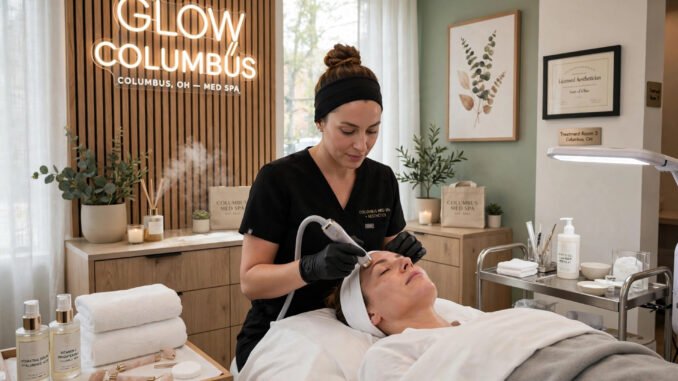
Microneedling has gone from celebrity secret to mainstream skincare — and with popularity comes a fog of pricing. Clinics quote anywhere from $100 to $700 per session, med spas bundle it with add-ons of dubious value, and at-home rollers promise the same results for $20. If you are considering microneedling in Columbus, Ohio, you need two things: honest local pricing and a clear understanding of what the treatment actually does — because the gap between professional microneedling and the DIY version is one of the widest in all of skincare.
What Microneedling Actually Does (and Does Not Do)
Microneedling (collagen induction therapy) uses fine needles to create controlled micro-injuries in the skin, triggering the body’s wound-healing cascade — new collagen and elastin production over the following weeks to months. It is genuinely evidence-backed for: acne scarring (the strongest evidence base), fine lines, enlarged pores, uneven texture, and stretch marks. A series of treatments produces gradual, cumulative improvement — not the instant transformation of filters or marketing photos.
What it does not do: erase deep wrinkles (it softens; it does not lift), replace Botox or fillers (different mechanisms entirely), or work in a single session — anyone selling one-and-done microneedling is selling hope. Realistic expectation: 3–6 sessions spaced 4–6 weeks apart, with results building for months after the final session. The American Academy of Dermatology summarizes the evidence and candidacy criteria — worth reading before booking anything.
What Microneedling Really Costs in Columbus, Ohio (2026)
Per-session pricing: Columbus med spas and dermatology clinics typically charge $250–$450 per session for face-only microneedling with a professional device (SkinPen, the only FDA-cleared microneedling device, or equivalent). Package pricing: Series of 3 sessions: $600–$1,100 (10–20% discount versus single sessions). Series of 6: $1,200–$2,000. Add-ons: PRP (platelet-rich plasma, “vampire facial”): +$200–$400/session — some evidence of enhanced results, but the value-per-dollar is debated; exosome or growth-factor serums: +$100–$250, thinner evidence; LED add-on: +$50–$100, modest benefit.
Total realistic investment: $900–$1,800 for a proper 3–4 session series without exotic add-ons. That is the number to budget — not the per-session teaser rate. Columbus pricing runs slightly below coastal metros (where $400–$700/session is common), which is one genuine advantage of getting it done in Ohio. Beware Groupon-style deals at $99/session: legitimate microneedling has real costs (devices, sterile needle cartridges, trained providers), and extreme discounting usually means corners cut on sterility, needle depth, or provider qualification.
Professional vs. At-Home: The Critical Difference
This distinction matters enormously. Professional microneedling uses motorized devices with adjustable needle depth (0.5–2.5mm), sterile single-use cartridges, topical numbing, and trained providers who vary depth by facial zone. It reaches the dermis where collagen induction happens. At-home dermarollers ($15–$30) use short needles (0.2–0.5mm) that barely penetrate the epidermis — they enhance product absorption slightly but do not induce meaningful collagen remodeling. Worse, cheap rollers have uneven needles that tear rather than puncture, and non-sterile home use risks infection.
The honest verdict: at-home rollers are a $20 absorption booster, not a $300 treatment replacement. If your goal is acne-scar or texture improvement, save the roller money toward one professional session — a single real treatment outperforms a year of rolling. The FDA’s guidance on microneedling devices underscores why regulation and sterility matter here — this is one skincare category where DIY carries genuine risk.
Choosing a Provider in Columbus (What to Ask)
Who performs it? Prefer dermatology clinics and established med spas with licensed providers (RN, NP, PA, or physician oversight) over pop-up “beauty bars.” What device? Ask specifically — SkinPen (FDA-cleared) or equivalent professional motorized pens. What depth? Providers should explain depth variation by zone (deeper on cheeks, shallower on forehead) — a one-depth-fits-all approach signals inexperience. What is included? Numbing, post-care products, and follow-up should be itemized, not surprise add-ons. Skin screening: A reputable provider also flags anything needing medical attention — know when a mole warrants a dermatologist visit rather than a cosmetic appointment. Can I see before/afters of their patients? Stock photos mean nothing. What is the contraindication screening? Active acne, eczema, rosacea flares, keloid history, and certain medications disqualify — a provider who skips screening is a provider to skip.
Red flags: pressure to buy 6-session packages before a consultation, PRP upsells presented as necessary rather than optional, no medical history taken, and prices far below the local range. For daily skin maintenance between (or instead of) professional treatments, our guides to at-home facials and sunscreen for sensitive skin cover the fundamentals that make any treatment work better.
Recovery Timeline: What to Expect After Each Session
Days 1–2: Redness and mild swelling resembling a moderate sunburn; skin feels tight and warm. Most patients work normally (with the understanding they look sun-kissed). Days 3–5: Redness fades; light flaking or dryness as the micro-channels heal — moisturize generously, do not pick. Days 5–7: Skin looks normal to others; the collagen-building process continues invisibly for weeks. Weeks 2–4: Gradual texture improvement becomes noticeable; this is when patients typically get enthusiastic. Months 2–6: Continued collagen remodeling — final results from a series are best judged at 3–6 months after the last session, not the week after. Plan sessions around your calendar accordingly: no important events within 7–10 days of a treatment, and schedule the series so the final session lands 3+ months before any major occasion where you want peak results.
What Wastes Money
Single sessions: One microneedling session produces minimal visible change — the treatment works cumulatively. Buying singles repeatedly at full price costs more than a package for worse results. Exotic add-ons first: Get the core treatment’s results before paying 50% more for PRP or exosomes — most patients cannot distinguish the add-on’s contribution. At-home devices as substitutes: As above — different category entirely. Overly frequent sessions: Skin needs 4–6 weeks between sessions for the healing cascade to complete; clinics pushing 2-week intervals are selling sessions, not results. Treating the wrong concern: Microneedling will not fix melasma (it can worsen it), active acne (spreads bacteria), or sagging skin (needs lifting modalities) — money spent on the wrong indication is 100% wasted.
Conclusion
Understanding microneedling costs in Columbus means: budget $900–$1,800 for a proper 3–4 session professional series ($250–$450/session), skip the $99 deals and the at-home rollers as substitutes, choose licensed providers with real devices and screening, and spend on the core treatment before any add-ons. Done right, it is among the best-supported cosmetic treatments for acne scarring and texture — done cheaply or DIY, it is money spent on risk without reward.
Frequently Asked Questions
How much does microneedling cost in Columbus, Ohio?
$250–$450 per session at reputable clinics; $600–$1,100 for 3-session packages. A full 3–4 session series realistically costs $900–$1,800 without add-ons.
How many microneedling sessions do I need?
Typically 3–6 sessions spaced 4–6 weeks apart for acne scarring, fine lines, or texture. Results are cumulative and continue building for months after the final session.
Do at-home dermarollers work as well as professional microneedling?
No. Home rollers use short needles that do not reach the dermis where collagen induction occurs. They modestly boost product absorption but cannot replicate professional results — and carry infection risk if not sterile.
Does microneedling hurt?
With topical numbing (standard at professional clinics), most patients report mild discomfort — pressure and vibration rather than pain. At-home rolling without numbing is often more uncomfortable than the professional version.
What should I avoid after microneedling?
Sun exposure (strict sunscreen for at least a week), makeup for 24 hours, active ingredients (retinoids, acids) for 3–5 days, sweaty exercise for 24–48 hours, and picking at flaking skin. Follow your provider’s specific aftercare.
Leave a Reply