
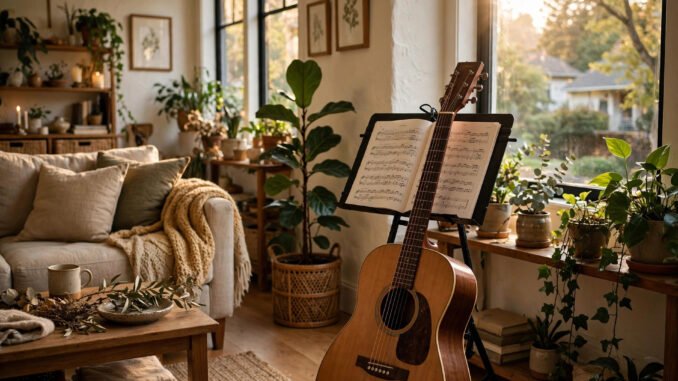
The daydream version of learning guitar costs about a hundred dollars and a free video app. The real version costs more than that, and less than most adults fear. Guitar is still one of the cheapest instruments to start well, but the money lands in places the adverts skip: not on a fancy badge or a stack of gear, but on a playable instrument, one careful setup, and a few early lessons that stop bad habits before they set. Adults waste most of their budget in the first month, usually by buying the wrong thing first and the right thing twice.
Three ways in, compared
Route one is a new budget guitar. A playable starter, acoustic or electric, sits in the $150 to $400 range, and the sweet spot inside it is $150 to $250. That money buys an FG800-style acoustic or a Classic Vibe-style electric: solid wood or well-finished laminate where it counts, hardware that holds tune, and fretwork that will not shred your fingertips. Start with the steel-string acoustic guitar if your heart is set on songs around a table, since an acoustic needs no amp, no cable, and no extra spend before your first chord rings out.
One warning matters more than any brand name. An $80 no-name guitar with high action and poor tuning stability fights you on every chord. The strings sit too far from the neck, so each note takes a squeeze that tires a new hand in minutes, and the tuning drifts while you play, so even a correct chord sounds wrong. Many adults quit that fight blaming their talent, when the instrument was the problem all along. Treat the very cheapest tier as a false saving, not a bargain.
Route two is the used market, and Portland is a kind place to shop it. The same class of guitar often sells for 30 to 40 percent less used, through local shops, listings, and the steady flow of instruments in a city full of players. A two-year-old starter that someone outgrew can be a better guitar than a new one at the same price. The catch is simple: a used guitar needs the same honest check as a new one. Look down the neck for twists, check for cracks around the headstock and bridge, play every fret for buzz, and budget for a setup either way, because you do not know how the last owner stored it.
Route three is the electric starter pack: a guitar bundled with a small practice amp, a strap, picks, and a cable in one box. The ease is real, and for a gift or a total beginner who wants everything at once, that ease has value. Know the weak link before you pay: in most packs the amp is the part built down to a price, thin and harsh at the volume you will actually use at home. If the pack route tempts you, weigh it against buying the same guitar on its own and putting the change toward a better small amp or toward lessons.
The costs every route shares
Whichever door you walk through, the same line items follow you home. Strings come first: $6 to $15 a set, changed every one to three months as a beginner, sooner if your hands sweat or the tone goes dull. Fresh strings are the cheapest upgrade in music, and old strings make a good guitar sound tired and feel harder to tune. Learn to change them yourself in the first month; it is a ten-minute skill that pays for itself all year.
The small kit adds up to less than most people guess. A clip-on tuner runs about $15, or you can start with a free phone app and upgrade later. Picks cost a few dollars for a variety pack, and you should try many, since thickness changes both sound and control. A strap sits around $20, and a gig bag or simple case runs $30 to $50, which is cheap protection for an instrument that will travel to lessons and friends’ houses. Electric players add amplification: a practice amp at $100 to $150, or headphone playing to start, which keeps the peace in an apartment and costs almost nothing if you already own decent headphones.
Above all of these sits the setup, at $50 to $75, and it deserves its own paragraph because adults keep skipping it. A setup means a technician adjusts the action, the intonation, and the neck relief so the guitar plays in tune up the neck and asks little force from your fingers. It is the single best money in the whole budget. A modest guitar with a careful setup plays far above its price, while a fine guitar with a poor setup can feel stubborn and sound sour. Never skip it to save money. If a shop offers to fold a setup into the sale, take that deal over a small cash discount every time.
Lessons, compared honestly
Private lessons are the fastest route and the priciest. Expect roughly $30 to $60 an hour for private teaching in a city like Portland, framed as a typical range to check locally rather than a fixed rate, since teachers set their own prices by experience and demand. What that hour buys an adult is correction in real time: a thumb creeping over the neck, a wrist bent at a hard angle, a strum that rushes. A teacher spots those in seconds, where a video cannot see you at all. For the first stretch of learning, that feedback is worth more than any gear upgrade.
Group classes and community programs cost less per hour and add a quiet form of pressure that adults often need: other people expecting you next week. Playing alongside fellow beginners also teaches timing in a way solo practice never does. Online subscriptions and free video courses cost the least and demand the most self-discipline. They suit the adult who practices on a schedule without being chased, and they stall the adult who needs a human waiting on Thursday. The honest blend for most grown-up starters is a handful of in-person lessons early, to lock in posture and habits, then self-guided practice with online help once the basics sit under your fingers. Adults comparing instrument costs before they commit may also find it useful to set guitar beside the real cost of learning drums as a beginner, where kit, space, and noise change the sums in a hurry.
Three budgets that add up
The lean start comes to $220 to $280. It is built from a used guitar at $120 to $180, a setup at $60, and small essentials at about $40, which covers picks, a strap shared or borrowed at first, and a tuner app or budget clip-on. The amp is deferred: acoustic players need none, and electric players practice through headphones while they save. A lean starter who reaches the two-month mark still playing can add what a capo does to the kit for about $15, since a capo at that price opens up dozens of songs in easy keys, and the total still stays modest.
The comfortable start comes to $435 to $580. It pairs a new guitar at $200 to $250 with a setup at $50 to $75, full essentials at $85 to $105 for a tuner, capo, picks, strap, and gig bag, and a first month of lessons at $100 to $150. That month of teaching is the line item that separates this tier from the lean one, and for most adults it is the difference between guessing and knowing during the weeks when habits form.
The all-in start lands between $885 and $1,180, well over $800. Its parts are a better guitar at $350 to $400, a practice amp at $100 to $150, a setup at $50 to $75, essentials at $85 to $105, and three months of lessons at $300 to $450. Nothing in that list is foolish. A finer guitar can inspire practice, and a quarter of lessons will move you a long way. Just hear the verdict on it plainly, before the next section: it buys comfort and speed, and no extra success. The adult who practices twenty minutes a day on the lean kit will outplay the adult who owns the all-in kit and opens its case twice a month.
Where adults waste money
The classic trap is buying the second guitar before learning ten chords on the first. New gear feels like progress, because shopping is easy and practice is slow, and shops are happy to help you confuse the two. The second trap is stacking subscriptions: two apps, a course library, and a video membership, each billing monthly while you use none of them past the trial. Pick one learning source, pay for that one, and let the rest go.
The third trap has already appeared once, and it returns here on purpose: skipping the setup. It ends more adult attempts than price ever does, because a badly set-up guitar makes every early session hurt, and pain reads as failure. Build the setup into whichever budget you choose, treat it as part of the guitar’s price, and the instrument stops being an opponent. Seen whole, a realistic first spend of $300 to $600 buys a setup that will not hold you back, which makes the comfortable route, or a used guitar with the same care, the value pick for a Portland adult. Spend there, practice daily, and let the second guitar wait until your hands have earned it.
Leave a Reply