
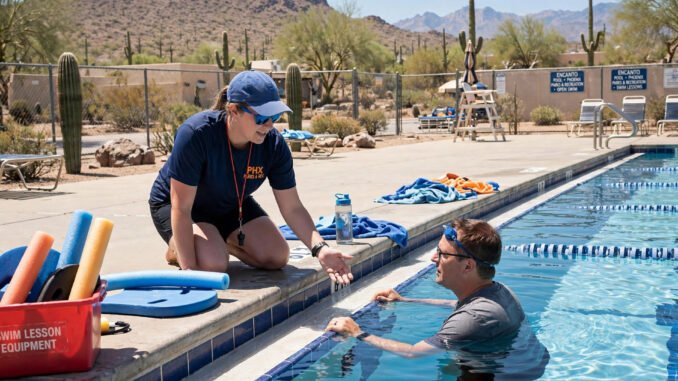
Phoenix may be the easiest city in America to learn to swim as an adult. The city gets around 300 days of sunshine a year, pools are part of daily life rather than a summer treat, and lessons are priced for the person who never learned as a child and feels awkward asking now. You will not be the only grown-up gripping the wall at the shallow end. In Phoenix, adult beginners are a normal sight, and the whole first phase can cost less than a single private lesson in many other cities. The steps below run in order: pick a route, buy a short list of gear, follow a six-week plan, and learn the local safety rules that desert heat demands.
Step 1: Pick your lane
Three routes serve adult beginners in Phoenix, and they suit different wallets and temperaments. Start with the city itself. The City of Phoenix runs around 29 pools in recent seasons, and its aquatics program includes adult learn-to-swim classes, mainly in the summer season, with some sites offering more of the year. Group lessons there have recently run about $5 to $10 a lesson, which makes the city program the cheapest door in by a wide margin. Class sizes are larger than private teaching, yet for water comfort and basic strokes, patient group instruction is often all a beginner needs.
The second route is the YMCA of the Valley of the Sun, with branches spread across the metro. Adult lessons there come in multi-week blocks that have recently run about $60 to $110 a block in recent pricing, with less charged to members. A membership has recently run about $50 to $65 a month, and it can beat per-class pricing if you plan to swim twice a week, since practice time between lessons is where new skills settle. The Y route suits adults who want a set weekly slot, a familiar pool, and steady faces in the lane beside them.
The third route is private teaching, through swim schools and solo instructors around the valley. A 30-minute private lesson has recently run about $25 to $45, and the price buys total attention: the instructor watches only your breathing, only your float, only your kick. The smart budget move is to buy just two or three privates at the start, use them to crack floating and breathing, then shift to cheap group sessions or open swim for practice. One line covers every price in this step and the rest of the plan: prices and schedules change from season to season, so check the current listings before you go. Treat swimming as a sport and skill with a long, ordinary history of adults learning late, because that is exactly what you are doing, and thousands in this city have done it before you.
Step 2: Buy the short gear list
Swim shops will happily sell a beginner two hundred dollars of kit. Resist almost all of it. You need a suit that stays put when you push off a wall, goggles that seal to your face without leaking, and, if you want one, a cap to keep hair out of your eyes and the pool filter. That short list comes to about $40 total if you shop plainly. Try goggles in the shop if you can; a pair that suits one face leaks on another, and leaking goggles will spoil your first lessons more than any stroke flaw.
Skip the rest for now. No fins, no hand paddles, no training gadgets with straps and settings. Tools like those have their place once you can swim a length without stopping, and before that they mostly hide the feel of the water that you are there to learn. A cheap mesh bag to carry wet gear is the one small extra worth adding, and a water bottle matters more in Phoenix than any gadget. Spend the money you save on lesson slots and pool time, where it turns into skill.
Step 3: Follow the six-week plan
Weeks one and two are about comfort, not distance. You will practice putting your face in the water and blowing bubbles out slowly, sinking and rising without panic, and floating on your front and back with support from the wall, a noodle, or an instructor’s hand. The skill that ends panic lives in this phase: standing up from a float. Learn to tuck your knees, press down with your hands, and get your feet under you calmly, every time, until it feels dull. Once recovery is automatic, fear loses most of its grip, and the strokes that follow have somewhere safe to stand.
Weeks three and four build the moving parts. Kicking with a board gives your legs their job while your hands rest, and short kicks with your face in the water teach you to breathe out under the surface instead of holding your breath. From there you add the skeleton of the front crawl stroke: arms pulling one at a time, body long, kick steady and small. Breathing to the side arrives in small doses, a quick turn of the head rather than a lift, a few strokes at a time with rests at the wall. Nobody strings this together neatly in week three. Short, messy repeats are the normal shape of progress.
Weeks five and six string the pieces into lengths. Swim one length with rests built in, then shorten the rests. Add treading water in the deep end with the wall close by, so staying up without forward motion becomes a skill you own rather than a fear you carry. By the end of week six, a realistic goal for most adult beginners is a slow, stop-and-start chain of lengths that looks, from the deck, very much like swimming. Continuous laps come after, built on this base, and they come faster than the first length ever did.
Step 4: Practice between lessons
Lessons teach; practice keeps. Short, frequent sessions beat one weekly marathon, because a new float or a new breathing rhythm fades over seven days and holds over two. Two extra open-swim visits a week, even twenty minutes each, will move you further than doubling your lesson length. Use that time to repeat the dull basics from your last class: floats, recoveries, kicks with a board, a few strokes with side breathing. Boring practice is where the body learns, quietly, without an audience in its head.
Keep each visit simple on purpose. Pick one or two drills, do them slowly, and leave while you still feel steady rather than wrung out. Note what felt easier than last time, in a phone note or on paper, since adult learners often miss their own progress when they only track distance. Your first full length will likely arrive during one of these plain sessions, with nobody watching, and that is a fine way for it to happen.
Step 5: Swim the Phoenix way
Safety in this step is stated plainly, and none of it should be softened. While you are learning, swim only at lifeguarded pools and never swim alone. Stay in water you can stand in until floating and recovery are automatic. A buddy on the deck or a friend in the next lane is good company, yet a lifeguard on duty is the rule, not a bonus, for as long as you are a beginner.
Heat changes the maths in Phoenix. A pool at noon in July can sit under sun strong enough to drain you before the swimming does. Swim mornings or evenings in summer, drink water before and after your session, and put sunscreen on well before you get in, topping it up as the label directs. Treat dizziness as a stop signal, not a challenge: if the deck feels unsteady or your head feels light, get out, sit in shade, sip water, and end the session. The pool will be there tomorrow. Learning to swim is low-impact exercise that suits joints well, which is part of its appeal for adults, and respecting heat is what keeps it that gentle here.
Step 6: Keep it going
After the six weeks, hold your place with a cheap recurring slot: the same pool, at the same time, twice a week. A fixed slot removes the daily debate about whether to go, and pool staff and fellow regulars start to expect you, which helps more than willpower does on a tired evening. Set a distance milestone to chase, such as ten lengths without a long rest, then twenty, and let the target grow at the pace your breathing allows.
Here is the full budget for the first two months, printed as one sum so you can plan against it: gear about $40, plus lessons at $40 to $80, plus open-swim admissions at $10 to $20, comes to roughly $90 to $140 in total. The low end assumes city lessons and a lean gear list; the high end leaves room for a private lesson or two and a Y block. Either way, the price of becoming a swimmer in Phoenix is smaller than most adults guess on the day they first walk onto the deck. And if swimming opens a door to moving more in general, you are in good company: many late starters go on to explore the best exercise for beginners who hate the gym, and find, to their surprise, that the pool was the gym they could stand all along.
Leave a Reply