
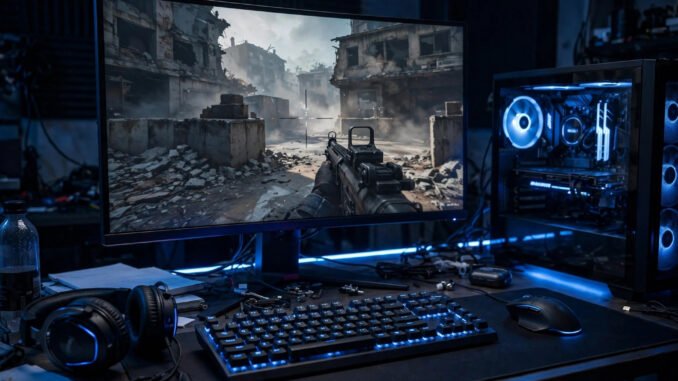
How long does it take to improve your aim in shooter games before you see real results? Every new player has lived the same humiliation: you see the enemy, you click, you miss, you’re dead — while someone with half your game sense lasers you effortlessly. Here’s the encouraging truth: aim is the most trainable skill in shooters, and the timeline is shorter than you think. Most players see noticeable improvement in 2–4 weeks of deliberate practice and dramatic improvement in 3–6 months. This guide gives you the realistic schedule, the training methods that actually work, and the mistakes that waste months.
The Honest Timeline: What to Expect and When
Week 1: Calibration (no visible improvement yet)
Your first week is about setup, not skill. Finding the right sensitivity, fixing your posture and grip, and learning to keep your crosshair at head level are unglamorous — and your stats may even dip as you unlearn bad habits. This is normal. Players who skip calibration build months of practice on a broken foundation.
Weeks 2–4: First real results
With 20–30 minutes of daily deliberate practice, most players notice cleaner tracking and faster target acquisition by week three. Your kill/death ratio won’t transform — game sense still lags — but 1v1 duels start feeling winnable. This is the phase where practice feels productive, which keeps motivation alive.
Months 2–3: The jump
Something clicks around month two: flick shots land without conscious thought, crosshair placement becomes automatic, and you stop thinking about how to aim during fights. Players commonly report climbing one or two competitive ranks in this window. The skill is moving from conscious effort to muscle memory.
Months 3–6: Diminishing returns begin
Improvement continues but slows — you’re now refining rather than building. Further gains come from game-specific skills (movement-aim integration, angle clearing) more than raw aim. Most players reach roughly 80% of their aim potential here; the last 20% takes years and matters only at high competitive levels.
Total honest answer: noticeable results in 2–4 weeks, transformative results in 3–6 months — assuming deliberate practice, not just playing.
Why “Just Playing More” Doesn’t Work
This is the insight that separates improvers from grinders. Playing matches trains game sense, positioning, and teamwork — but aim improves slowly in matches because you spend most of each round not aiming: running, waiting, respawning. Deliberate aim practice compresses hundreds of aiming repetitions into 20 minutes. The research parallel is music: scales before concerts.
Use dedicated trainers: Aim Lab (free on Steam) and KovaaK’s are the standards, with structured routines for tracking, flicking, and target switching. PC Gamer’s FPS settings guides cover the technical setup side. Twenty focused minutes in Aim Lab beats two hours of casual deathmatch for pure aim development.
The Setup Fundamentals (Do These First)
Sensitivity: lower than you think
The single biggest beginner error is sky-high sensitivity. Pros overwhelmingly use low sensitivities (equivalent to 20–50 cm of mouse movement for a 360° turn). Start around 30–40 cm/360, adjust ±20%, and then stop changing it — constantly tweaking sensitivity resets your muscle memory. Pick one and commit for a month.
Hardware basics
You don’t need a $200 mouse, but the fundamentals matter: a mouse that fits your grip style, a large mousepad (low sensitivity needs space), and — most impactful — a high-refresh-rate monitor (144Hz+). The jump from 60Hz to 144Hz is the single biggest hardware upgrade for aim; targets literally become easier to track because you see more frames of their movement.
Crosshair placement: the free skill
Half of “aim” is never aiming at all — it’s crosshair placement: keeping your crosshair where enemies’ heads will be before they appear. Pre-aim common angles, keep the crosshair at head height while moving, and minimize the distance your mouse must travel when an enemy appears. This costs zero mechanical skill and wins more duels than flick shots ever will.
A 20-Minute Daily Routine That Works
Structure beats duration. Here’s a routine used by improving players across Valorant, CS2, and Apex:
Minutes 0–5: Warm-up tracking. Smooth tracking scenarios — follow a moving target without firing. Builds the fine motor control everything else needs.
Minutes 5–12: Flicks and target switching. Scenarios where targets appear at random positions; snap to each. Focus on stopping on the target, not flying past it — overshooting means sensitivity is still too high.
Minutes 12–17: Game-specific drills. In your game’s practice range: counter-strafing (stop moving before shooting — accuracy plummets while moving), spray control for the first 5–7 bullets, or scoped flicks for your main weapon.
Minutes 17–20: Deathmatch with a rule. One deathmatch, but with a constraint: crosshair at head level the entire time, or only take fights while counter-strafed. Constraints force the habit.
Then play normally. The aim work is done — matches are for applying it. Players who follow this structure consistently report the 2–4 week results window above; players who “just play” often plateau for a year.
The Mindset Traps That Waste Months
Tilt-queuing. Playing angry destroys fine motor control and decision-making. Two losses in a row feeling unfair? Take a break — your aim is measurably worse when frustrated, and practicing while tilted builds bad habits.
Blaming everything but aim. Teammates, hit registration, “smurfs” — sometimes real, usually excuses. Record one of your deaths and watch it back: the VOD never lies, and it’s the fastest diagnostic tool you own.
Copying pro settings blindly. Pro sensitivities work for pros’ hands, mice, and desk space. Use them as a starting range, not gospel.
And keep perspective: shooters are supposed to be fun. If aim training starts feeling like homework, play something social instead — game nights with non-gamer friends or games designed for people who don’t usually play remind you why you picked up the controller in the first place.
Conclusion: Weeks, Not Years
Improving your aim in shooter games takes 2–4 weeks for noticeable results and 3–6 months for transformation — if you practice deliberately rather than just playing. Calibrate your sensitivity once, train 20 focused minutes daily, master crosshair placement (the free half of aiming), and review your deaths honestly. Aim is a motor skill, and motor skills obey practice like nothing else in gaming. The enemies won’t know what hit them — because this time, you’ll actually hit them.
Frequently Asked Questions
How long does it take to get good aim in shooters?
Most players see noticeable improvement in 2–4 weeks of daily 20-minute deliberate practice, and major improvement in 3–6 months. “Just playing” without structured practice can take a year or more for the same gains.
What’s the best aim trainer?
Aim Lab (free on Steam) is the best starting point with guided routines; KovaaK’s offers deeper customization for serious trainers. Both beat unstructured deathmatch for pure aim development.
What sensitivity should I use for FPS games?
Lower than beginners expect: roughly 20–50 cm of mouse movement per 360° turn. Start around 30–40 cm/360, adjust slightly, then commit for at least a month — constant changes reset muscle memory.
Does a 144Hz monitor really help aim?
Yes — it’s the highest-impact hardware upgrade for aiming. Higher refresh rates show more frames of target movement, making tracking tangibly easier. The 60Hz-to-144Hz jump is bigger than any mouse upgrade.
Why is my aim good in practice but bad in matches?
Matches add pressure, unpredictability, and movement — your practice hasn’t transferred yet. Bridge the gap with constrained deathmatches (e.g., head-level crosshair only) and VOD review of your deaths to find what breaks down under pressure.
Leave a Reply