
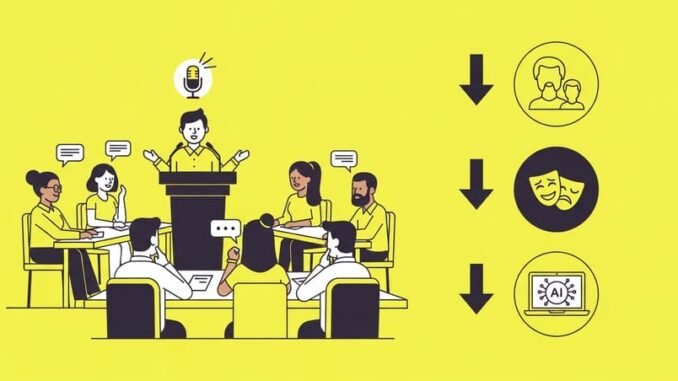
Your hands shake. Your voice climbs an octave. You forget your third point entirely and ramble until someone rescues you. Public speaking terrifies more people than death (the old joke has data behind it), and traditional advice — “join Toastmasters,” “practice in the mirror” — helps but slowly. AI offers something new: a tireless, judgment-free audience that gives specific feedback on every run-through. If you’re asking how can I use AI to improve my public speaking skills, the answer is a strong yes — for content, structure, delivery practice, and confidence-building alike. Here’s the complete method.
Why AI works unusually well here: speaking improvement requires reps with feedback — and that’s exactly what was scarce before. A human coach costs $150–$300/hour; friends give vague feedback (“that was good!”); mirrors don’t talk back. AI gives you unlimited structured practice with specific, actionable critique. It’s not a complete replacement for human audiences, but it’s the best practice tool most people have ever had.
How Can I Use AI To Improve My Public Speaking Skills? Content and Structure
From blank page to speech draft
Start with a thorough brief:
“I’m giving a [5-minute toast / 20-minute keynote / 10-minute team presentation] on [topic] to [audience: who they are, what they know, what they care about]. Tone: [inspiring / informative / funny / persuasive]. Key points I want to make: [list]. Help me structure this: hook, 3 main points with supporting stories/examples, and a memorable close.”
Then refine iteratively: “The opening feels weak — give me 5 hook options: a story, a surprising stat, a question, a bold claim, and humor.” Or: “This section is too technical for my audience — simplify without dumbing down.”
Story and persuasion coaching
- Story crafting: “Here’s my story about [experience]. Help me shape it for maximum impact — where’s the tension, what’s the turning point, what’s the takeaway?” Stories are what audiences remember; AI is excellent at structural story editing.
- Argument stress-testing: “Poke holes in my argument. What would a skeptic ask? Where’s my evidence weakest?” The Q&A won’t surprise you if AI already played devil’s advocate.
- Audience adaptation: “How should I adjust this talk for [executives / teenagers / technical experts / general public]?” Same content, different framing — AI re-targets effectively.
Delivery Practice: The Reps That Build Confidence
AI as your practice audience
This is the highest-value use:
- Read/paste your script (or bullet points — better to practice from notes than memorize).
- Deliver it out loud using voice mode — actually speaking, with pauses, emphasis, and energy.
- Get structured feedback: “Critique my delivery: pacing, filler words, clarity of main points, energy level, and whether my opening grabbed attention. Be specific — quote moments that worked and moments that didn’t.”
- Repeat. Three full run-throughs with feedback between each produces dramatic improvement. Most people do zero run-throughs before real talks.
Q&A simulation
“You’re the audience. After my talk on [topic], ask me the 8 toughest questions I’d likely face — including one hostile one. I’ll answer out loud; critique my answers.” Handling hostile questions calmly is a learned skill, and AI lets you rehearse it without real-world stakes.
Filler word and pacing analysis
Record yourself (phone voice memo is fine), transcribe with an AI tool, and ask: “Analyze this transcript: count filler words, flag rambling sections, identify where I buried my main points.” Seeing “you said ‘um’ 47 times and took 3 minutes to reach your first point” is powerfully motivating. Our transcription tool guide covers the tech.
Specialized Scenarios
- Wedding toasts / eulogies: “Help me write a 3-minute toast for my best friend. Tone: warm and funny, not embarrassing. Include: how we met, one funny story, one sincere moment, a toast ending.” AI handles the structure; you supply the genuine emotion and specific memories that make it land.
- Work presentations: “Turn these bullet points into speaker notes — conversational, not read-from-slide. Flag where I should pause for emphasis or ask the audience a question.”
- Interviews and pitches: Combine with our AI interview prep guide — same practice principles, higher stakes.
- Virtual presentations: “I’m presenting on Zoom to 50 people. What should I do differently vs. in-person?” (Shorter segments, more interaction, camera energy — AI knows the playbook.)
The Confidence Mechanics
Here’s what most speaking advice misses: confidence comes from preparation certainty — knowing your material so well that nerves have nothing to attach to. AI accelerates this:
- Over-prepare the opening 60 seconds. Nerves peak at the start; a rock-solid opening carries you into flow. Rehearse it 10x with AI feedback.
- Prepare for the worst: “What if I lose my place? What if the tech fails? Give me recovery scripts.” Having a plan for disasters paradoxically prevents the anxiety about them.
- Reframe the physiology. Shaking hands and racing heart are adrenaline — the same chemistry as excitement. AI can’t do this reframing for you, but knowing it helps: you’re not broken, you’re activated.
For structured in-person practice, Toastmasters International remains the gold standard — AI practice plus real human audiences is the complete package. Many speakers find AI reps (for content and delivery mechanics) combined with Toastmasters (for live audience dynamics) to be the fastest improvement path available.
What AI Can’t Do
- It can’t replicate a live audience’s energy. Eye contact, reading the room, feeding off laughter — practice these with humans.
- It can’t give you stage presence. Charisma, authenticity, and genuine passion are yours to develop. AI polishes the vehicle; you supply the fuel.
- Don’t over-script. AI-drafted speeches should become talking points, not memorized scripts. Audiences connect with speakers, not reciters.
The bottom line: use AI to structure your talk, craft hooks and stories, stress-test your arguments, then practice delivery out loud with AI feedback across 3+ full run-throughs, simulate tough Q&A, and analyze your filler words from transcripts. Combine AI reps with real human practice (Toastmasters) for the complete package. Most speakers improve more in two weeks of AI-assisted practice than in a year of winging it — because for the first time, deliberate practice with feedback is free and unlimited.
Leave a Reply