
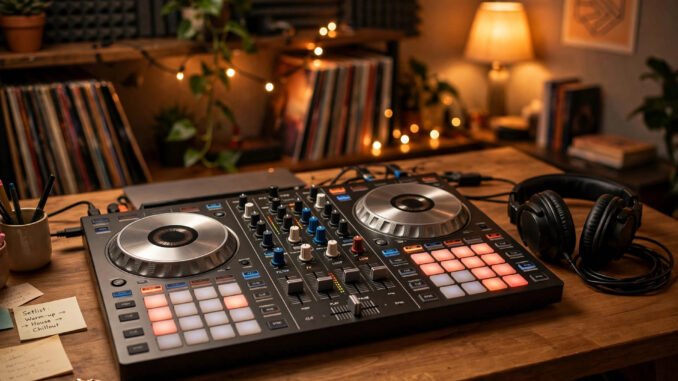
Walk into any music store or open any DJ gear website and you will feel it immediately: the wall of controllers, mixers, turntables, speakers, and software subscriptions, each one promising to be the missing piece of your DJ dream. A beginner can burn $2,000 before learning a single transition. The good news is that understanding DJ equipment is far simpler than the marketing makes it look. Every setup on earth is built from the same four building blocks, and you only need a fraction of them to start mixing real sets this week.
This guide covers what each piece does, what to buy first, and what to skip — with 2026 prices so you can budget honestly.
The Four Pieces Every DJ Setup Shares
Before touching a product page, lock in this mental model. A DJ setup needs: (1) two sound sources, so you can play one track while cueing the next; (2) a mixer, to blend those sources and control volume and EQ; (3) headphones, to hear the cueing track privately; and (4) speakers, so everyone else hears the main mix. That is the entire architecture of DJing. A $150 controller, a $4,000 club setup, and a pair of vinyl turntables all do exactly these four jobs — they just do them with different hardware.
Controllers: The Beginner’s Best Friend
A DJ controller is a single piece of hardware that combines the sound sources and the mixer into one unit, controlled by knobs, jog wheels, and performance pads, and powered by software on your laptop. Controllers like the Pioneer DJ DDJ-FLX4, the Numark Party Mix II, and the Hercules DJControl Inpulse 300 all follow this formula, typically priced between $129 and $299 in 2026.
Why controllers beat separate gear for beginners
Two reasons: cost and coherence. Buying a standalone mixer plus two media players costs several times more, and then you still need to learn how they talk to each other. A controller is pre-mapped to its software — you plug it in, open Serato DJ Lite or rekordbox (both free at entry level), and the jog wheels, EQ knobs, and faders already control the right things. For learning beatmatching, phrasing, and EQ blending, a controller teaches the identical skills you would learn on club gear, because the layout mirrors it.
What actually matters when comparing controllers
Ignore the number of pads and the color of the backlighting. Look for three things: jog wheel size and feel (larger wheels give finer pitch control), a built-in sound card with separate headphone and master outputs (without this you cannot cue privately), and software compatibility.
If you want to go deeper on building a music library before you ever touch gear, our guide to discovering new music beyond the same popular songs is a great companion read — track selection matters as much as equipment.
Mixers, Turntables, and CDJs: What Each One Does
Even if you start on a controller, you will encounter these in clubs, so understand them now.
Standalone mixers
A mixer like the Pioneer DJM-450 ($749) or the Allen & Heath Xone:23 ($349) sits between your sound sources and the speakers. Each channel has gain, three-band EQ, and a fader; the crossfader blends channels. You only need a standalone mixer when you own separate players (turntables or CDJs) or when you play venues with installed gear and bring your own mixer.
Turntables
Turntables play vinyl records. The Technics SL-1200MK7 (~$1,099) is the industry standard, and quality entry decks like the Audio-Technica AT-LP140XP (~$399) handle learning fine. Vinyl is wonderful but the priciest beginner route — decks, mixer, cartridges, and records add up fast. Start digital.
CDJs and all-in-one systems
CDJs are the club-standard USB players; all-in-one systems like the Pioneer XDJ-RR (~$1,099) pack players and mixer into one box. Upgrade territory, not beginner purchases.
Headphones and Speakers: The Two Most Skipped Purchases
Beginners obsess over controllers and neglect the two items that actually determine whether they can hear what they are doing.
DJ headphones
You need closed-back headphones with strong isolation and a rotating earcup — so you can monitor with one ear while the other hears the room. The Sennheiser HD 25 ($149) is the classic workhorse; the Audio-Technica ATH-M40x (~$99) is a fine budget pick. Do not DJ with open-back or noise-cancelling consumer headphones; the latency and sound processing on noise-cancelling models make beatmatching miserable. The GRAMMYs’ official site often profiles touring DJs’ live rigs, and you will notice every one of them still cues on simple, rugged headphones — not $500 flagships.
Speakers and monitors
For home practice, a pair of powered studio monitors (5-inch models from KRK, JBL, or PreSonus run $99–$149 each) is ideal because they reproduce sound accurately — you hear your EQ mistakes honestly. For small parties, you need PA speakers instead; monitors are not designed to fill a room and will distort if pushed. A single 12-inch powered PA speaker ($250–$400) covers a living-room party comfortably.
The Software Question: What You Actually Pay For
Your controller choice mostly decides your software. Pioneer controllers ship with rekordbox; most others pair with Serato DJ. Both offer genuinely free tiers (rekordbox’s free plan and Serato DJ Lite) that cover everything a beginner needs: two or four decks, cue points, loops, and effects. Paid tiers ($9.99–$14.99/month) unlock features like stem separation and DVS vinyl control — exciting, but nothing a beginner needs in year one.
One free, excellent option many beginners miss: the Library of Congress National Jukebox hosts thousands of historic recordings you can legally stream and study for free — perfect for practicing with real tracks across genres without spending a dime on music while you learn.
A note on music sourcing: streaming services like Beatport LINK and SoundCloud Go+ integrate with DJ software for $9.99–$19.99/month, but buying your core tracks outright (typically $1.29–$2.49 each on Beatport or Bandcamp) gives you permanent files that work offline. Many beginners start with 50–100 purchased tracks — plenty for months of practice — and the habit of using free apps for streaming music to discover what you actually like before you buy.
A Sensible Beginner Budget: Three Tiers
The $200 starter kit
Numark Party Mix II ($129) or similar + free Serato DJ Lite + headphones you already own. This teaches every core skill. It is the right choice if you are unsure DJing is for you.
The $500 serious-beginner rig
Pioneer DDJ-FLX4 ($299) + Sennheiser HD 25 or ATH-M40x ($99–$149) + free rekordbox. This is the sweet spot: professional layout, club-standard software workflow, and headphones you will keep for years even after upgrading the controller.
The $1,000 committed setup
A mid-tier controller like the DDJ-FLX6-GT ($649) + HD 25 headphones ($149) + one powered monitor ($149). Only spend this if you have been mixing consistently for several months and know you will continue.
What to Skip Until You Earn It
Beginners waste the most money on five things: (1) expensive controllers with features they cannot hear yet (four channels before you can blend two); (2) vinyl setups as a first rig; (3) paid software subscriptions before outgrowing the free tier; (4) lighting and FX hardware; and (5) overpriced cables and accessories. Buy gear when a specific limitation blocks your progress, not when a product page creates desire.
Conclusion
Understanding DJ equipment comes down to one insight: every setup is the same four blocks — two sound sources, a mixer, headphones, and speakers. A $200 controller teaches the same fundamentals as club gear. Spend your first dollars on a decent entry controller and real DJ headphones, use the free software tier, and build a small library of tracks you love. Skip vinyl, subscriptions, and upgrades until your skills — not the marketing — demand them. The DJs who last are the ones who spent their first year practicing transitions, not shopping.
Frequently Asked Questions
Can I learn DJing with just a laptop and no controller?
Yes, for the basics. Software like Mixxx is free and lets you practice beatmatching and phrasing with just a keyboard and mouse. A controller becomes valuable quickly, though, because jog wheels and faders teach the physical skills you will use on real gear.
How much should a beginner spend on their first DJ controller?
Between $129 and $299. Controllers in this range — the Numark Party Mix II, Hercules Inpulse 300, and Pioneer DDJ-FLX4 — include everything needed to learn, and you will know within six months whether the hobby deserves a bigger investment.
Do I need to pay for DJ software as a beginner?
No. rekordbox’s free tier and Serato DJ Lite cover two-to-four deck mixing, cue points, loops, and effects at no cost. Upgrade only when you need specific pro features like DVS or stem separation.
What is the single most important piece of beginner DJ gear?
Closed-back DJ headphones with good isolation. Without them you cannot cue tracks privately, which means you cannot practice the fundamental DJ skill: hearing the next track before the audience does.
Leave a Reply