
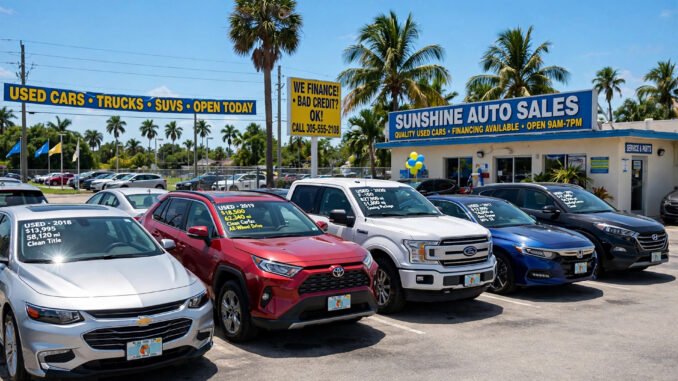
Miami’s used-car market is a paradox. On one hand, Florida’s huge population and constant turnover mean an enormous selection — off-lease sedans, snowbird convertibles, and fleet vehicles priced to move. On the other, South Florida consistently ranks among the nation’s hotspots for title washing, odometer fraud, and flood-damaged cars quietly resold after hurricane season. Buying smart here requires a process — this guide gives you that process, with real 2026 Miami costs at every step.
What a Used Car Really Costs in Miami (Beyond the Sticker)
The sticker price is only the opening number. A realistic 2026 budget for a reliable used car in Miami looks like this for, say, a 2018–2020 Honda Civic or Toyota Corolla listed at $14,500:
Purchase price: $14,500. Dealer fees: Florida dealers charge a “dealer fee” (doc fee) averaging $800–$1,000 in South Florida — among the highest in the nation, and it is pure profit. Negotiate it down or walk. Sales tax: Florida charges 6% state sales tax on vehicles plus Miami-Dade’s 1% discretionary surtax on the first $5,000 — about $920 total on a $14,500 car. Registration/title: roughly $400–$500 in Florida including the new plate. Pre-purchase inspection: $150–$250. Insurance: Florida has the most expensive car insurance in America — Miami drivers average $3,000–$4,500/year for full coverage in 2026. Get quotes before you buy.
All in, that “$14,500 car” costs about $17,000–$17,500 to drive off the lot, plus insurance. Budget the full number, not the sticker. And if the car will be your daily driver, our tips for making your daily commute more enjoyable will help you enjoy the purchase long after the paperwork.
Step 1: Run the VIN Before You Fall in Love
Never visit a car without first running its 17-digit VIN through a history report. In Miami this step is non-negotiable: flood cars from past hurricane seasons get dried out, detailed, retitled in another state, and resold in Florida with clean-looking paperwork.
Start free: the National Highway Traffic Safety Administration’s VIN decoder and recall lookup tell you factory specs and open recalls at no cost. Then pay for one full report — Carfax ($44.99 for one) or AutoCheck — on any car you are serious about. Look specifically for: flood or salvage title brands, title transfers through multiple states in short succession (classic title washing), odometer discrepancies, and service gaps. A Miami car with zero service records and a recent Louisiana title deserves extreme skepticism — Louisiana titles have historically been a laundering route for flood vehicles.
The flood-car smell test
At the car itself: pull up a corner of the trunk carpet and check for silt or mustiness, look for fogging inside headlight housings, check seat-belt retractors for grit, and sniff the AC on full blast. Flood damage hides well but rarely hides completely.
Step 2: Price It Like a Dealer Would
Check the car’s value on at least two pricing guides — Kelley Blue Book and Edmunds — using the exact trim, mileage, and condition. In 2026, Miami prices for popular used models run roughly 5–10% above the national average because of constant demand. That premium is real, but anything more than 10% over KBB “fair purchase price” for a clean car is dealer optimism, not market reality.
Also check what the same car sells for at competing Miami dealers within 25 miles — Hialeah, Kendall, and Doral dealers often undercut Brickell and Coral Gables lots on identical inventory. A 30-minute drive can save $1,500. Private-party sellers on Facebook Marketplace and Craigslist list 10–20% below dealers, but you lose any warranty and take on all the verification work yourself.
Step 3: The Pre-Purchase Inspection (Your $200 Insurance Policy)
This is the single highest-ROI $150–$250 in the entire process. Take the car to an independent mechanic — not the seller’s shop — for a pre-purchase inspection. Many Miami shops offer mobile inspections that come to the seller.
A good inspection covers: frame and accident damage (paint-depth gauge readings reveal hidden bodywork), engine and transmission health, suspension, brakes, tires, AC performance (critical in Miami — a weak compressor is a $1,200+ repair), and a scan for stored trouble codes. If the seller refuses an inspection, walk away. Legitimate sellers agree instantly; only sellers hiding something refuse. Use the inspection report as negotiation leverage: every $500 of needed work is $500 off the price.
Step 4: Financing Without the Rip-Off
Dealer financing is where Miami buyers lose the most money. The playbook: get pre-approved from your bank or a credit union before visiting any dealer. Credit unions like South Florida’s local options routinely beat dealer rates by 1–3 percentage points. In 2026, a buyer with good credit (700+) sees roughly 6–7% APR on a 60-month used-car loan; fair credit (650–699) sees 9–12%.
At the dealership, the finance office will offer to “beat your rate.” Let them try — but watch for the real profit centers: extended warranties marked up 200–300%, VIN etching ($300 for a $25 kit), paint protection, and gap insurance at triple the credit-union price. Decline everything in the finance office; you can buy gap insurance from your insurer for a fraction. The Consumer Financial Protection Bureau’s auto-loan resources explain these add-ons and your rights in plain language.
Also beware “yo-yo financing” — the dealer lets you drive home, then calls days later claiming the financing “fell through” and you must accept worse terms. In Florida, you are not obligated to sign a new deal; you can return the car. Knowing that kills the tactic.
Step 5: Miami-Specific Checks Before You Sign
Salt and sun damage: Cars parked near the beach corrode faster. Check underbody rust, faded clear coat, and cracked dashboards — Miami UV destroys interiors. A sunshade habit starts the day you buy.
AC and cooling system: Test the AC at idle for ten minutes, not just a quick blast. Overheating in Miami traffic reveals weak cooling systems fast.
Tires: Hot pavement eats tires; check date codes (tires older than six years need replacement regardless of tread) and budget $500–$800 for a set.
Title transfer: Florida requires title transfer within 30 days. Private-party buyers: meet at the seller’s bank or a AAA office, verify the title is clean and lien-free, and never pay cash without a bill of sale. Once the keys are yours, our guide to planning a US road trip with stops is worth a read — and a tidy organized garage makes home maintenance far less painful.
Negotiation: The Script That Works
Negotiate the out-the-door price, never the monthly payment. A workable script: “I have pre-approved financing, I’ve priced this car at $X on KBB, and my out-the-door offer is $Y.” Then stop talking. Silence is leverage. Be ready to leave — Miami has another identical Civic at another lot, and dealers know it. The end of the month is real: salespeople chasing quotas discount more aggressively in the final week. And always negotiate the dealer fee separately; a “$799 dealer fee” on top of an agreed price is negotiable, whatever the paperwork claims.
Check fueleconomy.gov for the car’s real-world MPG before you commit — at Miami gas prices, the difference between 25 and 35 MPG is roughly $800/year for a typical driver, which dwarfs small differences in sticker price.
Conclusion
Buying a used car in Miami without getting ripped off is a process, not a talent: run the VIN and check for flood history before you visit, price the car against KBB and competing local dealers, pay $200 for an independent pre-purchase inspection, arrive with credit-union pre-approval, and decline every finance-office add-on. Budget the full out-the-door number — price, $800+ dealer fee, 7% tax, $400+ registration, and Florida’s steep insurance — not the sticker. Do those six things and you will drive away in a reliable car at a fair price while the unprepared buyer next to you finances VIN etching at 12% APR.
Frequently Asked Questions
How much does it really cost to buy a used car in Miami?
Beyond the sticker price, budget for an $800–$1,000 dealer fee, 7% Miami-Dade sales tax, $400–$500 for title and registration, $150–$250 for a pre-purchase inspection, and Florida’s high insurance ($3,000–$4,500/year for full coverage in Miami).
How do I check if a used car was flood damaged?
Run a Carfax or AutoCheck VIN report looking for flood/salvage brands and multi-state title transfers, then inspect physically: check under trunk carpeting for silt, look for fogged headlights, gritty seat-belt retractors, and musty AC smell.
Should I get financing from the dealer or my bank?
Get pre-approved from your bank or credit union first. Dealer financing can be competitive, but the finance office’s real profit comes from marked-up add-ons like extended warranties and VIN etching — decline those regardless of who finances the loan.
Is a pre-purchase inspection worth it?
Absolutely. At $150–$250, an independent inspection routinely uncovers $500–$2,000 in hidden issues (weak AC compressors, prior accident repairs, worn suspension) and gives you documented leverage to renegotiate the price.
Leave a Reply