
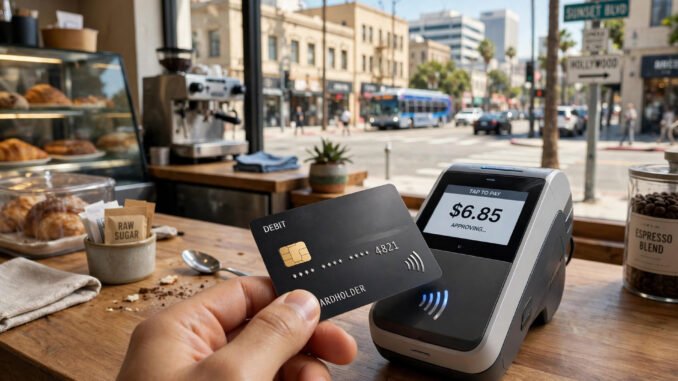
Crypto debit cards promise the best of both worlds: spend your Bitcoin and Ethereum anywhere Visa or Mastercard is accepted, sometimes earning crypto rewards while you do it. In Los Angeles — where crypto adoption runs high and the cards are heavily marketed — they sound like free money. The reality is more complicated. Between spread markups, conversion fees, tax complications, and shrinking rewards programs, the true cost of using a crypto debit card for daily spending is higher than the ads suggest.
This guide breaks down exactly what crypto debit cards cost in 2026, how they actually work under the hood, when they make sense, and when a regular cash-back card beats them effortlessly.
How Crypto Debit Cards Actually Work
Despite the name, you are not really “spending crypto” at the register. When you tap a crypto debit card at a Silver Lake coffee shop, the issuer instantly sells enough of your crypto to cover the purchase in dollars, then settles with the merchant in fiat. The merchant never touches crypto. What you experience as seamless spending is a real-time liquidation of your holdings — and that mechanism creates most of the costs below.
The major issuers in 2026 include Coinbase Card, Crypto.com’s Visa cards, Gemini’s credit card (technically a credit card with crypto rewards), and newer fintech offerings. Most are Visa or Mastercard, work with Apple Pay and Google Pay, and let you choose which asset funds each purchase. Rewards typically range from 1–4% back in crypto, often with tiered structures requiring you to stake the issuer’s native token for the top rates.
The Real Costs, Line by Line
1. The spread: the invisible 0.5–2% tax
Every conversion from crypto to dollars happens at the issuer’s exchange rate, not the market rate. That spread — typically 0.5% to 2% depending on the issuer and asset — applies to every single purchase. Spend $2,000/month through the card and a 1% spread quietly costs you $240/year. This is the largest cost and the least advertised.
2. Conversion and foreign transaction fees
Most crypto cards charge no explicit foreign transaction fee, which is a genuine perk for LA travelers. But domestic purchases can carry small conversion fees on some issuers (up to 0.5%), and ATM withdrawals almost always cost $2–$3 plus the spread — making crypto cards terrible ATM cards.
3. The tax bill: every swipe is a taxable event
This is the cost most users underestimate. The IRS treats cryptocurrency as property, not currency — so every purchase funded by crypto is technically a sale of property, triggering capital gains or losses. Buy coffee with Bitcoin that appreciated since you acquired it, and you owe tax on the gain. In practice, this means tracking the cost basis of every transaction, which is an accounting nightmare without dedicated software. For active daily spenders, the record-keeping burden alone can outweigh the rewards.
4. Rewards that shrink
Crypto card rewards have a history of being cut. Issuers that launched with 4–8% rewards have repeatedly reduced rates to 1–2% as programs matured. Any calculation assuming today’s headline rate should be stress-tested at half that rate — because history says that is where it lands. Compare against a flat 2% cash-back card (Citi Double Cash, Wells Fargo Active Cash), which has no spread, no tax complexity, and no devaluation risk.
5. Volatility drag on your spending money
Money you plan to spend next week should not be exposed to 10% daily swings. Keeping spending balances in crypto means your grocery budget can shrink 15% between paycheck and checkout. The disciplined approach — converting to a stablecoin like USDC for the spending balance — eliminates volatility but adds conversion steps and, on some issuers, additional fees.
When a Crypto Debit Card Actually Makes Sense
There are legitimate use cases. If you are already sitting on appreciated crypto you intend to spend down (rather than selling through an exchange and wiring to your bank), the card’s spread may be competitive with exchange withdrawal fees. If you travel internationally frequently, the lack of foreign transaction fees plus instant conversion beats many traditional cards. And if you are deep in a specific ecosystem (staking CRO for Crypto.com’s top tier, for example), the boosted rewards can genuinely beat cash-back cards — as long as you are comfortable with the lock-up risk on the staked tokens.
For everyone else, the honest math usually favors a different setup: earn in crypto if you like, but spend through a regular rewards card funded from your bank account. Keep your financial life simple enough to track — which starts with a budget you can actually stick to and a clear picture of your monthly cash flow.
Minimizing Costs If You Use One Anyway
Fund with stablecoins: Keep your card balance in USDC rather than volatile assets to kill volatility drag and simplify taxes (stablecoin-to-dollar conversions near $1 have negligible gains). Use it for planned spending only: Groceries, gas, subscriptions — predictable categories where you can estimate the tax impact. Track everything: Connect the card to crypto tax software from day one; reconstructing a year of coffee purchases at tax time is miserable. Read the rewards terms quarterly: Issuers change rates with 30 days’ notice — the card that was worth it in January may not be in June. Never use it at ATMs unless it is an emergency; the fee stack makes it the most expensive cash on earth.
And keep the card’s role in perspective within your broader spending. Small daily optimizations — like saving money on groceries each month — routinely beat any rewards card’s yield, crypto or otherwise.
The 2026 Verdict for Los Angeles Users
For the average LA spender putting $1,500–$2,500/month on a card: a crypto debit card earning 2% rewards but charging a ~1% spread nets roughly 1% — before tax complexity. A flat 2% cash-back card nets 2% with zero complexity. The crypto card only wins if you are earning boosted tier rewards (3–4%+) on spending you would do anyway, funding with stablecoins, and diligently tracking taxes. That is a narrow window, and it requires ongoing attention as issuers adjust terms. The Consumer Financial Protection Bureau offers neutral explainers on prepaid and debit card protections worth reading — note that crypto-funded cards may not carry the same error-resolution protections as traditional bank debit cards, an important fine-print difference.
Conclusion
Using a crypto debit card for daily spending in Los Angeles really costs you three things: a 0.5–2% spread on every purchase, a tax-reporting obligation on every swipe (because the IRS treats each spend as a property sale), and the attention cost of monitoring ever-changing rewards terms. Against that, you get 1–4% back in crypto and no foreign transaction fees. For most people, a simple 2% cash-back card wins on net benefit with none of the hassle. The crypto card earns its place only for specific users: those spending down existing holdings, frequent international travelers, or ecosystem loyalists capturing boosted tier rewards. Run your own numbers with the spread included — that is the step the marketing hopes you skip.
Frequently Asked Questions
Do I pay taxes when I buy things with a crypto debit card?
Generally yes. The IRS treats cryptocurrency as property, so spending crypto is a sale that can trigger capital gains tax if the crypto appreciated since you acquired it. Stablecoin spending near $1 typically creates negligible gains.
What fees do crypto debit cards charge?
The main cost is the conversion spread (0.5–2%) built into the exchange rate on every purchase. Most charge no foreign transaction fees, but ATM withdrawals typically cost $2–$3 plus spread, and some issuers add small conversion fees.
Are crypto debit card rewards better than cash back?
Rarely, after accounting for the spread. A card advertising 2% crypto rewards with a 1% spread nets about 1% — less than a flat 2% cash-back card. Only boosted tiers (3–4%+) with stablecoin funding tend to beat traditional cash back.
Can I use a crypto debit card at any store?
Yes, anywhere Visa or Mastercard is accepted, including via Apple Pay and Google Pay. The merchant receives dollars; the crypto-to-fiat conversion happens instantly on the issuer’s side.
Is my money protected on a crypto debit card like a bank account?
Not necessarily. Crypto balances generally lack FDIC insurance, and crypto-funded cards may not carry the same federal error-resolution protections as traditional bank debit cards. Check your issuer’s terms carefully.
Leave a Reply