
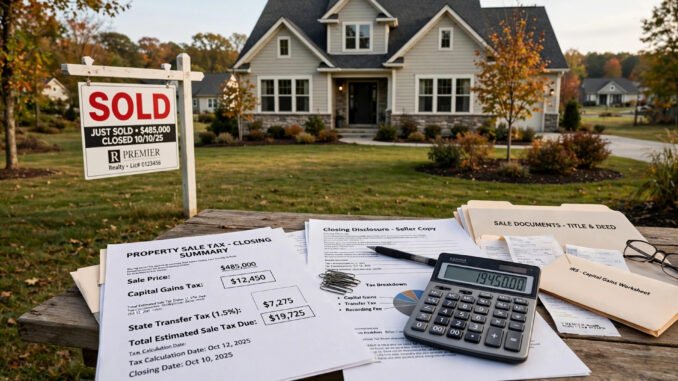
You sold your house — or you are about to — and someone mentions “capital gains” with the tone people use for jury duty. Suddenly the profit you were celebrating has a tax shadow over it. Understanding capital gains on property sales as a complete beginner is genuinely important: the difference between knowing the rules and not can be tens of thousands of dollars. The good news: for most homeowners selling a primary residence, the tax bill is zero. For everyone else, the rules are learnable.
This guide explains how capital gains tax on property works, the exclusions that save most sellers, how to calculate what you owe, and the strategies that legally minimize it.
What Capital Gains Tax Actually Is
Capital gains tax is the tax on profit from selling an asset — in this case, your gain (sale price minus your “basis,” roughly what you paid plus qualifying improvements) is taxed as income. Two rates matter:
Short-term gains (owned one year or less): taxed as ordinary income — your marginal tax rate, up to 37% federally. Flippers and quick sellers pay the most.
Long-term gains (owned more than one year): taxed at preferential rates — 0%, 15%, or 20% depending on your income, plus a potential 3.8% Net Investment Income Tax for high earners. Holding past the one-year mark is the single most valuable tax move in real estate.
State taxes add on top — rates range from 0% (Texas, Florida, Washington) to 13%+ (California). Your total bill is federal plus state.
The Primary Residence Exclusion (the Big One)
Section 121 of the tax code — the homeowner’s best friend — lets you exclude $250,000 of gain ($500,000 for married couples filing jointly) when selling a primary residence. Requirements: you owned the home for at least 2 years, and lived in it as your primary residence for at least 2 of the last 5 years (the “2-of-5 rule” — the years need not be consecutive).
What this means practically: bought for $300,000, selling for $550,000, lived there 3 years? Your $250,000 gain is fully excluded (single filer) — zero federal tax. Married couple with a $450,000 gain? Fully excluded under the $500,000 limit. Most American homeowners never pay capital gains on their home sale because of this exclusion.
Partial exclusions exist for forced moves (job relocation, health issues, divorce) even if you do not meet the full 2 years — the exclusion prorates. And you can use the exclusion repeatedly, but not more than once every 2 years.
Calculating Your Gain (Basis Is Everything)
Your taxable gain is not sale price minus purchase price — it is sale price minus adjusted basis, and basis includes more than you think:
Add to basis: qualifying home improvements (new roof, HVAC, additions, kitchen remodels — not repairs like fixing a faucet), closing costs from the purchase (title insurance, recording fees — not points, in most cases), and special assessments for local improvements.
Subtract from sale price: selling costs — agent commissions, closing costs, staging, and repairs made specifically to sell. On a $500,000 sale with 6% commissions, that is $30,000+ reducing your taxable gain.
Example: bought for $300,000, added a $40,000 kitchen remodel (documented), selling for $520,000 with $32,000 in selling costs. Adjusted basis: $340,000. Net sale: $488,000. Gain: $148,000 — fully excluded for a qualifying single filer. Keep receipts for every improvement. Undocumented improvements do not exist at tax time. Tracking expenses without an accountant applies the same discipline — records are money.
When the Exclusion Does Not Apply
Investment/rental properties: no Section 121 exclusion (with limited exceptions for converted properties). Gains are fully taxable — but depreciation recapture adds a twist: the depreciation you claimed (or should have claimed) is “recaptured” at 25%. Many landlords are shocked to learn depreciation is mandatory in the IRS’s eyes whether you claimed it or not.
Second homes and vacation properties: no exclusion. Full capital gains apply.
Flips (owned ≤1 year): short-term rates — ordinary income tax on the profit. This is why flipping margins need to be large; the taxman takes the first big bite.
Gains above the exclusion: the excess is taxed at long-term rates. A $700,000 gain for a married couple means $200,000 taxable — still far better than no exclusion.
Strategies That Legally Reduce the Bill
Time the sale past one year. If you are near the 12-month mark on an investment property, waiting weeks can convert ordinary-income rates to preferential long-term rates — potentially saving tens of thousands.
Meet the 2-of-5 rule. If you are close to two years of residence, delaying the sale to qualify for the exclusion is almost always worth it.
1031 exchanges (investment property). Defer capital gains indefinitely by exchanging into like-kind investment property. Strict timelines (45 days to identify, 180 days to close) and qualified-intermediary requirements make this professional-advisor territory — but the deferral power is enormous.
Harvest strategically. In low-income years (retirement gap years, sabbaticals), the 0% long-term capital gains bracket covers substantial gains tax-free. Timing sales to low-income years is advanced but powerful planning.
Document everything. Every improvement receipt, every closing statement, every selling expense. At audit or at filing, documentation is the difference between the basis you deserve and the basis you can prove.
For the authoritative details, the IRS publications on property sales (notably Publication 523 for home sales) are surprisingly readable, and the Tax Policy Center’s capital gains explainers provide independent analysis of how the rates work in practice. Also see freelancer tax obligations in the US covers the self-employment side many property sellers also navigate. Given the dollars involved, a one-hour consultation with a CPA ($200–$400) before selling is among the best investments a property seller can make.
Conclusion
Capital gains on property sales work like this: calculate your gain (sale price minus adjusted basis minus selling costs), apply the $250,000/$500,000 primary-residence exclusion if you qualify (most sellers do), and pay long-term rates on anything above. The big levers are holding past one year, meeting the 2-of-5 residence rule, documenting every improvement, and getting professional advice for investment properties. Understand these rules before you list — not after you close.
Frequently Asked Questions
Do I pay capital gains tax when selling my primary home?
Usually not — the Section 121 exclusion covers $250,000 ($500,000 married) of gain if you owned and lived in the home 2 of the last 5 years. Most sellers fall entirely within the exclusion and owe zero federal tax on the sale.
What counts as a home improvement for tax basis?
Improvements that add value, prolong life, or adapt the home to new uses: additions, new roof, HVAC replacement, kitchen/bathroom remodels. Repairs that merely maintain (fixing leaks, repainting) generally do not count. Keep all receipts.
How is depreciation recapture taxed on rental property?
Depreciation you claimed (or were entitled to claim) is recaptured at a 25% rate when you sell, regardless of your other capital gains rates. This surprises many landlords — the IRS treats unclaimed depreciation as claimed.
Can I avoid capital gains by buying another house?
Not anymore — the old “rollover” rule was replaced by the Section 121 exclusion in 1997. Buying another home does not defer gains on investment property (that is what 1031 exchanges are for) and is irrelevant for primary residences within the exclusion.
Should I hire a CPA when selling property?
For primary-residence sales within the exclusion: usually unnecessary. For investment properties, large gains, 1031 exchanges, or complex situations: absolutely — a $300 consultation routinely saves thousands in correctly applied rules.
Leave a Reply