
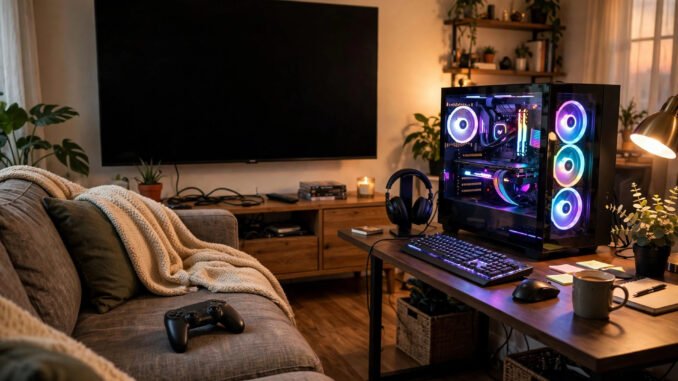
Is choosing between console and PC gaming actually worth it for a beginner? If you’re new to gaming, this debate can feel like walking into a family feud — passionate partisans, jargon everywhere, and the sneaking suspicion that one wrong choice wastes hundreds of dollars. Here’s the truth the partisans won’t tell you: for a beginner, either choice is fine, and the “right” answer depends on your life, not on benchmarks. This guide cuts through the tribalism with real 2026 prices, honest trade-offs, and a decision framework that takes ten minutes.
The Real Difference (It’s Not Graphics)
Veterans argue about frame rates and ray tracing, but the beginner-relevant differences are practical:
Consoles (PlayStation 5, Xbox Series X|S, Nintendo Switch 2) are appliances. You plug them into your TV, insert a game, and play. No drivers, no settings menus with 40 options, no wondering if your hardware can run something. The 2026 console lineup is mature: the PS5 and Xbox Series X deliver genuinely excellent performance, and Nintendo’s Switch 2 (launched 2025) finally brings Nintendo into the modern-performance era while keeping its unbeatable portability.
PCs are workshops. A gaming PC does everything — work, creativity, browsing — and plays games, often with more settings, mods, and cheaper game prices (Steam sales are legendary). But it’s a hobby in itself: updates, drivers, occasional troubleshooting. As PC Gamer’s hardware guides document, the ceiling is higher but so is the involvement.
The beginner question isn’t “which is better?” — it’s “which friction bothers you less?”
The Honest Cost Breakdown (2026 Real Prices)
Let’s talk money, because this is where beginners get burned:
Console: ~$300–$550 to start
A Switch 2 or Xbox Series S sits around $300–$350; PS5 and Series X around $450–$550. Add one $70 game (or a $10–$17/month subscription like Game Pass or PS Plus with a library included), and you’re playing within an hour of unboxing. Total first-year cost: roughly $400–$700. The catch: games rarely drop below $40–$70, and online multiplayer requires the subscription.
PC: ~$600–$1,200 to start (but you may own half of it)
A competent entry-level gaming PC (capable of 1080p high settings) costs $700–$900 prebuilt in 2026; building your own can shave $100–$200 if you’re comfortable. The hidden beginner trap: you probably need a computer anyway. If you’d buy a $500 laptop regardless, the marginal cost of “gaming-capable” is a few hundred dollars — making PC the cheaper path for students and remote workers. Games are dramatically cheaper (Steam sales routinely hit 50–80% off), and online multiplayer is free.
Three-year total cost often converges. Consoles start cheaper; PCs recoup through cheaper games and free multiplayer. Anyone telling you one is “obviously” cheaper is selling something.
The Decision Framework: Five Questions
Answer these honestly and the choice makes itself:
1. Where do you want to play? Couch + big TV = console (or a PC hooked to the TV, but that’s advanced). Desk = either. Bed/travel = Switch 2 or a gaming laptop.
2. What do your friends play? This decides more purchases than any spec sheet. Cross-play exists for many big titles now (Fortnite, Call of Duty, Minecraft), but party chat and shared libraries still favor matching platforms. Ask your circle before you buy.
3. Do you enjoy tinkering? If settings menus excite you, PC. If they exhaust you, console. Neither is a character flaw.
4. What games call to you? Nintendo exclusives (Zelda, Mario) require Nintendo hardware — no PC version exists. Sony exclusives increasingly come to PC after 1–2 years. Strategy games, MMOs, and mod-heavy games (Skyrim modded, Minecraft Java) are PC-native. Competitive shooters thrive on both.
5. Do you need a computer anyway? Student, remote worker, creator — if yes, a gaming PC pulls double duty and the economics tilt hard toward PC.
The third path: handhelds and cloud
In 2026 there’s a legitimate third option: handheld gaming PCs (like the Steam Deck and its competitors) and cloud gaming. A handheld PC plays a full game library on the couch, in bed, or on a plane — PC versatility with console-like simplicity, starting around $400. Cloud gaming needs no gaming hardware at all beyond a screen and decent internet. Neither fully replaces a console or desktop yet, but for a beginner who values flexibility — or who travels — they’re worth pricing into the decision. The platform wars have more than two sides now.
What Beginners Actually Regret
Talk to gamers about purchase regret and patterns emerge. Console buyers regret: buying at launch then waiting months for games they want; subscription creep; realizing their friends are all on the other platform. PC buyers regret: overspending on specs they never use (a beginner doesn’t need a $1,500 GPU); underestimating the tinkering; buying a cheap prebuilt with a terrible power supply.
The universal non-regret: starting with games, not hardware. Pick 2–3 games you’re genuinely excited about — great entry points include the best video games for people who don’t usually play — then buy the cheapest platform that runs them well. Hardware serves games, never the reverse. And if your household does game nights, check how to make game night more fun for non-gamers before investing in multiplayer setups.
The 2026 Landscape: Why Beginners Have It Best Right Now
Honestly, there’s never been a better time to start. Console generations are mature (deep game libraries, stable prices, refined hardware), PC component prices normalized after the crypto-mining and shortage chaos, cloud gaming offers a third path (more on that in our cloud gaming guide), and subscription libraries mean beginners can sample dozens of games cheaply before committing to tastes. The “wrong choice” of 2026 is a mild inconvenience, not a disaster — most games, saves, and friends transfer more easily than ever.
Tom’s Hardware’s console vs. PC coverage keeps current benchmarks if you want numbers, but remember: benchmarks measure machines, not fun.
Conclusion: Worth Deciding, Not Worth Agonizing
Is choosing between console and PC worth it for a beginner? Deciding — yes, ten minutes with the five questions above. Agonizing — no. Consoles offer simplicity and couch comfort for $300–$550; PCs offer versatility and cheap games for $600–$1,200 (less if you need a computer anyway). Match the platform to your room, your friends, and your tolerance for tinkering — then stop researching and start playing. The best platform is the one with your favorite game loaded and your friends online. Everything else is forum noise.
Frequently Asked Questions
Is console or PC better for a beginner?
Consoles are simpler (plug-and-play, no maintenance); PCs are more versatile (doubles as a work computer, cheaper games, free online multiplayer). Beginners who dislike tinkering should lean console; students/remote workers who need a computer anyway should lean PC.
How much does it cost to start gaming in 2026?
Roughly $300–$550 for a console setup or $600–$1,200 for a gaming PC. First-year totals including games/subscriptions run $400–$700 (console) or $700–$1,300 (PC), though PC game sales and free multiplayer narrow the gap over time.
Can I play with friends on different platforms?
Often, yes. Many major multiplayer games (Fortnite, Call of Duty, Minecraft, Rocket League) support cross-play between console and PC. Check each specific game’s cross-play support before assuming.
Do I need an expensive PC to enjoy gaming?
No. A $700–$900 PC handles 1080p gaming beautifully, which is where most beginners play. Expensive GPUs matter for 4K/high-refresh competitive play — concerns for enthusiasts, not beginners.
What’s the easiest console for a total beginner?
The Nintendo Switch 2: intuitive controls, family-friendly library, portable for playing anywhere, and the lowest price of entry. For cinematic blockbusters on the TV, the PS5’s DualSense controller and exclusives are the beginner-friendly pick.
Leave a Reply