
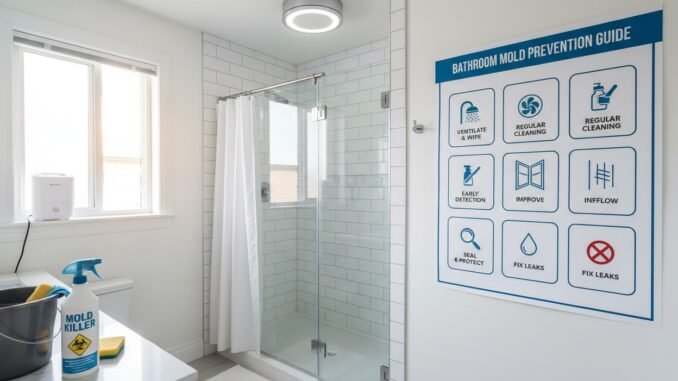
Bathroom mold isn’t a cleaning failure — it’s a moisture failure. You can scrub all you want, but if the room stays damp, mold returns like clockwork. The best ways to prevent mold in the bathroom all target one thing: getting moisture out fast and keeping surfaces dry. I battled recurring shower mold for a year before learning this — the scrubbing was treating the symptom. Fix the moisture, and the mold problem mostly solves itself. Here’s the complete prevention system.
Rule #1: Ventilation (The 80% Solution)
- Run the exhaust fan during AND 20–30 minutes after every shower. The “after” part is what everyone skips — and it’s when most moisture damage happens. A $15 humidity-sensing switch (replaces the fan switch, runs automatically until humidity drops) solves the forgetting problem permanently.
- Fan must vent OUTSIDE — not into the attic (shockingly common in older homes, and it just moves the mold to the attic). Check where yours terminates.
- Fan sizing: you need roughly 1 CFM per square foot (50 sq. ft. bathroom = 50 CFM minimum). An undersized fan running forever still loses to a shower. Panasonic WhisperGreen fans ($120–$180) are quiet enough that people actually leave them on — noise is why fans get switched off early.
- No fan? Open a window during/after showers. Not as good, but infinitely better than nothing. A $20 window fan exhausting outward helps enormously.
Rule #2: Dry Surfaces Quickly
- Squeegee shower walls after every use ($10 tool, 60 seconds): removes 75% of the water that would otherwise sit there feeding mold for hours. This single habit prevents more mold than any cleaner.
- Shower curtain: spread it fully closed after showering (bunched curtains stay wet in folds — prime mold real estate). Wash it monthly; replace $10 liners quarterly.
- Fix drips and leaks: a dripping showerhead or faucet keeps surfaces perpetually damp. Fix the $10 washer (see our faucet repair guide) — it’s also a mold-prevention measure.
- Don’t leave wet towels bunched up — hang them spread out or run them through the dryer. A damp towel pile is a mold farm.
Rule #3: Make Surfaces Mold-Hostile
- Re-caulk failing caulk: cracked or peeling caulk traps water behind it — mold’s favorite hiding spot. Remove old caulk completely (don’t caulk over it), dry the joint 24 hours, apply mold-resistant silicone caulk ($8–$10/tube).
- Seal grout: unsealed grout absorbs water like a sponge. Penetrating sealer ($15–$25) every 1–2 years in the shower.
- Paint: use mold/mildew-resistant bathroom paint (Benjamin Moore Aura Bath & Spa, Zinsser Perma-White — $40–$60/gallon) on walls and ceilings. Standard paint in a steamy bathroom is a mold invitation.
- Keep humidity under 50%: a $10 hygrometer tells you where you stand. If the bathroom stays above 60% for hours, you need more ventilation, period.
What Are the Best Ways to Prevent Mold in the Bathroom? Safe Cleanup
For existing mold (small areas, under 10 sq. ft. — larger = call a pro):
- What works: concrobium ($10 — crushes mold without bleach fumes), white vinegar (kills 82% of mold species), hydrogen peroxide 3%, or borax solution. Scrub, then dry completely.
- Skip the bleach myth: bleach whitens mold on non-porous surfaces but doesn’t kill roots in porous materials (grout, drywall, caulk) — and the water in bleach actually feeds it. The EPA recommends against bleach for porous mold cleanup.
- Protect yourself: N95 mask ($2), gloves, ventilate. Don’t dry-scrape large mold patches (spreads spores).
- Replace, don’t clean: moldy caulk, drywall, or insulation — these are porous and can’t be truly cleaned. Cut out and replace.
The prevention hierarchy: ventilation > drying habits > resistant materials > cleaning. Get the fan right and squeegee the shower, and you’ll rarely need the cleaners at all. Mold is just moisture with patience — remove the moisture, and there’s nothing to be patient about.
Mold Prevention Mistakes to Avoid
- Scrubbing without fixing moisture: you can bleach mold weekly and it returns — because mold is a moisture problem, not a cleaning problem. Ventilation + drying habits prevent; scrubbing just treats symptoms.
- Using bleach on porous surfaces: bleach doesn’t kill mold roots in grout, drywall, or caulk — and its water content feeds regrowth. Use Concrobium, vinegar, or hydrogen peroxide on porous materials; replace moldy caulk/drywall rather than cleaning it.
- Turning the fan off when the shower ends: the 20–30 minutes after is when most moisture damage happens. A $15 humidity-sensing switch runs the fan automatically until humidity drops — set it and forget it.
- Venting the fan into the attic: shockingly common in older homes — it just moves the mold to the attic. Fans must terminate outside (roof or wall cap). Check yours.
Bathroom Mold FAQs
What’s the best way to remove bathroom mold?
Small areas (under 10 sq. ft.): Concrobium ($10), white vinegar, or 3% hydrogen peroxide — scrub, then dry completely. N95 mask + gloves. Larger areas or HVAC mold: call a professional — disturbing big colonies spreads spores through the house.
Does bleach kill mold?
On non-porous surfaces (tile, glass): yes, sort of. On porous materials (grout, drywall, wood, caulk): no — it whitens the surface while roots survive and regrow, fed by the bleach’s own water. The EPA recommends against bleach for porous mold.
How do I keep mold from coming back?
The hierarchy: ventilation > drying habits > resistant materials > cleaning. Fan 20–30 min post-shower, squeegee walls (60 seconds, removes 75% of water), fix drips, seal grout every 1–2 years, mold-resistant paint. Get the moisture right and mold has nothing to grow on.
Is bathroom mold dangerous?
Most bathroom mold (Cladosporium, common mildews) is an allergen/irritant, not a toxin — but it aggravates asthma and allergies. Stachybotrys (“black mold”) on chronically wet drywall is the concerning one — don’t guess; if mold covers large areas or keeps returning through drywall, get professional assessment ($300–$600).
Leave a Reply