
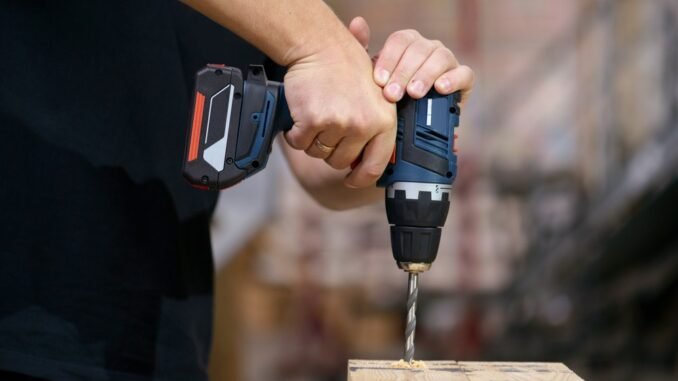
If you buy one power tool, make it a drill. But walk into Home Depot and you’re facing a wall of nearly identical drills from $40 to $300, and the wrong choice means a tool that dies mid-project or one you overpaid for by $200. Learning how to pick the right drill for home DIY projects comes down to three decisions: drill vs. driver, voltage, and brand ecosystem. Get those right and the rest is details. Here’s the no-nonsense guide.
Decision 1: Drill/Driver vs. Impact Driver (You Probably Want Both, Eventually)
- Drill/driver (the must-have): drills holes, drives screws with adjustable clutch. The chuck grips round drill bits. This is the one tool every homeowner needs.
- Impact driver (the specialist): drives long screws and lag bolts with concussive force — vastly better at driving, can’t drill holes well (hex-only chuck). Once you use one for deck screws or cabinet installs, you’ll never go back.
- The answer: buy a combo kit (drill + impact driver + 2 batteries + charger) — $99–$179 on sale. It’s barely more than a single drill and covers everything. This is the best value in power tools.
Decision 2: Voltage — 12V vs. 18V/20V
- 12V: lighter (2 lbs vs. 3.5 lbs), compact, plenty for drilling into drywall/wood and driving small screws. Great for apartments, furniture assembly, light DIY. Kits from $79–$129.
- 18V/20V (same thing — marketing): the standard homeowner choice. Handles drilling into studs, masonry with hammer mode, driving 3-inch screws all day. If you own a house, buy this. Kits from $99–$179.
- Bottom line: apartment/light use → 12V is delightful. House with real projects → 18V/20V, no question.
Decision 3: Brand Ecosystem (This Matters More Than Specs)
Batteries are the real investment — a $80 battery outlasts the tool. Pick a brand and stay in it so every future tool (saw, sander, inflator) shares batteries:
- Ryobi (Home Depot): the DIY king — 300+ tools on one 18V battery platform, frequent sales, unbeatable breadth. The combo kit regularly hits $99. My top recommendation for most homeowners.
- DeWalt (20V Max): pro-grade durability, huge lineup, slightly pricier. The “buy once” choice.
- Milwaukee (M18): the contractor favorite — superb tools, premium prices.
- Makita / Bosch: excellent, slightly smaller US retail presence.
- Avoid: no-name Amazon brands with proprietary batteries you’ll never find again.
How Do I Pick the Right Drill for Home DIY Projects? Specs That Matter
- Brushless motor: worth the extra $20–$40 — 50%+ longer runtime, more power, longer tool life. Non-negotiable in 2026.
- Chuck size: 1/2″ handles all homeowner bits; 3/8″ is fine for light duty.
- Clutch settings: 20+ clutch positions prevent stripping screws and sinking drywall screws too deep.
- Batteries: kit should include two batteries (one charging while you work) — 2.0Ah minimum, 4.0Ah+ for heavy use.
- Hammer mode: needed only if drilling into brick/concrete. Nice to have; not essential for wood/drywall homes.
Starter Kit Picks (2026)
- Best overall: Ryobi 18V brushless drill + impact driver combo kit — ~$129–$159. Covers 95% of homeowner needs.
- Step up: DeWalt 20V Max XR brushless combo — ~$179–$229 on sale. Pro durability.
- Compact/light: Milwaukee M12 Fuel drill/driver kit — ~$129–$149. Tiny but mighty.
- Don’t forget: a drill bit set ($20–$30 — titanium twist bits + spade bits) and driver bit set ($15). The tool is useless without bits.
Safety basics: clamp your workpiece (never hold it), wear eye protection ($8 — non-negotiable), and let the bit do the work — pushing harder just burns bits and strains the motor. Buy the Ryobi combo on sale, grab a bit set, and you’re equipped for a decade of home projects.
Drill Buying Mistakes to Avoid
- Buying drill-only when the combo kit is $30 more: a drill + impact driver combo ($99–$179) covers everything; drill-only saves little and you’ll buy the impact driver separately later for more. The combo is the best value in power tools.
- Ignoring the battery ecosystem: the $80 battery outlasts the tool — buying into a dead-end brand (no-name Amazon, proprietary batteries) strands you. Ryobi, DeWalt, Milwaukee all offer 100+ tools on shared batteries.
- Skipping brushless to save $25: brushless motors deliver 50%+ longer runtime, more power, and longer tool life. In 2026, brushed is obsolete for anyone doing real projects.
- Buying 12V for a house full of projects: 12V is delightful for apartments — but drilling into studs, masonry, and driving 3-inch screws all day wants 18V/20V. Match voltage to the workload.
Choosing a Drill FAQs
What’s the difference between a drill and an impact driver?
A drill/driver drills holes (chuck grips round bits) and drives screws with an adjustable clutch. An impact driver drives screws with concussive rotational force — vastly better at driving long screws and lag bolts, but can’t drill holes (hex-only chuck). Own both via a combo kit.
Is 20V actually more powerful than 12V?
Yes, substantially — higher voltage = more power for demanding tasks (masonry, large bits, long screws). But 12V tools are lighter (2 vs. 3.5 lbs) and plenty for drywall, wood, and small screws. House with projects: 18V/20V. Apartment/light DIY: 12V is a joy.
Which drill brand should I choose?
Ryobi 18V for most homeowners — 300+ tools on one battery platform, frequent $99–$129 combo-kit sales, unbeatable breadth. DeWalt 20V Max for pro-grade durability. Milwaukee M18 for contractors. Pick one ecosystem and stay in it.
What bits do I need to start?
A titanium twist-bit set ($20–$30 — drilling) and a driver bit set ($15 — Phillips, Torx, square drive). The tool is useless without bits — and Torx/star-drive screws (with matching bits) strip far less than Phillips. Buy the bits with the drill.
Must-Have Drill Accessories
The drill is half the system — budget $40–$60 for the accessories that make it useful: titanium twist-bit set ($20–$30), driver bit set with Torx/square drive ($15 — strips far less than Phillips), spade bits for large holes ($12 set), a countersink bit ($10 — professional-looking screw finishes), and eye protection ($8 — non-negotiable). Pro Tool Reviews runs the most rigorous independent drill testing in the business — their head-to-head comparisons (torque, runtime, ergonomics under load) cut through manufacturer marketing specs that all claim to be “the most powerful.” Buy the combo kit on sale, grab the bits, read one professional review — and you’re equipped for a decade.
Leave a Reply