
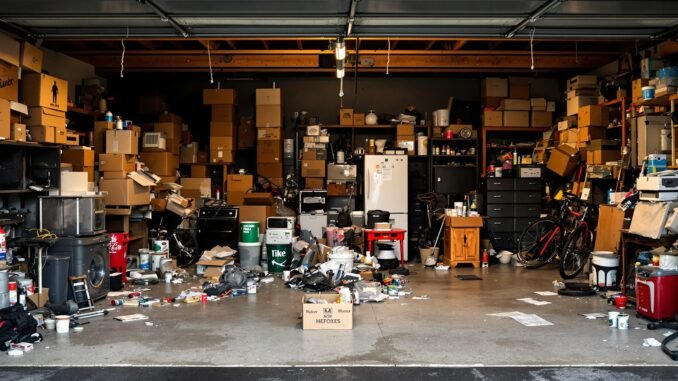
Every messy garage reaches the same tipping point: you can’t find the screwdriver, you can’t park the car, and you’ve started storing things in the living room instead. The best way to organize a messy garage isn’t buying more bins — it’s a systematic purge, sort, and zone process. I did this to a two-car garage that hadn’t seen a car in three years; one long weekend later, both cars fit with room to spare. Here’s the exact method.
Phase 1: The Purge (Saturday Morning — Be Ruthless)
Pull everything out onto the driveway. Yes, everything — it’s the only way to see what you actually own. Then sort into four piles:
- Keep: used in the last year, or genuinely needed (emergency supplies, seasonal gear).
- Donate/sell: the duplicate tools, the “project” bike untouched since 2021, the box of cables for devices you no longer own. If you haven’t touched it in 2 years, it’s not a possession — it’s storage rent.
- Trash/recycle: dried paint (dry it with kitty litter first — most municipalities won’t take liquid paint), broken items, mystery chemicals (take to hazardous waste drop-off, never the trash).
- Relocate: things that don’t belong in a garage at all — indoor items, paperwork, the treadmill of guilt.
Typical result: 30–40% of garage contents leave. The purge is the project; everything after is just arranging what’s left.
Phase 2: Sort Into Zones (Saturday Afternoon)
Group keepers by function, not by size:
- Tools & workshop: hand tools, power tools, hardware, workbench area
- Automotive: fluids, jumper cables, cleaning supplies, emergency kit
- Yard & garden: mowers, trimmers, soil, pots, hoses
- Sports & recreation: bikes, camping gear, balls, coolers
- Seasonal: holiday decorations, winter gear — these go highest and deepest (accessed twice a year)
- Household overflow: bulk paper goods, paint, cleaning supplies
Phase 3: Go Vertical (Sunday — The Transformation)
Garage floors are for cars and walking. Everything else goes up. In order of impact per dollar:
- Wall-mounted slatwall or pegboard ($50–$150 for a 4×8 section): tools visible, reachable, off the floor. A French cleat system (DIY from plywood, ~$30) is even more flexible.
- Overhead ceiling racks ($60–$120 each): the seasonal zone lives here — holiday bins, camping gear. Frees shocking amounts of floor space. Check joist mounting and weight ratings (typically 250–600 lbs per rack).
- Heavy-duty shelving ($80–$150 per unit — Gladiator or Husky from Home Depot): for paint, automotive, bulk goods. Anchor tall units to the wall.
- Bike hoists or wall hooks ($15–$30/bike): bikes are the #1 floor-space hog. Get them vertical.
- Clear stackable bins ($8–$15 each — 27-gallon HDX totes): one category per bin, labeled on two sides with a label maker or painter’s tape. Clear beats opaque — you can see what’s inside.
What Is the Best Way to Organize a Messy Garage? The Maintenance Rules
- Outline tools on pegboard (trace with marker) — a missing tool’s silhouette screams at you to put it back.
- One in, one out: new tool in, old/similar tool out. Garages re-clutter without this rule.
- Floor zones: tape parking outlines on the floor so bikes and bins don’t migrate into car space.
- Annual 1-hour reset: every spring, pull the seasonal bins down, re-sort, donate the creep. One hour preserves the whole system.
- Chemical safety: flammables (gas, paint thinner) in a flame cabinet or away from ignition sources; never store propane indoors. Your local fire department’s guidance beats any blog — but the basics are non-negotiable.
Budget for the full transformation: $300–$600 in storage hardware. Compare that to a $150/month storage unit ($1,800/year) holding the overflow of a disorganized garage — the garage project pays for itself in months. Purge Saturday morning, zone Saturday afternoon, go vertical Sunday, park the car Sunday night. That’s the whole project.
Garage Organization Mistakes to Avoid
- Buying bins before purging: organizing clutter just creates organized clutter. Purge first (typically 30–40% leaves), then buy storage for what’s left — you’ll buy half as much.
- Storing everything at floor level: garage floors are for cars and walking. If it’s on the floor, it’s in the way — walls and ceiling hold everything else. Overhead racks alone free shocking amounts of space.
- Opaque unmarked bins: a wall of identical gray totes with no labels is a memory test you’ll fail. Clear bins or labels on two sides — future you is grateful.
- No “one in, one out” rule: garages re-clutter without it. New tool in, old one out — the maintenance rule that preserves the whole system.
Garage Organization FAQs
How much does it cost to organize a garage?
$300–$600 in storage hardware (slatwall/pegboard, overhead racks, heavy-duty shelving, bins, bike hooks) for a full two-car transformation. Compare: a $150/month storage unit ($1,800/year) holding the overflow — the project pays for itself in months.
What’s the best garage wall storage system?
Slatwall panels ($50–$150 per 4×8 section) with hooks — flexible, strong, clean-looking. DIY French cleats from plywood (~$30) are even more customizable. Pegboard is the budget classic but less sturdy for heavy tools.
Are overhead ceiling racks safe?
Yes, when properly installed: lag into ceiling joists (not just drywall), respect the weight rating (typically 250–600 lbs per rack), and distribute weight evenly. They’re ideal for seasonal items (holiday bins, camping gear) accessed twice a year.
How do I keep it organized long-term?
Outline tools on pegboard (missing tools scream to be returned), tape floor zones for car space, one-in-one-out for new acquisitions, and a 1-hour spring reset annually. Systems survive on maintenance, not perfection.
Climate Control: The Forgotten Garage Upgrade
Garages hit 120°F in summer and freezing in winter — brutal for stored paint, batteries, and anything liquid. The fixes: insulate the garage door ($80–$150 kit — cuts temperature swings dramatically), weatherstrip the door edges ($20), and ensure ventilation (a $30 louvered vent or periodic door-cracking prevents fume buildup from stored chemicals). If the garage shares a wall with living space, insulating that shared wall also cuts your home’s energy bills. Gladiator garage systems are the benchmark for heavy-duty garage storage — their wall tracks and cabinets are engineered for the temperature swings and humidity that destroy indoor-grade shelving in garage environments. Climate-appropriate storage lasts; indoor furniture in a garage warps, rusts, and sags.
Leave a Reply