
Seven days, client meetings, maybe a dinner — and you’re determined to skip baggage claim, avoid lost-luggage roulette, and move through airports like a ghost. What should I pack for a week-long business trip in one carry-on? It’s absolutely doable — I’ve done 10-day business trips in a carry-on — but it requires a system, not just stuffing. The secret: a mix-and-match capsule in one color palette, fabrics that resist wrinkles, and ruthless editing of “just in case” items. Here’s the complete packing list and the techniques that make it fit.
What Should I Pack for a Week-Long Business Trip in One Carry-On? The Capsule
One color palette: navy/gray/white (or black/white/gray) + one accent. Every piece matches every other piece. That’s the entire trick — 8 clothing items become 15+ outfits.
Women’s 7-Day Business Capsule
- Tops (5): 3 blouses/shells + 2 knit tops, all in palette neutrals. Wrinkle-resistant fabrics (jersey, crepe, silk blends).
- Bottoms (3): 2 trousers/skirts + 1 dress (a sheath or wrap dress doubles as a full outfit). Dark colors hide travel wear.
- Layers (2): 1 blazer (wear on the plane — the bulkiest item travels on you) + 1 cardigan or light sweater.
- Shoes (2 pairs max): 1 professional pair (worn on plane) + 1 versatile flat/heel. Two pairs is the hard limit — shoes eat space.
- Undergarments: 7 + 1 spare (small, pack flat). Consider quick-dry fabrics for sink-washing mid-trip.
- Accessories: 1 scarf (outfit-changer + plane blanket), minimal jewelry set, 1 belt.
Men’s 7-Day Business Capsule
- Shirts (5): dress shirts in white/light blue/subtle pattern. Non-iron cotton or blends — worth the premium for travel.
- Bottoms (3): 2 dress trousers + 1 chino (or suit trousers + separates). Navy and gray cover everything.
- Layers (2): 1 blazer or suit jacket (worn on plane) + 1 sweater or vest.
- Ties (3): rolled, not folded — zero wrinkles, tiny space.
- Shoes (2 pairs max): 1 dress pair (worn on plane) + 1 versatile loafer/sneaker.
- Undergarments/socks: 7 + 1 spare. Dark socks only (one color = no matching).
The Packing Techniques (How It All Fits)
- Roll, don’t fold — for knits, casual items, and undergarments. Rolling saves space and prevents creases. (Exception: structured shirts fold better — see below.)
- Bundle wrapping for dress clothes: wrap garments around a central core (pouch of undergarments) — the tension prevents wrinkles better than any fold. YouTube “bundle packing” once and you’ll never go back.
- Packing cubes ($20–$30 set) — the carry-on essential. Cubes by category (tops, bottoms, undergarments), compress slightly, and let you unpack/repack in seconds. They also keep clean and worn separated.
- Shoes: heel-to-toe, stuffed with socks/underwear (dead space = wasted space), in shoe bags at the bottom near the wheels.
- Blazer/suit: wear it on the plane. If you must pack it: turn inside out, fold shoulder-to-shoulder, roll loosely. Or use the “dry-cleaner fold” in a packing cube.
- Toiletries: TSA 3-1-1 compliant quart bag, solid alternatives where possible (shampoo bars, solid deodorant — no liquid limits, no spills). Decant into 1oz bottles; you need less than you think for a week.
- Tech: laptop, chargers in one pouch, portable battery, universal adapter for international. Noise-canceling earbuds for the flight.
The Wear-on-Plane Outfit
Your bulkiest items travel on your body: blazer, heaviest shoes, jeans or trousers, layers. The plane outfit should also be presentable enough for a surprise meeting — which is where the comfortable flight outfit formula earns its keep.
Mid-Trip Maintenance
- Sink-wash midweek: quick-dry undergarments and tops washed on day 3–4 halve what you pack. Travel detergent packets ($5) or hotel shampoo work.
- Wrinkle emergency kit: travel steamer ($25 — the business traveler’s secret weapon) or the shower-steam trick (hang clothes in a steamy bathroom 15 minutes). Wrinkle-release spray as backup.
- Hotel laundry: for trips over 7 days, hotel laundry (or a local wash-and-fold, $15–$25 for a bag) beats packing more.
- Rewear strategy: trousers/skirts get 2–3 wears (they don’t touch skin directly); tops get 1–2. Plan the rotation so laundry day falls mid-trip.
What NOT to Pack
- “Just in case” outfits — pack for the trip you have, not hypothetical galas.
- More than 2 pairs of shoes — the #1 space killer.
- Full-size toiletries — decant everything.
- Books (e-reader), bulky jackets (wear them), excessive tech accessories.
- Anything you haven’t worn in the last month — untested items on business trips are risks, not options.
This system scales from the professional wardrobe you built at home — the trip capsule is just your wardrobe’s greatest hits. And the wrinkle-fighting matters for the day-to-night transitions that business trips always include.
For carry-on recommendations, Wirecutter’s luggage picks are rigorously tested, and Travel + Leisure covers packing systems extensively.
The Personal Item: Your Secret Weapon
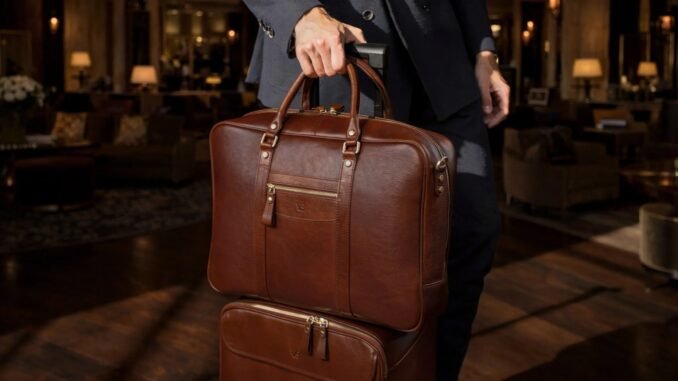
The carry-on gets the glory, but the personal item (backpack, tote, or briefcase — typically 18″x14″x8″ max) is where business-trip efficiency lives. What goes in it: laptop + chargers, travel documents, medications, valuables, a full change of clothes (the lost-luggage insurance — if your carry-on gets gate-checked and lost, you’re still functional), toiletries for the flight, snacks, water bottle, entertainment. The change of clothes is non-negotiable — one wrinkle-resistant outfit (knit top, ponte pants, undergarments) vacuum-packed flat takes almost no space and saves you if luggage goes missing. Organization: pouches by category (tech, documents, personal) — digging through a black hole of a tote at security wastes everyone’s time. The bag itself: a structured backpack or tote that slides over your carry-on handle — one unit moving through the airport, not two separate struggles. Between a well-packed carry-on and a strategic personal item, you’re carrying a full week of business capability that no airline can lose.
International Business Travel: Extra Considerations
Crossing borders adds layers to the carry-on system. Power: a universal adapter ($15) plus a small power strip (one adapter, multiple devices) — hotel rooms never have enough outlets. Documents: passport, visa if needed, printed hotel confirmations and invitation letters (immigration sometimes asks) — keep physical and digital copies separate. Medications: in original labeled containers, with prescriptions for anything controlled — some common US medications are restricted elsewhere. Connectivity: an eSIM or local SIM plan set up before departure beats roaming charges. Cultural dress codes: research before packing — some business cultures are more formal (pack the tie), some less; religious sites may require coverage. Time zones: the personal-item change of clothes matters even more on 12-hour flights. The system scales — it just needs these international modules added.
The practical takeaway: one neutral palette, 5 tops + 3 bottoms + blazer + 2 shoe pairs max, wrinkle-resistant fabrics, roll + bundle-wrap + packing cubes, bulkiest items worn on the plane, sink-wash midweek. Seven days of business polish in a carry-on isn’t minimalism — it’s just good systems.
Leave a Reply