
Your knees ache going down stairs. They click when you stand up. Maybe an old sports injury never quite healed, or maybe decades of desk life just caught up with you. How can I strengthen my knees without going to the gym? Here’s the thing most people get backwards: knee pain often isn’t a knee problem — it’s a muscle problem. The knee is basically a hinge caught between the hip and the ankle, and when the muscles around it (quads, glutes, hamstrings, calves) are weak, the joint itself absorbs forces it wasn’t designed to handle. Strengthen the scaffolding, and the knee usually feels dramatically better.
No gym, no machines, no expensive equipment. Everything here uses bodyweight plus maybe a chair and a resistance band. I’ve rehabbed my own cranky knees with exactly this approach after years of running on pavement with zero strength work — wish I’d started a decade earlier.
How Can I Strengthen My Knees Without Going to the Gym? The Key Muscles
Before the exercises, understand the team you’re training:
- Quadriceps (front of thigh) — the knee’s primary shock absorbers. Weak quads = more force through the joint.
- Glutes (especially gluteus medius, the side-butt) — control knee alignment. When they’re weak, knees cave inward (valgus collapse), grinding the joint.
- Hamstrings (back of thigh) — stabilize the knee from behind; quad-hamstring imbalance is a classic injury setup.
- Calves and foot muscles — affect how force travels up through the ankle into the knee.
The Home Knee-Strengthening Routine (20 Minutes, 3x Per Week)
Do 2–3 rounds of this circuit. Start with bodyweight; add a resistance band ($12–$15 on Amazon) when it gets easy.
- Wall sits: back flat against a wall, knees at 90 degrees, hold 20–45 seconds. The single best quad builder with zero equipment and zero knee impact.
- Step-ups: step onto a sturdy chair or bottom stair, drive through the heel, 10 per leg. Keep your knee tracking over your toes — don’t let it cave inward.
- Glute bridges: 15 reps, squeezing hard at the top. Add a band above the knees and press outward for glute medius.
- Terminal knee extensions: loop a band behind your knee anchored to a door, straighten the knee against resistance, 12 per leg. Targets the VMO (the teardrop quad muscle critical for kneecap tracking).
- Standing calf raises: 15 slow reps on a step, letting heels drop below the step level for a full stretch.
- Side-lying leg raises: 12 per side. Boring, humbling, and incredibly effective for the glute medius.
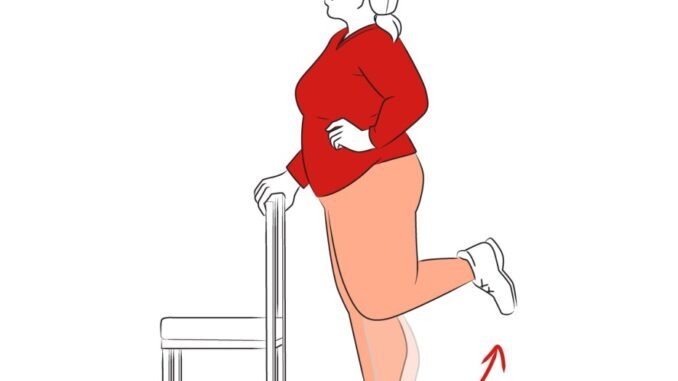
- Hamstring curls: standing, heel toward butt, 12 per leg. Slow and controlled.
Form rule that overrides everything: no sharp pain. Muscle burn and effort are fine; sharp, stabbing, or swelling-inducing pain means stop and get evaluated. Mild achiness that fades within a day is normal when starting.
Low-Impact Cardio That Loves Your Knees
Strength is half the equation; the other half is keeping the joint nourished and mobile without pounding it:
- Walking — flat surfaces to start. The benefits of daily walking apply fully to knees: movement pumps synovial fluid that nourishes cartilage.
- Cycling or stationary biking — the classic knee-friendly cardio. Low resistance, higher cadence.
- Swimming and water walking — buoyancy unloads the joint while resistance strengthens everything around it. Ideal if you’re significantly overweight or post-injury.
- Elliptical — if you have access to one, it’s the closest to running without the impact.
What to be cautious with until strength improves: deep lunges, full pistol squats, running downhill, and high-impact jumping. Not forever-banned — just earn them with strength first.
The Supporting Cast: Weight, Shoes, and Recovery
Body weight matters enormously. Every extra pound of body weight translates to roughly 4 pounds of force through the knee with each step. Losing even 10 pounds can feel like a new pair of knees — one of the highest-leverage interventions for knee osteoarthritis there is. If that’s a goal, intermittent fasting or simply a sustainable eating system can help without gym time.
Shoes: worn-out shoes with collapsed cushioning change your gait and load the knees unevenly. If your daily sneakers have 500+ miles on them, replace them. You don’t need $180 shoes — just not dead ones. Recovery: ice for 15 minutes after activity if a knee is warm or puffy; gentle heat before activity if it’s stiff. And don’t skip rest days — muscle (and tendon) strengthening happens during recovery, not during the workout.
When to See a Doctor or Physical Therapist
Home strengthening handles the common stuff — general achiness, stiffness, mild instability, post-desk-life weakness. Get professional evaluation for: a knee that locks, catches, or gives way; significant swelling that doesn’t resolve in a few days; inability to bear weight; pain after a specific injury (twist, fall, pop); or pain that worsens after 4–6 weeks of consistent strengthening. A physical therapist can diagnose movement patterns (often in 1–2 visits) that no article can. The American Academy of Orthopaedic Surgeons’ knee arthritis resources are excellent for understanding the common diagnoses.
The Warm-Up Your Knees Wish You’d Do
Five minutes of prep makes every workout kinder to your knees — and most people skip it entirely. Before walking, cycling, or your strength circuit: 1 minute of marching in place (warms the joint fluid), 10 leg swings per leg front-to-back (mobilizes the hip, which protects the knee), 10 bodyweight squats to a chair (wakes up the quads gradually), and 30 seconds of calf raises. That’s it — under 4 minutes. Cold, stiff joints absorb shock poorly; warmed-up joints distribute it. This matters doubly if you exercise in the morning, when joints are at their stiffest, or in cold weather. Think of it as brushing your teeth for your knees: unglamorous, quick, and the people who do it have dramatically fewer problems than the people who don’t. Your future workouts — and your stairs — will feel noticeably different.
The practical takeaway: 20 minutes, 3 times a week — wall sits, step-ups, glute bridges, band work, calf raises. No gym required. Pair with low-impact cardio like walking or cycling, keep your weight in check, replace dead shoes, and respect sharp pain. Most cranky knees are weak knees in disguise, and weak can be fixed at home.
Leave a Reply