
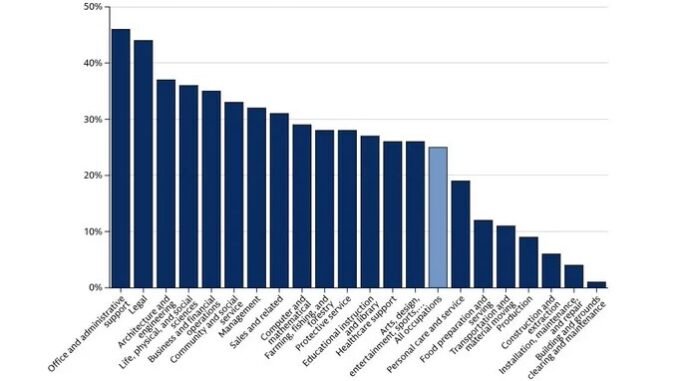
Every few months, another headline declares that AI will eliminate half of all jobs. Then you look around and the plumbers are booked six weeks out, nurses are in desperate demand, and your therapist isn’t going anywhere. The fear is real, but it’s also unfocused — and unfocused fear leads to bad career decisions. If you’re asking what jobs are least likely to be replaced by AI, here’s the evidence-based answer: not a list of “safe job titles,” but the underlying pattern of what AI can’t do — so you can evaluate any career, including yours.
The core principle: AI excels at pattern recognition, information processing, and content generation — work that happens with symbols on screens. It struggles with physical dexterity in unpredictable environments, genuine human trust and emotional connection, high-stakes judgment with accountability, and novel creative direction. Jobs built on the second list are the most durable. Let’s get specific.
What Jobs Are Least Likely to Be Replaced by AI? The Durability Framework
Researchers who study automation (including the well-known Oxford/Frey-Osborne work and its successors) keep converging on the same “bottlenecks” — capabilities that resist automation:
- Complex physical manipulation in unstructured environments (not factory assembly — that’s automated; but unpredictable physical work)
- Social intelligence: negotiation, persuasion, care, trust-building, reading people
- Creative originality: genuinely novel ideas, artistic vision, strategic innovation
- Accountability and judgment: decisions where a human must answer for the outcome
Jobs combining several bottlenecks are the safest. Jobs involving none are the most exposed. The Bureau of Labor Statistics occupational outlook data, cross-referenced with automation research, confirms the pattern: the fastest-growing occupations skew heavily toward human-centric and physical work.
The Most AI-Resistant Career Categories
Skilled trades (highest durability)
Electricians, plumbers, HVAC technicians, carpenters, welders — AI can’t crawl under your house, diagnose why the pipes bang only on Tuesdays, or rewire a 1920s home with undocumented modifications. The work is physical, unpredictable, and site-specific. Bonus: massive labor shortages mean strong wages (experienced electricians earn $60k–$100k+) and the shortages are growing as tradespeople retire. Our analysis of whether college degrees are losing value makes the ROI case for trades even stronger.
Healthcare (human touch roles)
Nurses, physical therapists, occupational therapists, home health aides, mental health counselors — healthcare combines physical care, emotional trust, and high-stakes judgment. AI assists diagnosis (see how AI is changing diagnosis) but the care remains human. An aging US population guarantees demand growth for decades. Note the distinction: roles centered on human contact are safe; roles centered on processing medical data or images face more pressure.
Education (relationship-based)
Teachers of young children, special education professionals, coaches, mentors — the core of teaching is human relationship and motivation, not information delivery (AI handles delivery fine). Our piece on teachers using AI shows the future: educators who wield AI tools become more effective, not obsolete.
Creative direction and novel problem-solving
Creative directors, novelists, research scientists, strategists, entrepreneurs — AI generates variations on existing patterns brilliantly but doesn’t originate genuine vision. The people who decide what to make (taste, judgment, originality) remain essential; the people who only execute formulaic creative work face pressure. The lesson: move up the judgment ladder in any creative field.
High-trust advisory roles
Therapists, financial advisors (fiduciary), lawyers (trial and counseling), clergy, social workers — roles where the human relationship is the product. Clients don’t just want correct advice; they want to be heard, understood, and guided by someone accountable. AI can draft the document but can’t sit across the table when it matters.
Physical-world problem solvers
Mechanics, appliance repair, locksmiths, chefs (high-end), farmers, construction managers — unpredictable physical environments plus judgment. Your car’s weird noise that only happens when turning left uphill in the rain? That’s a human diagnostic job for the foreseeable future.
Jobs Facing the Most Pressure (Be Honest With Yourself)
The flip side — roles centered on routine information processing:
- Data entry and basic bookkeeping
- Routine customer service (phone trees and scripted responses)
- Basic copywriting and content mills
- Simple graphic design (template-based)
- Paralegal document review (routine portions)
- Telemarketing and routine sales prospecting
- Basic financial analysis and report generation
If your job is on this list, the move isn’t panic — it’s repositioning toward the judgment, relationship, and creativity layers of your field, which our customer service AI analysis explores in depth for one affected industry.
Future-Proofing Any Career: The 5 Moves
- Become the AI wielder, not the AI competitor. In every field, the premium goes to professionals who use AI to produce 10x output. Learn your industry’s AI tools deeply.
- Move toward judgment. Routine execution gets automated; decisions, strategy, and accountability don’t. Climb toward the decisions.
- Invest in human skills. Communication, persuasion, empathy, leadership — these appreciate as automation spreads. They’re also the hardest to fake.
- Build a reputation. Trust is non-automatable. A strong professional reputation is career armor.
- Stay adaptable. The specific safe list will shift. The meta-skill — learning new tools and repositioning — is the ultimate insurance.
Quick Answers: AI-Proof Careers
Is going into the trades really a good hedge against AI?
The data says yes — and it’s not close. Electricians, plumbers, and HVAC techs face minimal automation risk (physical, unpredictable, site-specific work), earn strong wages ($60k–$100k+ experienced), and face growing labor shortages as workers retire. The ROI case versus expensive degrees keeps getting stronger.
Should I change careers if my job is at high risk?
Don’t panic-switch — reposition. Most at-risk roles have adjacent positions emphasizing judgment, relationships, and creativity (the automatable layers get stripped; the human layers remain). Start by becoming the AI power-user in your current field while building skills toward the judgment-heavy parts of it.
The bottom line: the safest jobs combine physical-world unpredictability, genuine human trust, creative judgment, and accountability — skilled trades, hands-on healthcare, relationship-based education, creative direction, and high-trust advisory work. But the deeper lesson applies to every career: don’t compete with AI at pattern matching; build your value where humans are irreplaceable. The question isn’t really “is my job safe?” — it’s “am I moving toward the parts of my work that only a human can do?”
Leave a Reply