
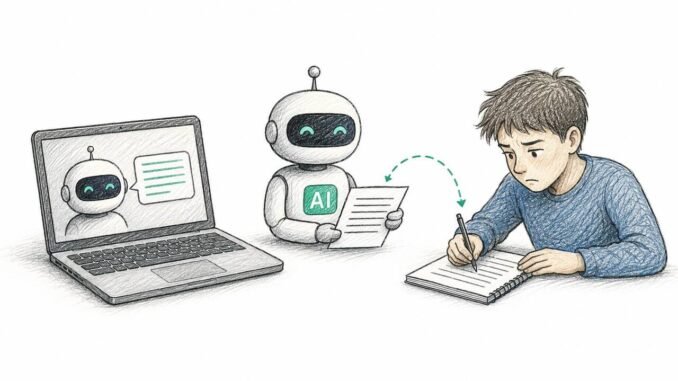
It’s 10pm, the essay is due tomorrow, and ChatGPT can write it in 30 seconds. The temptation isn’t just understandable — for a lot of students, it feels almost irrational not to use it. But before you outsource tonight’s homework, it’s worth asking honestly: what are the risks of relying too much on AI for homework? Not the lecture about cheating — the real, practical risks to your grades, your learning, and your future. Because the students getting hurt by AI overuse aren’t the ones getting caught. They’re the ones who never get caught.
I’m going to be straight with you: using AI for homework isn’t automatically bad. It’s a tool, and tools aren’t moral. But relying on it — letting it do the thinking while you do the submitting — creates problems that compound quietly over months and then detonate all at once. Usually during finals.
What Are the Risks of Relying Too Much on AI for Homework? The Learning Gap
This is the big one, and it’s invisible until it’s too late. Homework exists to build skills through practice — the struggle is the learning. When AI does the work:
- You don’t build the underlying skill. Every AI-written essay is a writing workout you skipped. Every AI-solved math problem is pattern recognition you didn’t develop. This compounds: next month’s material assumes you learned this month’s.
- Exams expose everything. Homework might be 30% of your grade, but exams are the other 70% — and you can’t bring ChatGPT into the testing room. Students who AI’d their way through homework routinely describe the shock of sitting down for a midterm and realizing they can’t do what their homework said they could.
- Foundational gaps cascade. This is brutal in cumulative subjects like math, science, and languages. Miss the fundamentals in September via AI shortcuts, and by November nothing makes sense — because everything builds on what you skipped.
Think of it like fitness: having someone else lift the weights for you doesn’t make you stronger. It just means you’re weak holding a participation trophy.
The Accuracy Problem: AI Is Confidently Wrong
AI chatbots don’t know when they’re wrong — they generate plausible-sounding text, and plausibility isn’t truth. For homework, this creates specific dangers:
- Fabricated citations: AI invents academic papers, quotes, and sources that don’t exist. Teachers check these. Getting caught submitting fake sources is an academic integrity violation far worse than a bad grade.
- Subtle factual errors: Dates, formulas, historical details — AI gets these wrong just often enough to tank an otherwise good assignment. You won’t catch errors in material you don’t understand (which, if AI did your learning, is all of it).
- Generic, shallow analysis: AI writes competent-sounding surface-level work. Teachers — especially good ones — recognize the difference between genuine engagement with material and polished emptiness. “Well-written but says nothing” gets a C, not an A.
Academic Integrity Consequences Are Getting Serious
Schools aren’t just warning anymore:
- Detection is improving — not just AI detectors (which are unreliable), but teachers comparing your in-class work to your homework, oral follow-ups, and process requirements like drafts and revision histories.
- Penalties escalate fast: A zero on the assignment is the mild outcome. Course failure, academic probation, suspension, and permanent marks on your record are all on the table at most schools now.
- College applications ask about it. Disciplinary history follows you. An academic integrity violation in high school can torpedo college admissions — a wildly disproportionate price for one essay.
For the classroom perspective on where the lines are drawn, see our guide on how teachers use AI without cheating concerns — knowing what teachers expect helps you stay on the right side. The U.S. Department of Education’s AI guidance also outlines how schools are expected to approach academic integrity in the AI era.
The Skill Atrophy Nobody Talks About
Beyond grades, there’s a deeper cost. The skills homework builds — writing clearly, reasoning through problems, managing frustration, thinking critically — are exactly the skills that remain valuable in an AI economy. Our analysis of jobs least likely to be replaced by AI keeps coming back to judgment, creativity, and deep understanding. Outsourcing your education to AI is selling the very abilities that will differentiate you from AI later. It’s a terrible trade.
Using AI Without the Risks: The Smart Approach
Here’s the thing — AI can help with homework without hurting you. The difference is who’s doing the thinking:
- Use AI as a tutor, not a ghostwriter. “Explain this concept like I’m 15” / “Give me practice problems on quadratic equations” / “Quiz me on these vocabulary words.” You’re still doing the work — AI is just making the work more effective.
- Use it for feedback on YOUR work. Write the essay yourself, then ask AI to critique the argument structure or flag unclear paragraphs. You revise. The learning happens in revision.
- Use it to understand, then close it. Stuck on a problem? Have AI explain the method step by step. Then close the tab and solve three similar problems yourself. If you can’t, you didn’t learn it yet.
- Use it for brainstorming and organizing. Outlines, idea generation, study schedules — AI excels at structure. You fill in the substance.
- Don’t have it write assignments you submit as your own.
- Don’t use it for work you haven’t attempted yourself first.
- Don’t trust its facts without verifying.
Parents: this is a conversation worth having directly, not just a rule worth imposing. Our guide on talking to kids about using AI responsibly can help frame it.
Quick Answers: AI and Homework
Is using AI for homework actually cheating?
It depends on how: having AI explain a concept you then apply yourself is studying; having AI produce work you submit as your own is academic dishonesty at most schools. The practical test: if you can’t do the work without the AI afterward, you didn’t learn it — and the exam will expose that.
The bottom line: the real risk of AI homework overuse isn’t getting caught — it’s graduating with credentials your abilities can’t cash. Use AI as a tutor, a feedback tool, and a study partner, and it makes you smarter. Use it as a ghostwriter and it makes you dependent, with the bill coming due at exam time and beyond. The students who thrive with AI aren’t the ones who use it most — they’re the ones who use it best.
Leave a Reply