
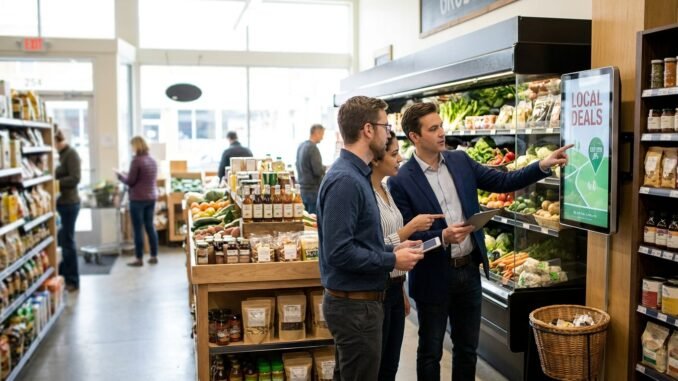
You’ve got a product you’re proud of — maybe a hot sauce, a candle line, handmade jewelry, or a specialty food item — and you keep picturing it on a real store shelf. Getting there feels mysterious from the outside, like there’s some secret handshake. There isn’t. If you’re asking how do I get my products into local stores, the process is straightforward: make your product retail-ready, research the right stores, pitch the buyer directly, and make the first order risk-free for them. Most local buying decisions are made by one person, often the owner, and they say yes far more often than you’d expect.
I’ve watched dozens of small makers go from farmers markets to store shelves, and the pattern is consistent: the ones who succeed treat it like a sales process, not a lottery. Here’s the playbook.
How Do I Get My Products Into Local Stores? Step 1: Become Retail-Ready
Before you pitch anyone, your product has to survive on a shelf next to professional brands. Buyers will reject you instantly if any of these are missing:
- Professional packaging: This is the #1 reason small products get rejected. Your packaging needs a clear product name, your brand, net weight/volume, ingredients (for food/cosmetics), and a barcode (UPC). You can buy legitimate UPC barcodes for around $30 each from GS1 US — don’t use cheap resold barcodes, they cause problems with bigger retailers later.
- Legal compliance: Food products need proper nutrition labels, allergen declarations, and in most states, production in a licensed commercial kitchen (cottage food laws cover only certain low-risk items). Cosmetics need ingredient listings per FDA rules. Check your state’s requirements before you pitch — a buyer will ask.
- Wholesale pricing that works: The standard retail formula: your wholesale price should be roughly 50% of the retail price (that’s “keystone” markup). If your candle retails for $24, wholesale is $12. Can you make it for $6 or less and still profit? If not, fix your costs before pitching — buyers won’t negotiate their margin.
- Consistent supply: Can you deliver 24, 48, 100 units on a regular schedule? A store that sells out of your product and can’t restock for a month will drop you.
Step 2: Research Stores Like a Detective
Don’t blast every store in town. Target 15–25 stores where your product genuinely fits the existing assortment:
- Walk the shelves: Visit in person. Note the price points, the packaging styles, and whether there’s a gap your product fills. Take photos (discreetly) of the relevant shelf section.
- Identify the buyer: In independent stores, it’s usually the owner or manager. Ask an employee: “Who handles buying for [category]?” Get a name.
- Check their vibe: A store that stocks only organic, local products won’t take your conventionally-made item no matter how good the pitch. Match their values.
- Start with independents: Boutique shops, gift stores, specialty food shops, salons, and coffee shops are your best first targets. Chains have corporate buying processes that are brutal for small suppliers — save those for later.
Step 3: The Pitch (Keep It Simple)
Forget fancy pitch decks. For local stores, this is what works:
The in-person visit
Walk in during a slow time (Tuesday–Thursday mornings are usually best — never weekends or lunch rush). Bring samples, a one-page sell sheet, and confidence. Your pitch should take 90 seconds:
“Hi, I’m [name] from [brand]. I make [product] right here in [town]. It retails at [price point], I wholesale at [price], and I’d love to leave you a sample. We sell really well at [other location or market] — customers keep coming back for [reason]. Can I leave this with you?”
That’s it. Don’t oversell. Leave the sample and the sell sheet, get their card or email, and follow up in one week.
Your one-page sell sheet should include:
- Product photos (good ones — this matters enormously)
- Wholesale and suggested retail prices
- Minimum order quantity (keep it low for first orders — 12 units is friendly)
- Your story in 2–3 sentences (local angle sells)
- Contact info and ordering process
- Any press, awards, or existing stockists
Step 4: Make the First Order Risk-Free
Here’s the secret weapon for getting that first yes: remove the buyer’s risk. Offer one of these:
- Small minimums: “Start with just 12 units” is much easier to approve than a 48-unit case.
- Sale-or-return (consignment) for the first order: “If it doesn’t sell in 60 days, I’ll take back what’s left.” Very few products actually get returned, but the offer gets you on the shelf.
- Free fill: Give them 6 free units with their first paid order. It costs you little and gets more of your product in front of customers.
- A demo or tasting: Offer to do an in-store sampling event. Stores love this — it drives foot traffic — and nothing sells a food or beauty product like trying it.
Step 5: Support Your Product After Placement
Getting on the shelf is only halftime. Products that don’t sell get discontinued — usually within 60–90 days. Your job now:
- Drive your own traffic: Post about the store on your social media. Tag them. Send your customers there. Stores notice which brands bring people in.
- Check in monthly: A quick visit or call: “How’s it moving? Need a restock?” This is also how you learn what’s working.
- Restock fast: An empty spot on the shelf is a lost sale and an annoyed buyer. Have inventory ready.
- Refresh seasonally: New flavors, holiday packaging, limited editions — give the buyer reasons to reorder and feature you.
One maker I know landed in 40 local stores in her first year with this exact approach. Her secret? She treated every store owner like a partner, not a customer, and she restocked within 48 hours every single time. Reliability beats a perfect product.
For the business side of things, make sure your finances can handle wholesale — our guide on managing cash flow month to month is essential reading since wholesale means waiting 30+ days for payment. And if you’re still building the brand behind the product, check out how to create a professional logo on a budget and the SBA’s marketing resources.
The bottom line: get retail-ready (packaging, barcode, pricing, compliance), target independent stores that fit, pitch in person with samples during slow hours, make the first order risk-free, and then support the heck out of your product once it’s on the shelf. Local buyers say yes to people they like selling products their customers will buy. Be both.
Leave a Reply