
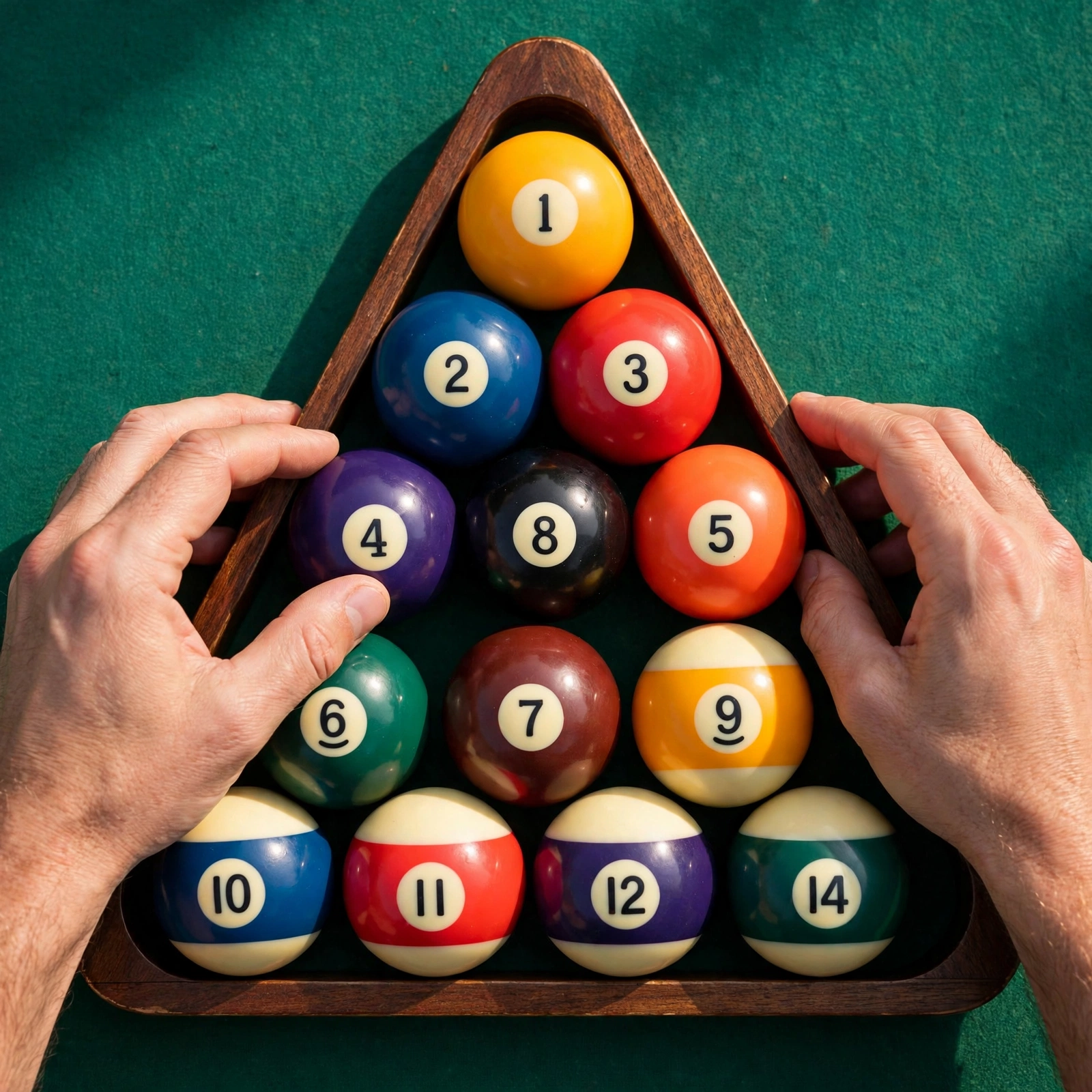
It sounds simple — put the balls in the triangle and play. But racking pool balls wrong causes more arguments and bad breaks than almost anything else in the game. Balls that are not racked tightly do not spread properly, the cue ball does not transfer energy evenly, and someone always claims the rack was rigged. Learning how to set up pool balls correctly takes about two minutes to learn and saves endless hassle. Here is the full guide for 8-ball and 9-ball, plus the tight-rack tricks experienced players use.
Why a Good Rack Matters
A proper rack is not just tradition. When all 15 balls touch each other with no gaps, the energy of the break travels through the pack evenly and the balls spread across the table. A loose rack absorbs energy in the gaps, so the break looks weak and the balls barely move. Worse, a sloppy rack can give the breaker (or the opponent) an unfair advantage. Tournament players obsess over racks for a reason — and once you know the rules, you will rack like one too. If you are still learning the game itself, read our beginner’s guide to how to play pool first.
How to Set Up Pool Balls for 8-Ball (Step by Step)
Eight-ball uses all 15 object balls plus the cue ball. Follow these steps:
Step 1: Find the Foot Spot
Look at the end of the table opposite the end where players break from. You will see a small spot (or mark) on the cloth about a quarter of the way from the foot rail. This is the foot spot. The apex (front) ball of the rack sits on this spot. If your table has no visible spot, estimate it: roughly one quarter of the table length from the foot cushion.
Step 2: Place the Triangle
Set the triangle rack on the table with its point facing the head of the table (toward the breaker). Place the apex ball — a ball with the number 1 on it by convention, though any ball works in casual play — directly on the foot spot, inside the front of the rack.
Step 3: Set the Corners
The two back corner balls of the triangle must be one solid and one stripe. This is an official rule in most eight-ball pool rule sets, and it keeps the rack fair so neither player gets an edge from the corner balls.
Step 4: Place the 8-Ball in the Center
The 8-ball always goes in the exact center of the triangle — the third row, middle position. This is the one placement rule that never changes.
Step 5: Fill the Rest Randomly
The remaining balls go in the other positions in any random order. In casual play, nobody cares about the exact arrangement. In league or tournament play, the order is random but the corner and 8-ball rules still apply. Just make sure you do not accidentally cluster all your solids or stripes together — spread them out for fairness.
Step 6: Tighten and Lift
This is the step most people skip. With the rack in place, press the balls forward and together with your fingers so every ball touches its neighbors — no gaps anywhere. Then lift the triangle straight up slowly, keeping the front of the rack as a pivot point so the apex ball does not roll. If any ball moves, set the rack back down and tighten again.
How to Set Up Pool Balls for 9-Ball
Nine-ball uses a diamond-shaped rack and only balls 1 through 9:
- The 1-ball goes at the apex (front of the diamond), on the foot spot.
- The 9-ball goes in the exact center of the diamond.
- The remaining balls (2 through 8) go in the other positions in random order.
- Tighten the rack the same way and lift slowly.
- how do i get started playing padel
- how to play pool
The 1-ball must be struck first on the break in 9-ball, which is why it sits at the front. Check the official racking rules if you play in a league, since some rule sets add extra placement requirements.
The Tight-Rack Trick
Getting a truly tight rack is a skill. Try these tips:
- Roll the rack forward: after placing all balls, slide the whole rack slightly forward toward the head of the table, then pull it back. This settles the balls against each other.
- Press with your thumbs: push the back row forward while holding the front of the rack steady.
- Check from table level: crouch down and look across the balls — gaps you cannot see from above become obvious.
- Wet the cloth slightly: in humid rooms the balls can stick to each other and roll when you lift. A quick wipe of the foot spot area with a dry cloth helps.
A rack so tight the balls barely move when you lift the triangle is a perfect rack.
Common Racking Mistakes
- 8-ball not in the center: the most common mistake in casual games. Center it every time.
- Two stripes or two solids in the back corners: always one of each in 8-ball.
- Lifting the rack too fast: the apex ball rolls off the foot spot and the whole rack shifts.
- Gaps between balls: any visible gap means a dead break. Tighten and re-lift.
- Racking with dirty balls: chalk dust and grime make balls cling and roll oddly. Wipe them down occasionally.
After the Rack: Breaking Tips
A perfect rack deserves a good break. Place the cue ball anywhere behind the head string (in the kitchen), aim at the apex ball with a touch of follow, and strike firmly with a level cue. You do not need maximum power — a controlled, accurate break with a tight rack spreads the balls better than a wild smash. And remember: in most casual rules, if you sink a ball on the break, you shoot again.
Frequently Asked Questions
Does the order of the other balls matter in 8-ball?
No. Apart from the 8-ball in the center and one solid plus one stripe in the back corners, the remaining balls can be placed randomly. Anyone who insists on a specific “lucky” arrangement is making it up.
Where exactly is the foot spot?
It is on the long center line of the table, one quarter of the table length from the foot rail (the end opposite the breaker). Most tables have a small spot or sticker marking it.
Can I rack with the triangle pointing the other way?
No — the apex (point) of the rack must face the breaker at the head of the table. A backwards rack is not a legal rack.
That is all there is to it. Set the apex on the foot spot, center the 8-ball, put one solid and one stripe in the back corners, fill the rest randomly, and tighten until no ball can move. Do this every game and your breaks will be cleaner, your games fairer, and nobody will ever argue about your rack again. For more precision-based fun, check our guide on how to improve archery accuracy, or learn how to make jewelry for a creative change of pace.
Leave a Reply