
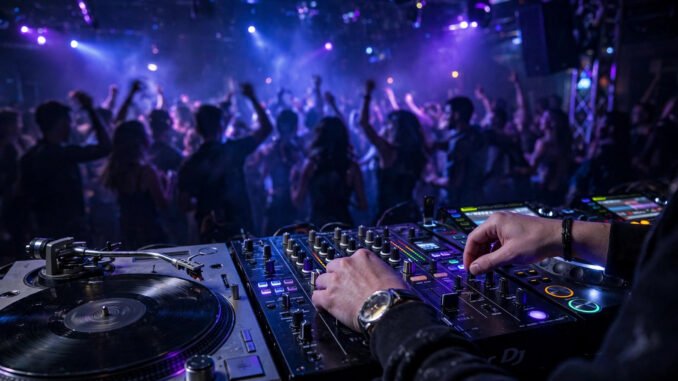
The door into DJing used to be guarded by price. Turntables cost serious money, records cost more, and the knowledge lived inside clubs you might never enter. That guard has stepped aside. A laptop you already own, free software, and a starter controller in the neighbourhood of $200 can put a working setup on your table tonight. With the money question shrunk, the honest question grows larger: what does the road from a first wobbly transition to a first real audience actually look like, month by month?
What the Job Actually Is
Strip away the lights and a DJ does three things at once. They read a room, sensing whether the floor wants energy raised, held, or released. They build and shape that energy across an hour or a night, choosing not just good songs but the right song for this exact minute. And underneath both jobs sits the craft: cueing tracks, matching tempos, phrasing transitions so musical sentences line up, and blending frequencies so two songs can share a moment without turning to soup. A fuller account of what a disc jockey actually does shows how old the role is and how much of it has always been judgement rather than equipment.
Modern software includes a sync button that aligns tempos for you. Use it without shame while you learn, and learn without it anyway. Sync aligns beats. It cannot choose your next record, hear that a transition needs four more bars, or notice a floor drifting towards the bar. Ears are the job. The phases below build those ears in order.
Phase One, Weeks 1 to 2: First Mixes for Zero Dollars
Your opening rig costs nothing. Install the free version of Rekordbox or Serato Lite on your laptop, load songs you already own, and control the software with your keyboard and mouse. Clumsy? Completely. Sufficient for the first lessons? Also completely.
Spend these two weeks on layout and counting. Learn where the decks, mixer channels, level meters, and headphone cue controls live until your hands stop hunting. Then count music the way DJs count it: beats group into bars, bars group into phrases, and most dance and pop tracks change something meaningful at the top of a phrase. Your single goal for the phase is one clean transition. Start the incoming track at the right phrase, blend it in without a level jump or a tempo stumble, and let the outgoing track leave with dignity. Record it. That recording, however rough, is your baseline.
Resist buying anything in this phase. Two weeks of keyboard mixing teaches you whether the activity itself hooks you, and it teaches the vocabulary that makes controller shopping sensible later. A surprising number of people discover they love selecting music but dislike mixing it, or the reverse, and either discovery is valuable and free.
Phase Two, Months 1 to 3: The Learner Rig
Once the habit survives its first weeks, hands-on control changes everything. Jog wheels let you nudge a track into alignment by touch. Real faders and EQ knobs turn blending from mouse arithmetic into muscle memory. Starter controllers in the Pioneer DDJ-FLX2 and DDJ-REV1 class sit around $180 to $250 at recent prices, and either style of layout can carry serious learning: one leans towards club-style decks, the other towards turntable-inspired performance. A used previous-generation controller, often around $100 to $150, teaches the same skills if it works properly and pairs with your software.
Headphones in this phase can be a pair you already own. What matters is the cue workflow: one ear on the room or speakers, the cued track in the headphones, lining up the next transition before the floor hears it. Practise that split listening until it stops feeling like a magic trick.
The centrepiece skill of these months is matching tempos by ear. The craft has a name and a long history, set out plainly under beatmatching explained: adjust the incoming track’s speed until its beats lock with the outgoing track, then hold them there. Drill it in short daily bursts, first with sync visible, then with the tempo display covered. You will chase beats, overshoot, and correct late. Then, somewhere in month two or three, corrections start arriving early. That shift, from reacting to anticipating, is the first real milestone of DJ craft.
Keep sessions short and frequent. Thirty focused minutes of transition drills teach more than a three-hour monthly marathon, because your ears tire and your mistakes start rehearsing themselves. End each session by recording one transition you are proud of and one that failed, and note why each happened.
Phase Three, Months 3 to 6: A Personal Sound
Technique without taste produces competent, forgettable sets. These months build the library and judgement that make your mixing yours. Start buying and organising music deliberately rather than hoarding at random. Beatport and Bandcamp sell individual tracks you can keep, and DJ pools supply edited versions built for mixing, with these sources together running roughly $10 to $50 a month depending on how much you take. Tag everything by energy and mood as well as genre, because on a real night you search by feeling at least as often as by category.
Record every practice mix in full, not just the clean transitions. Listening back the next day, away from the decks, exposes what performing hides: transitions that felt smooth but dragged, energy that sagged for ten minutes in the middle, a brilliant pairing you stumbled into and should keep. Keep a short list of pairings that worked. Professional sets are built from hundreds of those small certainties.
Play for friends before strangers. A living room audience of four teaches nerves, requests, and reading faces in a way solo practice never will. Expect a request that wrecks your plan. Handling it kindly while protecting the energy of the room is itself a core skill, and it can only be learned live.
Go out and study working DJs in real rooms as often as you can. Stand where you can see the floor and the booth. Notice when the room lifts, which record caused it, and what the DJ did during the quiet minutes to earn it. Nights out become cheaper research when you use how to get cheap tickets to concerts and live shows to keep the habit affordable, and every hour spent on a dancefloor as a listener sharpens the instincts you bring back to your own practice.
Phase Four, Months 6 to 12: First Audiences
The step from bedroom to audience is smaller than it feels. House parties for people you know, livestreams to a handful of viewers, community events, and early support slots in bars all count as real performances. Each one teaches the lesson practice cannot: a room has its own will, and your job is to negotiate with it in real time.
Prepare like a professional even when nobody is paying you. Arrive with more music than the slot needs, organised and backed up. Test your setup before the audience arrives. Bring spare cables and a simple fallback, such as a phone with a short emergency mix, because silence is the only unforgivable DJ failure. Play the slot you were given rather than the headline set in your head; an early warm-up played with restraint earns invitations that a peak-time imitation never will.
Gear upgrades belong here, after the habit exists and audiences are real. The committed tier centres on a mid-range controller in the $300 to $600 class, better headphones around $100 to $150, and a monitor speaker so you can hear your booth clearly at home and at small events. Bought in that order, after six months or more of steady practice, each piece solves a problem you have actually met. Bought in month one, the same pieces mostly solve boredom, briefly.
What It Costs, Restated Plainly
Three tiers cover the whole first year. The start costs $0: laptop, free software, music you own, keyboard control. The learner tier runs about $200 to $300: a starter controller in the range above, plus small costs such as cables or a first month of a DJ pool, using headphones you already have. The committed tier runs $800 to $1,500, hedged because prices move: a mid-range controller, proper headphones, a monitor speaker, and a growing music library across the year. Notice what is absent. No tier requires the flagship club setup, and no tier should be bought before the tier below it has been lived in.
The Money Question, Answered Honestly
Can DJing pay? For established acts, yes, sometimes well. Weddings and private events are the clearest example: experienced mobile DJs in many markets advertise in the $1,000 to $3,000 range per event, because they are selling reliability, equipment, music knowledge, and an insured business wrapped around the performance. That figure belongs to veterans with reviews, backup gear, and years of word of mouth behind them.
Hold the other half of the truth just as firmly. Most beginners earn nothing in their first year, and that is normal rather than a verdict on talent. The first year buys skill, a library, recordings, and a reputation among a small circle of people who have actually seen you play. Treat any talk of quick income as a warning sign about the person talking. DJing can grow into a business built over years of exactly the phases above. Learn it first because the craft itself, a room moving because of choices you made, is worth the year on its own terms.
Leave a Reply