
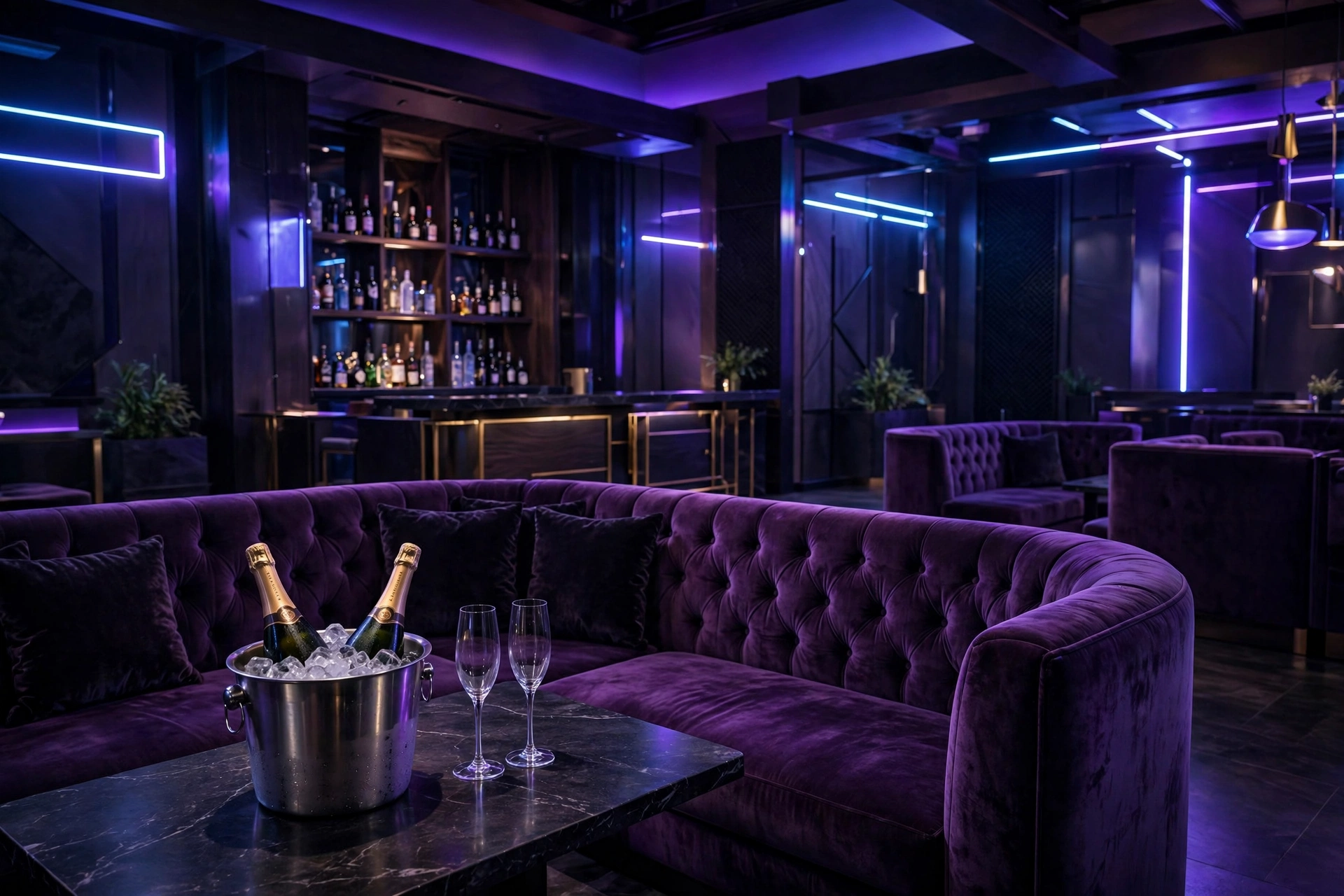
Walking past the line and into your own reserved section with bottle service is one of those classic nightlife experiences — birthdays, bachelor parties, reunions, or just a big night out with friends. But if you’ve never done it, the process can feel opaque. How do you book a club section? How much does it cost? What’s actually included?
This guide covers the whole process: finding the right club, understanding pricing, booking, and making the night go smoothly.
What a Club Section Actually Gets You
A booked section (also called table service or bottle service) typically includes:
- A reserved table or roped-off area for your group for the night
- Bottle service: One or more full bottles of liquor with mixers, garnishes, and ice
- A dedicated server who handles your drinks all night
- Skip-the-line entry for everyone in your party
- No cover charge for guests in your section (usually)
What it doesn’t include: the alcohol is the main cost driver. You’re paying a premium over retail — that’s the business model. A $30 bottle of vodka becomes a $300+ bottle at the club.
How Much Does It Cost?
Prices vary wildly by city, club, night, and section location:
- Small clubs / weeknights: $300–$800 minimum spend
- Mid-size clubs / regular weekends: $800–$2,000
- Major clubs in Vegas, Miami, NYC, LA: $1,500–$5,000+
- Prime sections (dance floor, DJ booth adjacent) on big nights: $5,000–$20,000+
- Special events (New Year’s Eve, big DJ headliners): Multiples of normal pricing
“Minimum spend” is the key concept: you commit to spending at least that amount on bottles and service. The minimum usually goes toward your bottles; tax and gratuity (often 20%+) are added on top. Always ask for the all-in number.
Step 1: Choose the Right Club and Night
- Match the vibe to your group. EDM mega-club? Hip-hop lounge? Upscale cocktail club? The section experience differs enormously.
- Check the calendar. Headliner DJs and holiday weekends spike prices. A regular Friday is often half the price of a special event Saturday.
- Read recent reviews. Clubs change management, and service quality varies. Look at recent Google and Yelp reviews, not ones from two years ago.
- Consider your group size. Sections typically fit 6–15 people. Too few people in a big section feels empty; too many in a small one is miserable.
Step 2: Contact the Club (Don’t Just Show Up)
You have three main booking routes:
Book directly with the club
Most clubs have a “bottle service” or “reservations” page, phone number, or Instagram. Calling or DMing gets you to the reservations team. This is usually the cheapest route — no middleman markup.
Use a promoter
Promoters are independent agents who bring groups to clubs. A good promoter can get you better section placement, waived minimums on slow nights, or extras thrown in. They earn commission from the club, so their service is typically free to you. Find them through the club’s Instagram or nightlife apps. Vet them: a legit promoter answers questions clearly and doesn’t demand cash upfront.
Use a booking platform
Apps and sites like Tablelist or Discotech let you browse clubs, see section options, and book with transparent pricing. Convenient, especially in unfamiliar cities, though prices may include a service fee.
Step 3: Understand the Deal Before You Commit
Ask these questions explicitly before booking:
- What is the minimum spend, and what does it include?
- How are tax and gratuity calculated? (Assume 25–30% on top of the minimum.)
- How many guests are included? What’s the cost per extra guest?
- What time does our section start, and when do we lose it if we’re late?
- Which bottles are included at this minimum? (Well vs. premium brands differ.)
- Is there a dress code? (Almost always yes — ask specifics.)
- What’s the cancellation policy?
Get the key terms in writing — text, email, or booking confirmation. Verbal promises from a promoter at 1 AM are worth nothing.
Step 4: Plan the Night
Split costs in advance
Decide how the bill splits before the night. Equal splits are simplest. Collect money upfront via Venmo — chasing people for $200 at 2 AM ruins friendships.
Arrive on time
Sections are typically held until a set time (often midnight or 12:30). Late arrival can mean losing your table or getting bumped to a worse spot. Aim to arrive 30 minutes before your reservation time.
Dress the part
Most clubs enforce dress codes strictly for section guests: collared shirts and dress shoes for men, no athletic wear, no shorts, no flip-flops. Check the specific code — getting turned away at the door with a $1,500 reservation is a special kind of pain.
Bring ID and the card
The person who booked usually needs to present ID and the credit card used for the reservation. Some clubs pre-authorize the minimum spend.
Night-Of Tips
- Pace yourselves. Bottle service makes it easy to drink fast. Eat beforehand and hydrate.
- Tip your server in cash beyond the auto-gratuity if service is great — it genuinely improves your night.
- Know your server’s name. You’ll get faster refills.
- Keep valuables minimal. Crowded clubs and dark sections are prime spots for lost phones.
- Arrange rides home in advance. Non-negotiable.
Cheaper Alternatives Worth Considering
Full bottle service isn’t the only way to skip the line:
- Guest list: Many clubs offer free or reduced entry via online guest lists — no section, but no cover.
- Pre-sale tickets: Buying tickets in advance is far cheaper than paying cover at the door.
- Bar seating: Some venues offer reserved bar areas with a lower minimum.
- Weeknights: Same club, same section, half the minimum on a Thursday.
The Bottom Line
Booking a club section is straightforward once you know the mechanics: pick your club and night, contact reservations or a promoter, nail down the all-in cost in writing, split the bill in advance, and show up on time dressed right. Do that, and you’ll skip the line and actually enjoy the night instead of managing logistics from the dance floor.
Planning a bigger celebration? Our guide to baby shower basket ideas covers the daytime-party equivalent of going all out — and if you’re organizing any major event on a deadline, planning a wedding in six months has transferable timeline wisdom.
How the Nightclub Business Works
Understanding the business model helps you navigate it. Understanding how nightclubs operate helps: the business revolves around a simple equation: the venue makes its money on alcohol markup, and everything else — the DJ, the lighting, the door policy — exists to get high-spending groups inside. Bottle service sections are the most profitable square footage in the building, which is why clubs compete aggressively for section bookings and why promoters exist. Knowing this gives you leverage: on slower nights, clubs would rather fill a section at a discount than leave it empty, so don’t be afraid to negotiate.
Bottle Service: Industry Context
Bottle service as a concept was popularized in the late 1990s and 2000s, and the bottle service industry overview shows how thoroughly it reshaped nightlife economics. What began as a VIP perk in a few major clubs became the dominant revenue model for upscale venues worldwide. The key insight for bookers: the “minimum spend” isn’t a fee — it’s a pre-commitment to buy product. You’re not paying $1,500 for a table; you’re committing to buy $1,500 worth of marked-up alcohol. Framed that way, the value proposition depends entirely on how much your group would drink anyway.
Safety and Etiquette for Section Guests
- Watch your drinks. Sections feel private but they’re still public venues. Keep bottles and glasses within your group’s area.
- Respect the staff. Servers, security, and bussers deal with difficult guests all night. Politeness gets you better service; attitude gets you cut off.
- Know the house rules. Most clubs prohibit outside food/drink, and many restrict photography in VIP areas. Ask rather than assume.
- Have an exit plan. Designate a sober coordinator, pre-book rides, and set a meeting point. The night ends well when the ending is planned.
- Don’t over-invite. Every extra person dilutes the experience and complicates the bill split. The right group size beats the biggest group size.
Leave a Reply