
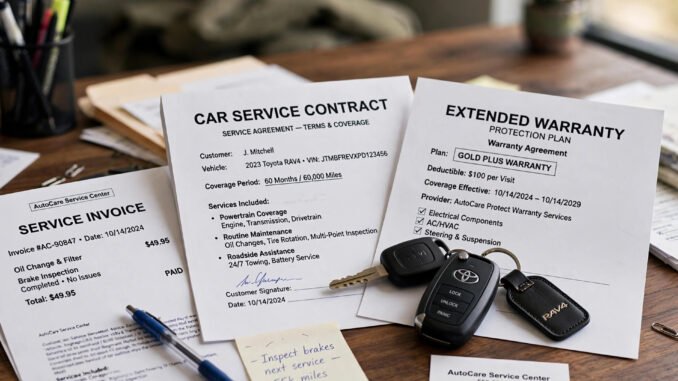
You are in the finance office, exhausted from negotiating the car price, and now comes the pitch: “For just $2,800, we can extend your warranty to 7 years/100,000 miles. Given how expensive repairs are these days…” You are tired, the number sounds almost reasonable, and everyone warns you about repair costs. Should you buy it? For most beginners, the answer is no — but the full picture is more nuanced than the internet’s blanket “never buy” advice.
This guide explains how extended car warranties actually work, when they make sense, when they are a waste, and how to buy one properly if you decide you want it.
What Extended Warranties Actually Are
First, terminology: “extended warranty” is marketing. These are vehicle service contracts — insurance-like products where you pay upfront (or financed) and the contract administrator pays for covered repairs later. Key distinctions:
Manufacturer-backed (OEM) plans: sold by the automaker (Toyota Extra Care, Honda Care, Ford Protect). Honored at any dealer nationwide, use OEM parts, and have the fewest claim disputes. The only type worth considering.
Third-party plans: sold by independent companies — including most of what dealerships push hardest (highest commissions). Coverage varies wildly, claim denial rates are higher, and companies can (and do) go bankrupt, voiding your contract. The CFPB and state attorneys general regularly take action against deceptive third-party warranty sellers.
What they cover: plans range from “exclusionary” (covers everything except listed exclusions — the best) to “stated component” (covers only listed parts — read carefully) to “powertrain only” (engine, transmission, drivetrain — the cheapest and narrowest). The coverage tier matters more than the brand name.
The Math: Why They Are Usually a Bad Deal
Vehicle service contracts are priced so the seller profits — meaning the average buyer loses. Industry loss ratios (percentage of premiums paid out in claims) run 50–65%, versus ~85% for auto insurance. Translation: for every $2,500 you pay, expect ~$1,250–$1,625 back in covered repairs on average.
The expected-value calculation for a typical buyer:
Cost: $2,000–$3,500 for a mid-tier plan on a mainstream car.
Expected covered repairs (years 4–7 on a reliable car): $800–$1,500 for most owners. Reliable cars (Toyota, Honda, Mazda) simply do not break much in this window.
Expected net: −$1,000 to −$2,000. You are paying a premium for peace of mind, not making a financial investment.
The rational alternative: self-insure. Put the $2,800 in a high-yield savings account as a car-repair fund. Statistically you will come out ahead — and the money is yours whether the car breaks or not. This is what financially sophisticated buyers do, and it is the single best advice in this guide.
When Extended Warranties DO Make Sense
Blanket “never buy” advice ignores real situations where the math or psychology favors coverage:
1. Unreliable or complex vehicles. European luxury cars, vehicles with known expensive failure modes (certain transmissions, air suspension, complex electronics), or models with poor reliability records. When expected repairs are $4,000–$8,000, a $2,500 exclusionary plan can have positive expected value. Check Consumer Reports reliability ratings for your specific model — this is the data-driven trigger.
2. You cannot absorb a surprise $3,000 bill. If a transmission failure would mean credit card debt or missing rent, the warranty’s value is not just financial — it is the avoidance of a debt spiral. Insurance exists for risks you cannot afford, and for tight-budget buyers, that logic applies. (Though building the repair fund remains the better long-term play.)
3. You keep cars long-term. The value concentrates in years 5–8 and miles 70,000–120,000. If you sell at year 4, you paid for coverage you barely used (some plans are transferable or refundable pro-rata — check terms).
4. Peace of mind has real value to you. Not everything is expected-value math. If warranty coverage genuinely reduces your anxiety and you can afford it, that is a legitimate purchase — just make it eyes-open, not pressured.
How to Buy One Properly (If You Decide To)
Never buy in the finance office under pressure. You can buy manufacturer-backed plans anytime before the factory warranty expires — often cheaper online from high-volume dealers (many sell Honda Care, Toyota Extra Care at $500–$1,000 below your local dealer’s price). The finance office is the most expensive place to buy.
Choose exclusionary coverage from the manufacturer. “Everything except listed exclusions” beats “only listed components” decisively. Read the exclusion list — wear items (brakes, tires, wipers), maintenance, and pre-existing conditions are always excluded.
Negotiate the price. Warranty prices are negotiable with huge margins — dealers routinely discount $500–$1,000 when pushed. Get quotes from multiple dealers (email works).
Understand the deductible and claim process. Per-visit or per-repair deductibles ($0–$200), whether you can use independent shops or only dealers, and prior-authorization requirements. The cheapest plan with a terrible claim process is the most expensive plan.
For context on the insurance logic, whether you need business insurance for a home business applies the same expected-value thinking, as does choosing the right health insurance plan — insurance decisions share a common framework.
The Alternatives Worth Considering
Certified pre-owned (CPO): manufacturer-backed extended coverage baked into the purchase price, often 1–2 years beyond the original warranty. Frequently better value than buying a plan separately.
New-car factory warranty maximization: some brands offer notably long standard warranties (Hyundai/Kia: 5yr/60k basic, 10yr/100k powertrain; Mitsubishi similar). Choosing a brand with a long factory warranty is free extended coverage.
The repair fund: $2,500–$3,000 in a dedicated savings account. Covers the average buyer’s actual repair costs with money left over, earns interest, and never denies a claim. The mathematically superior choice for reliable cars.
The Insurance Information Institute’s guidance on service contracts is worth reading before signing anything.
Conclusion
Extended car warranties are usually a bad deal — priced for seller profit, with 50–65% loss ratios — and the smart money self-insures with a dedicated repair fund. They make sense in specific cases: unreliable/complex vehicles, buyers who cannot absorb surprise repairs, long-term keepers, and those who value the peace of mind eyes-open. If you buy, do it later (not in the finance office), choose manufacturer-backed exclusionary coverage, negotiate hard, and never buy third-party plans from cold callers. The best warranty decision is usually the one you make calmly, at home, weeks after the purchase.
Frequently Asked Questions
Can I buy an extended warranty after leaving the dealership?
Yes — manufacturer-backed plans can typically be purchased anytime before the factory warranty expires (usually 3yr/36k miles), often cheaper from high-volume online dealers. Never let “today only” pressure rush this decision.
Are third-party extended warranties scams?
Not all, but the category is rife with problems: higher denial rates, bankrupt administrators, and aggressive robocall marketing. Manufacturer-backed plans are categorically safer. If considering third-party, research the administrator’s financial stability and complaint history thoroughly.
What voids an extended warranty?
Missed scheduled maintenance (keep records), modifications (tunes, lifts), commercial use on personal plans, pre-existing conditions, and odometer fraud. The maintenance-records requirement is the most common claim-denial trigger — keep every receipt.
Can I cancel an extended warranty for a refund?
Usually yes — most contracts allow cancellation with pro-rata refunds (minus a fee) within the coverage period. If you sell the car, cancel and recover the unused portion rather than leaving money on the table.
Do extended warranties cover wear and tear?
Generally no — brakes, tires, wipers, belts, and other wear items are excluded from virtually all plans. Warranties cover mechanical/electrical failures, not maintenance or consumables. Read the exclusion list before buying, always.
Leave a Reply