
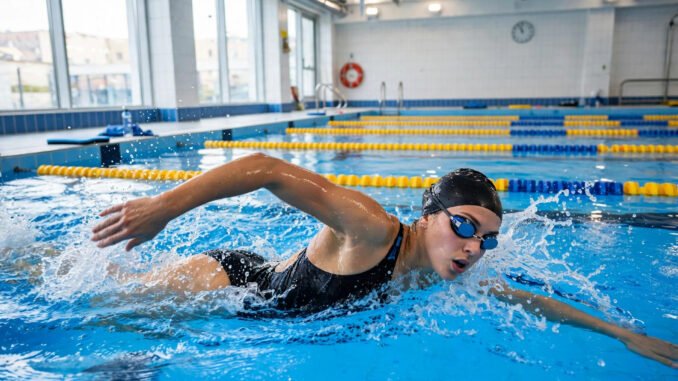
Yes. Two forty-five-minute swims a week is enough to get genuinely fitter. That short answer holds for most healthy adults, as long as the two sessions are swum with purpose rather than drifted through. Together they give you ninety minutes of moderate to vigorous exercise, they train your heart, lungs, back, shoulders, core, and legs at the same time, and they do it without the joint pounding that puts many people off running. The gains also arrive on a fairly predictable schedule, which helps you stick with the plan long enough to see them.
This is general information about exercise, not medical advice for any one person. If you have a heart condition, breathing trouble, or a shoulder problem, check with a clinician before you build a routine around any new exercise. With that said, for a beginner who can swim safely and wants a routine that fits a busy week, twice a week is a strong place to start.
Why Twice a Week Works
Start with the arithmetic. The CDC guideline for adults calls for one hundred and fifty minutes of moderate aerobic activity a week. Two forty-five-minute swims give you ninety of those minutes on their own. Ordinary daily walking, the school run, stairs at work, a dog walk in the evening, clears much of the rest for most people. You are not sneaking under the bar with a technicality. You are getting most of the way to a widely used public health target with two pool visits, then topping it up with movement you already do.
Water itself does part of the work for you. As a look at swimming as a sport and exercise makes clear, you move through a medium far denser than air. Water is commonly said to offer roughly a dozen times the resistance of air, and while that figure is an approximation, the feel of it is not. Every pull and kick pushes against real resistance. So a swim is never only cardio. Each stroke is also light resistance work for the back, shoulders, core, and legs, repeated hundreds of times in a session.
That mix explains the calorie numbers, which should be read honestly. Many adults burn roughly three hundred to five hundred calories in forty-five minutes of swimming, depending on body size and effort. A gentle session sits near the low end. A steady session with intervals sits higher. Those are estimates, not promises, and food intake still decides what happens to weight over time. What the swim reliably gives you is fitness, the ability to do more before you get out of breath, and that arrives whether the scale moves fast or slowly.
Frequency matters as much as the total minutes. Two sessions spread across the week give your body a training signal, a day or two to recover and adapt, then another signal before the effect fades. One long swim a week is harder to recover from and easier to skip. Three or more sessions can be great, but they are not required for real progress at the start. Twice a week hits the point where consistency, not volume, does the heavy lifting, and most of the benefit, for most people, comes from showing up to those two sessions week after week.
The Two Sessions
Give each swim a different job. If both sessions are the same slow plod, boredom grows and fitness stalls. One endurance swim and one technique and intervals swim cover different ground, keep the week interesting, and together train the two things a new swimmer needs most, an engine and a cleaner stroke.
Session A: Endurance, 45 to 50 Minutes
Warm up with four easy lengths, any stroke, at a pace that lets your shoulders loosen and your breathing settle. Then swim continuously for twenty-five to thirty minutes at a pace where you could speak in short sentences if you stopped. That short-sentence pace is a practical test. You are working, your breathing is up, but you are not gasping or sprinting.
If continuous swimming is not there yet, there is no shame in building toward it. Alternate two lengths of swimming with thirty seconds of rest at the wall. Repeat that pattern for the main block. Each week, shrink the rests a little, or add a length before each rest, until the gaps close. Most beginners who follow that simple path find continuous swimming arrives within a few weeks.
Most of this session will be the front crawl stroke, since it is the fastest and most efficient stroke for fitness swimming, but mixing in backstroke or breaststroke for a length now and then is fine. Cool down with four easy lengths of backstroke, letting your breathing slow before you get out. Across the whole session, total distance usually lands around one thousand two hundred to one thousand eight hundred yards, depending on your pace. The distance is a result, not a target to chase at the cost of good form.
Session B: Technique and Intervals, 45 Minutes
Warm up with four easy lengths again. Then swim eight times twenty-five yards of drills, resting briefly between each. Three drills cover most beginner faults. In the catch-up drill, one hand waits at the front until the other hand arrives, which teaches patience and body rotation. In fingertip drag, the recovery hand drags its fingertips lightly across the water, which encourages a high elbow. Side kicking, done on your side with one arm extended, teaches a balanced body position.
After the drills, swim six times fifty yards at a comfortably hard effort, with twenty seconds of rest between each. Comfortably hard means you finish each fifty glad it is over, but you could repeat the same pace after the rest. If your stroke falls apart, you went too fast. Slow down just enough to hold your form, because fast swimming with a broken stroke teaches the broken stroke.
What Results Arrive When
In weeks one to four, the biggest gains are skill gains. You will feel dramatically better in the water before you are much fitter, because your brain is learning efficient movement. Breathing finds a rhythm. You stop fighting the water and start sliding through it. Do not mistake this early ease for a lack of progress. Learning to waste less energy is progress, and it is what later fitness gains are built on.
Between weeks six and twelve, real fitness starts to show. Resting breathing feels easier. Continuous distance climbs. The interval session that once needed every second of its rests begins to feel controlled. Clothes may fit a little differently, and everyday tasks like stairs or carrying shopping ask less of you. This is the stretch where most swimmers say the routine has clicked, usually because they stopped missing sessions.
From months four to six, many swimmers meet a plateau. The same two sessions, swum at the same paces, stop producing change because your body has adapted to them. That is a sign the plan worked, not that it failed. To break through, add a third shorter session if your week allows it, or sharpen the interval day by making the hard fifties a touch faster or the rests a touch shorter. Change one variable at a time, hold it for a few weeks, and judge the result.
Making It Happen
The plan only works if the two slots survive real life. Put them in your calendar at fixed times, on fixed days, and treat them like appointments you would not casually move. Choose a pool within easy reach of home or work. A perfect pool forty minutes away loses to a plain pool ten minutes away, every single week, because travel time is where good intentions go to die.
Pack your bag the night before and leave it by the door. Goggles that fit, a towel, and a spare pair of goggles for the day the strap snaps will save more sessions than any pep talk. If pools are not your usual world, it may help to compare this routine with the best exercise for beginners who hate the gym, because the right exercise is always the one you will still be doing in six months.
People often ask whether swimming pairs with running. Yes, they pair well. Swimming builds aerobic fitness with no impact, and running builds bone strength and land fitness the pool cannot give. Keep one easy day between hard sessions in either sport, so a hard interval swim does not sit back to back with a hard run. On tired weeks, let one sport go easy rather than pushing both.
Frequently Asked Questions
Will swimming twice a week help me lose weight?
It helps, because it burns energy and builds fitness you can use everywhere else. But food decides weight. Swimming, especially in cool water, can sharpen appetite, and a large snack after every swim can wipe out the session’s burn without you noticing. Enjoy the swim, eat normal balanced meals, and let the deficit be modest and steady if weight loss is your goal.
Will I get bored swimming the same thing twice a week?
You are not swimming the same thing. The endurance day and the technique and intervals day feel very different, and both change as you progress, longer continuous blocks in one, sharper intervals in the other. Boredom usually comes from endless identical laps with no purpose. Two distinct sessions with clear jobs are the fix already built into this plan.
Do I need to be a good swimmer to start?
No. You need to be safe in the water and able to swim one length without panic. If you cannot do that yet, take lessons first and build basic safety and confidence, then start this routine. Many adult beginners begin exactly there, and pool lifeguards and instructors see it every week.
What about my shoulders?
Shoulders carry a lot of the work in swimming, so respect them. Keep volume increases gradual, keep technique clean, and stop a drill that pinches or hurts. Persistent shoulder pain is a stop-and-check signal. Do not push through pain that lingers from session to session. Get it looked at, rest it, and return when you have a clear answer on what caused it.
Two swims a week will not turn you into a racer by spring, and no honest plan should claim it will. What it will do, reliably, is make you fitter, stronger in the water, and more capable on land, on a schedule a real life can hold. That is enough. Start with the next two slots in your calendar, and let consistency do the rest.
Leave a Reply