
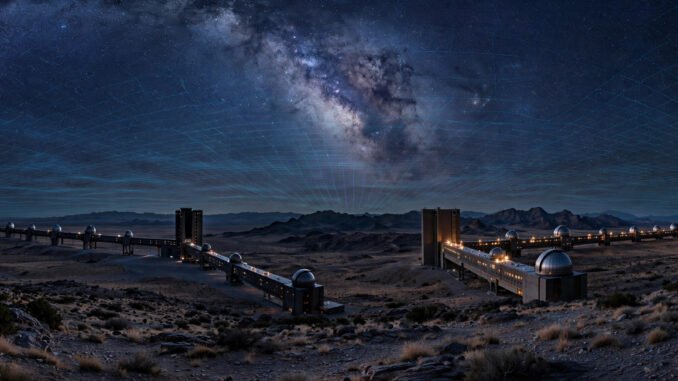
In 1915, Albert Einstein predicted that the most violent events in the universe — colliding black holes, merging neutron stars — would send ripples through the very fabric of space and time. A full century later, in September 2015, scientists felt one of those ripples pass through Earth: a distortion thousands of times smaller than a proton, caught by detectors in Louisiana and Washington State. It was humanity’s first direct detection of gravitational waves, and it opened an entirely new sense for observing the cosmos. Here is the part nobody tells you: understanding all of it — the physics, the machines, the discoveries — costs exactly zero dollars. No tuition, no textbook, no telescope required.
What Gravitational Waves Actually Are
Forget the word “gravity” for a moment and think about spacetime as a vast, invisible trampoline stretching in every direction. Everything with mass sits on that trampoline and dents it — that dent is what we experience as gravity. Now imagine two black holes spiraling into each other on that trampoline. They don’t just sit there denting it; they thrash around so violently that they send ripples racing outward across the surface. Those ripples are gravitational waves.
When a gravitational wave passes through you, it alternately stretches and squeezes space itself — you get slightly taller and thinner, then slightly shorter and wider, then back to normal. The effect is absurdly tiny by the time it reaches Earth. The wave detected in 2015 changed the length of a 4-kilometer detector arm by about one ten-thousandth the width of a proton. Your body experiences the same stretching from distant cosmic collisions right now, and you will never feel it. The waves travel at the speed of light, carry information about events no telescope could ever see, and pass through everything — planets, stars, you — completely unbothered.
How We Caught One: The Most Absurd Measurement Ever Made
The detectors that caught that first wave are called LIGO — the Laser Interferometer Gravitational-Wave Observatory — with sites in Hanford, Washington and Livingston, Louisiana. Each site is essentially a giant L-shape with arms 4 kilometers long. A laser beam is split down both arms, bounced off mirrors, and recombined. If a gravitational wave stretches one arm while squeezing the other, the laser light arrives slightly out of sync, and that mismatch is the signal.
Saying it simply undersells the insanity of it. To work, LIGO’s mirrors must be isolated from every earthly vibration: passing trucks, ocean waves crashing on distant shores, even tiny seismic grumbles. The 2015 detection, named GW150914, came from two black holes — about 29 and 36 times the mass of our sun — merging 1.3 billion light-years away. In the final fraction of a second, they converted about three suns’ worth of mass directly into gravitational-wave energy. The signal lasted two-tenths of a second and swept upward in frequency like a chirp. Scientists literally turned the data into sound, and you can listen to that chirp for free today.
The Free Learning Path: From Curious to Conversant
You can go from “never heard of it” to “can explain it at dinner” in a couple of weekends without paying anything. Here is the path that actually works.
Start with the story, not the math
Begin at the LIGO Laboratory’s official website, which has plain-language explainers, timelines, and the full catalog of detections written for non-physicists. The story of the 2015 detection — including the fact that it arrived during an engineering test run, before the official observing run even started — is genuinely dramatic and gives every abstract concept a human anchor.
Watch the right twenty minutes
PBS Space Time and Fermilab’s YouTube channels both have free episodes on gravitational waves that use visuals to do what equations can’t. Watch one episode on what the waves are and one on how LIGO works, and the core picture will click. The animations of black hole mergers alone are worth it.
Touch the real data
This is the part that feels like a superpower: LIGO’s Open Science Center publishes actual detector data from real events, free to download, with tutorials aimed at students. You can pull up the strain data from GW150914 — the actual wobble measured on September 14, 2015 — and plot the famous chirp yourself using free Python tools. Nobody is gatekeeping this; the collaboration releases it deliberately so anyone can verify and learn.
Read the paper (yes, really)
The discovery paper, “Observation of Gravitational Waves from a Binary Black Hole Merger,” is on the free arXiv preprint server. You won’t follow every equation, and that’s fine — read the abstract, the introduction, and the conclusion. Getting comfortable skimming real papers is the single fastest way to stop feeling like an outsider to science.
Five Misunderstandings Worth Dropping
They’re not ocean-style “gravity waves.” Atmospheric scientists use “gravity waves” for ripples in air and water driven by buoyancy. Gravitational waves are ripples in spacetime itself, predicted by general relativity. Different phenomenon, confusingly similar name.
The “chirp” isn’t sound traveling through space. Space is silent; there’s no air to carry sound. The chirp is data sonification — scientists mapped the wave’s rising frequency onto audio so human ears could grasp the pattern. It’s a translation, not a recording.
LIGO doesn’t “see” anything. It measures distance changes with laser light. Gravitational-wave astronomy is more like listening than looking, which is exactly why it reveals things telescopes can’t: black hole mergers emit no light at all.
They don’t affect your daily life. The stretching is real but incomprehensibly small. No health effects, no earthquakes, no tides. Anyone selling you gravitational-wave wellness products is selling fiction.
Einstein wasn’t “proven right” so much as given a new instrument. General relativity had already passed every test for a century. What the detection gave us wasn’t confirmation — it was a new sense organ for the universe.
Why 2026 Is a Great Time to Learn This
The field has exploded since 2015. The catalog now holds around a hundred confirmed detections, including neutron star mergers that were seen in both gravitational waves and ordinary light — the 2017 event GW170817 let astronomers watch heavy elements like gold being forged in real time. In 2023, pulsar timing collaborations including NANOGrav found evidence of a background hum of gravitational waves from pairs of supermassive black holes grinding together across cosmic time. And the European Space Agency’s LISA mission — three spacecraft flying in a triangle millions of kilometers wide, a space-based LIGO — is moving toward launch in the 2030s. Learning the basics now means you’ll actually understand the headlines when the next big detection drops. If cosmic-scale weirdness hooks you, these sci-fi books that bend gravity and spacetime make excellent companion reading, and the pattern-spotting tricks behind the detections share DNA with the techniques used to check whether a photo or video was made by AI — faint real signals hiding in noise.
So the honest answer to the question: the best way to understand gravitational waves without wasting money is to follow the data. Start with LIGO’s free explainers, watch one good visual episode, download the actual chirp from the Open Science Center, and skim the discovery paper. Total cost: zero. Total time: a couple of curious weekends. You’ll end up understanding one of the deepest ideas in modern physics — that space itself can ripple — using the same data the discoverers used. Einstein needed a century for the universe to prove him right. You just need an internet connection.
Frequently Asked Questions
Do I need to understand math to get gravitational waves?
No. The core idea — violent cosmic events ripple spacetime, and we measure the ripples with lasers — needs no equations. Math deepens the picture later, but the conceptual understanding is fully available in plain English through LIGO’s free materials and science explainers.
Can gravitational waves be used for communication or travel?
Not practically. They carry enormous energy at the source but interact so weakly with matter that detecting them took the most sensitive instrument ever built. No one has proposed a realistic way to generate or modulate them for communication.
How many gravitational wave detections have there been?
Around one hundred confirmed events as of 2026, nearly all merging black holes, plus a few neutron star mergers. New observing runs add more each year, and the public catalog on the LIGO website lists every one with plain-language summaries.
What is LISA and when does it launch?
LISA (Laser Interferometer Space Antenna) is ESA’s planned space-based gravitational-wave detector: three spacecraft in a triangle with million-kilometer arms, designed to catch waves from supermassive black hole mergers. It’s targeting a mid-2030s launch, with NASA contributing as a partner.
Is the data really free for anyone to download?
Yes. The LIGO Open Science Center releases strain data from observing runs along with tutorials, explicitly so students, educators, and curious outsiders can work with the same measurements the scientists used. No account fees, no paywalls.
Leave a Reply