
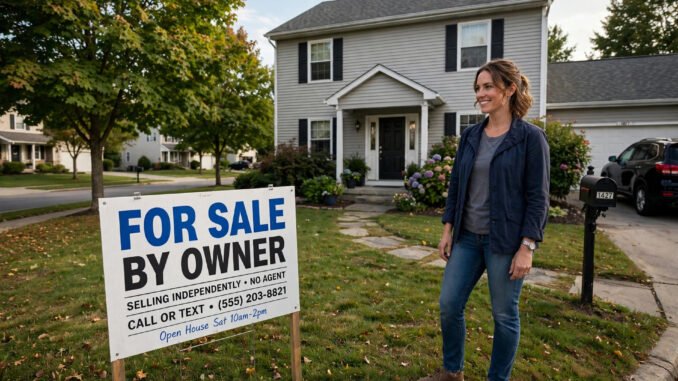
The standard real estate commission — historically around 5–6% split between buyer’s and seller’s agents — is one of the largest transaction costs most Americans ever pay. On a $500,000 home, that is $25,000–$30,000. No wonder sellers ask: is selling your home without an agent actually worth it? The honest answer: sometimes, emphatically yes — and sometimes it is the most expensive “saving” you will ever attempt. The difference is knowing which situation you are in before you list.
The Math: What You Actually Save
Post-2024 industry changes (following the NAR settlement) have made commissions more negotiable and transparent than ever. Typical total commissions now often land at 4–5% rather than the old 6%. On a $500,000 sale at 5%, agents cost $25,000. Selling yourself (FSBO — For Sale By Owner) eliminates the listing-agent share (~2–2.5%, or $10,000–$12,500) and, if the buyer is also unrepresented, potentially the entire commission.
But the savings are gross, not net. FSBO sellers must price accurately (mispricing by 3% wipes out the commission savings), market effectively, and negotiate well. Industry data has long shown FSBO homes selling for less than agent-listed homes — though that gap narrows significantly for sellers who do the work properly, and much of the historical gap reflects distressed or rural sales. The real question is not “commission versus no commission” but “net proceeds with an agent versus net proceeds without” — and that depends on your skills and your market.
Before deciding, understand the full transaction landscape with the Consumer Financial Protection Bureau’s home-selling resources, which explain closing costs, disclosures, and your rights in plain language.
When FSBO Is Genuinely Worth It
Hot seller’s markets
When well-priced homes sell in days with multiple offers, the agent’s core value — finding buyers — is largely handled by the market itself. Listing on the MLS via a flat-fee service ($300–$500), pricing from solid comps, and fielding offers is very doable. This is the highest-ROI FSBO scenario.
You have transaction experience
Former agents, investors, attorneys, or anyone who has bought/sold multiple homes already knows the paperwork rhythm. The learning curve that sinks first-timers does not apply.
Selling to someone you know
Family members, neighbors, tenants — when buyer and seller already agree on price, paying $15,000 for intermediation is pure waste. Hire a real estate attorney ($500–$1,500) for the paperwork and keep the rest.
Your home is straightforward
Recently updated, no major defects, clear title, conforming lot — simple properties need less professional judgment to price and sell than complex ones.
When an Agent Earns Every Penny
Unique or difficult properties
Historic homes, properties with defects, odd layouts, rural acreage, or anything requiring creative marketing — pricing these wrong costs far more than a commission. Agents who specialize in unusual properties pay for themselves in pricing accuracy alone.
You’re relocating or time-starved
FSBO is a part-time job for 30–90 days: showings, calls, paperwork, negotiations. If you are moving cities or working 60-hour weeks, the “savings” cost you evenings, weekends, and stress — price your time honestly.
Buyer’s markets
When inventory sits for months, marketing skill and buyer-agent networks genuinely move the needle. In cold markets, agent-listed homes sell faster and the speed itself has value (every extra month of double housing payments erodes FSBO savings).
Legal complexity
Divorce sales, estate sales, title issues, unpermitted work — transactions with legal hair need professional guidance. A $15,000 commission is cheap insurance against a $50,000 disclosure lawsuit.
The FSBO Playbook (If You Go For It)
Price with data, not hope. Pull actual sold comps (not list prices) from the last 90 days within half a mile — Zillow and Redfin show these free. Price 1–2% below the nearest comparable agent-listed home to drive traffic; bidding momentum beats aspirational pricing. Get on the MLS. Roughly 90% of buyers find homes via MLS-fed sites. Flat-fee MLS listing services ($300–$500) put you on Zillow, Realtor.com, and Redfin — non-negotiable. Photograph like a pro. Smartphone photos in daylight, decluttered rooms, $0 — or hire a real-estate photographer ($150–$300), the highest-ROI $200 in FSBO. Maximize appeal with our guide to DIY projects that increase home value and improving curb appeal cheaply before listing. Pre-inspect. A $400 pre-listing inspection lets you fix issues on your terms instead of renegotiating under pressure. Hire the attorney. A real estate attorney ($500–$1,500) reviews contracts and handles closing — this is the professional you actually need. Offer buyer-agent commission. Offering 2–2.5% to buyer’s agents keeps your listing attractive to the 90% of buyers who use agents; you still save the listing-agent half. Total FSBO cost done right: ~$2,000–$4,000 versus $12,500–$25,000 in commissions.
HUD’s home-selling guidance covers disclosure obligations that vary by state — get these right, because disclosure failures are the main source of post-sale lawsuits against FSBO sellers.
Negotiating Without an Agent: What Changes
The negotiation table is where FSBO sellers most feel the absence of an agent — and where preparation matters most. Get pre-approval letters from buyers before engaging seriously; unqualified buyers waste months. Respond to offers within 24–48 hours — speed signals seriousness and keeps momentum. Negotiate more than price: closing timeline, contingencies, appraisal gaps, and included items are all levers; a buyer offering $5,000 less with no inspection contingency and a 21-day close may beat a higher offer loaded with escape hatches. Use deadlines: “highest and best by Sunday 5 p.m.” creates the competitive tension agents manufacture naturally. Never negotiate against yourself — if a buyer counters, respond once with your best position rather than inching toward them across five rounds. And keep emotions out of it: the buyer’s lowball is not an insult to your home; it is an opening number. Counter with data (your comps) and silence, not indignation. If negotiations stall on legal or complex terms, that $500–$1,500 attorney earns their fee right here — have them review counteroffers before you sign, not after.
Conclusion
Selling your home without an agent is worth it when the market is hot, the property is straightforward, you have time and temperament for the process, and you execute the playbook (flat-fee MLS, data-driven pricing, pro photos, attorney review, buyer-agent commission offered). It is not worth it for complex properties, cold markets, relocations, or legally messy situations — where an agent’s pricing accuracy and process management outweigh the commission. Run the net-proceeds math for your specific situation, not the ideology. The goal was never “no agent”; it was “most money in your pocket with least risk.”
Frequently Asked Questions
How much can I save selling my home without an agent?
Typically $10,000–$25,000 on a $500,000 home (the 2–5% commission), minus ~$2,000–$4,000 in FSBO costs (flat-fee MLS, photography, attorney, pre-inspection). Net savings run $8,000–$20,000 when executed well.
Do FSBO homes sell for less?
On average, yes — but the gap shrinks dramatically for sellers who list on the MLS via flat-fee services, price from sold comps, and use professional photography. Much of the historical gap reflects non-MLS and distressed sales.
How do I list my home on the MLS without an agent?
Flat-fee MLS listing services ($300–$500) enter your listing into the local MLS, which syndicates to Zillow, Realtor.com, Redfin, and other major portals.
Should I still offer commission to buyer’s agents?
Usually yes — offering 2–2.5% keeps your home attractive to represented buyers (the majority). You still save the listing-agent half of the traditional commission.
Do I need a lawyer to sell FSBO?
Strongly recommended. A real estate attorney ($500–$1,500) reviews contracts, ensures disclosure compliance, and handles closing — the professional protection that matters most in FSBO.
Leave a Reply