
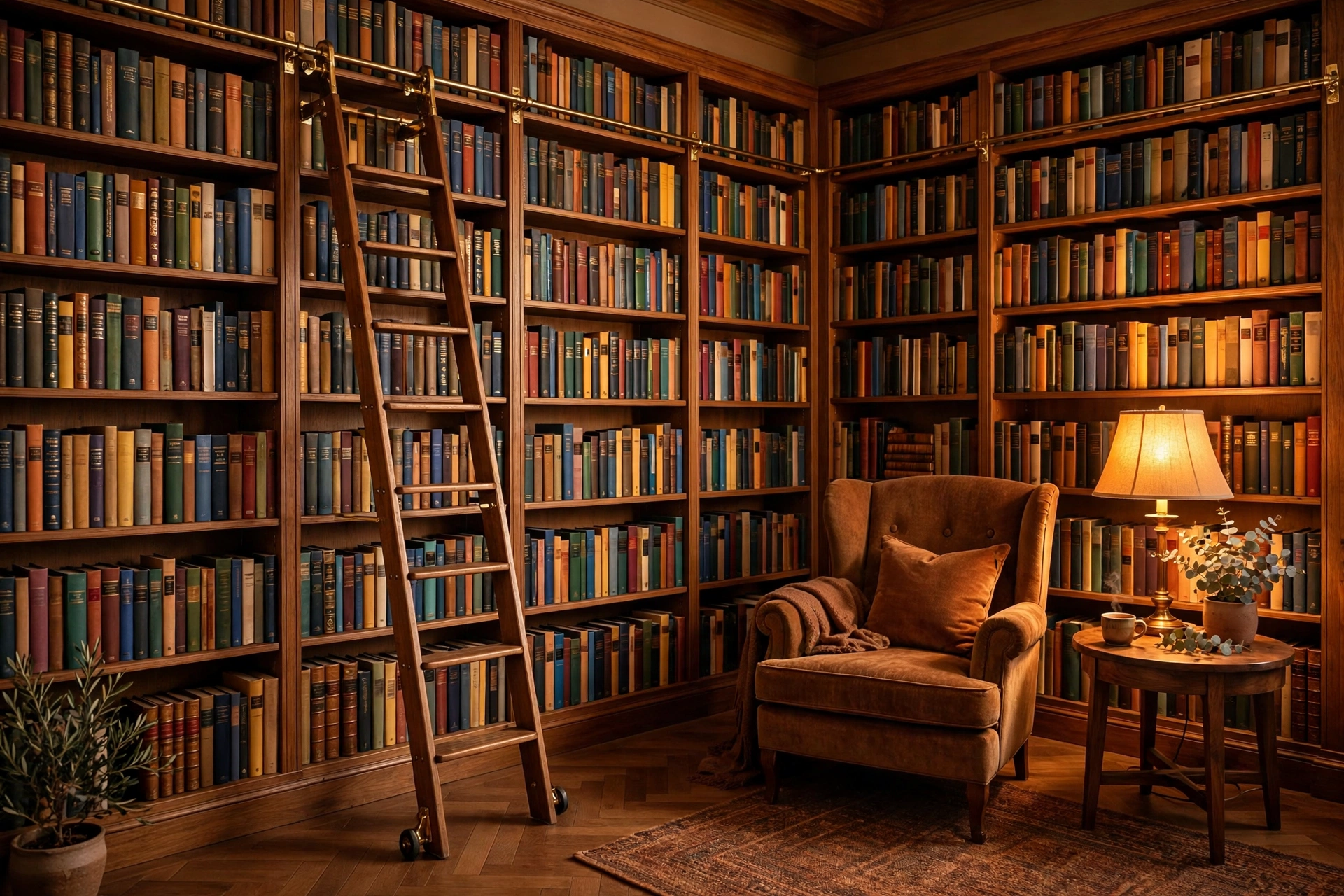
How many books make a library? It is one of those questions that sounds like it should have a crisp official answer — and does not. No international body certifies the exact number of volumes that turns a pile of books into a library. But conventions, history, and a few famous benchmarks give us a surprisingly useful answer.
The Short Answer: Around 1,000
The most commonly cited threshold is 1,000 books. This number pops up again and again: in discussions of personal libraries, in the old rule of thumb that a “serious” private collection starts at a thousand volumes, and in the way bibliophiles talk about their shelves. It is not law — it is lore — but lore that stuck because it feels right: a thousand books is roughly when a collection stops being “some books I own” and starts being a resource you can browse, lend, and get lost in.
That said, plenty of people happily call a few hundred well-chosen volumes their library. A library is arguably defined less by count than by organization: cataloged, shelved with intent, and maintained as a collection rather than a random stack.
What the Professionals Say
Professional standards dodge the question rather than answer it. The American Library Association and IFLA define libraries by function — organized collections made accessible to a community — not by volume count. A village reading room with 500 books and a lending system is a library; a mansion with 5,000 decorative unread volumes is arguably just storage.
For scale, consider the giants: the Library of Congress holds well over 170 million items, the British Library over 170 million too. At the other end, the famous “1,000 books before kindergarten” reading programs treat a thousand as a meaningful lifetime milestone for a child — which tells you something about how substantial a thousand books really is.
Famous Personal Libraries
History’s great readers set the bar high. Thomas Jefferson’s personal library — the seed of the Library of Congress — held about 6,500 volumes. Umberto Eco’s legendary collection ran to roughly 30,000 books. Karl Marx’s working library was around 1,500. You do not need Eco’s warehouse; Jefferson built one of history’s most influential collections with six and a half thousand.
Building Your Own: Quality Over Quantity
If your goal is a personal library rather than a record, think in shelves, not numbers:
- Start with what you will actually reread. A library is a tool, not a trophy.
- Organize early. Even simple genre-and-author shelving saves future headaches.
- Weed regularly. Real libraries discard books; so should you.
- Aim for the thousand if you want the traditional milestone — at a book a week, that is about twenty years of joyful reading.
And if you are the trivia-loving type building that collection, you might enjoy testing your shelves against questions like how Stalin came to power — a good library should be able to answer the questions that keep you up at night.
So, the Real Answer
Technically: as few as you like, if they are organized and used. Traditionally: 1,000 books. Practically: you have a library the moment your books are cataloged, curated, and shared — whether that is 300 volumes or 30,000.
Types of Libraries (and Their Very Different Counts)
Context matters enormously:
- Public libraries: Even small-town branches usually hold 20,000–50,000 volumes; city systems run into the millions.
- Academic libraries: A college library under 100,000 volumes is considered small; major research universities hold 5–15 million.
- School libraries: Often 5,000–20,000 books — modest by university standards, but organized and cataloged like the big ones.
- Personal libraries: This is where the 1,000-book tradition lives. A few hundred curated volumes is a respectable start.
- Little Free Libraries: Those charming sidewalk boxes hold 20–30 books and are absolutely libraries in spirit.
How Libraries Actually Count
Professionals count “volumes,” not just titles — a ten-volume encyclopedia set is ten volumes. They also count serials, manuscripts, maps, and increasingly digital holdings. When the Library of Congress says 170 million items, that includes books, photographs, maps, sheet music, and recordings. Your home count can be simpler: count the spines on the shelf.
Do Ebooks Count Toward Your Library?
Purists grumble, but yes — a curated, organized digital collection is a library. Many serious readers now run hybrid collections: beloved physical books on shelves, plus hundreds of ebooks and audiobooks. What matters is the same as ever: organization, curation, and use. A thousand Kindle books you chose carefully is more of a library than a thousand random free downloads you will never open.
Starting a Little Free Library
If the idea of a library with twenty books appeals to you, consider starting a Little Free Library — the take-a-book, share-a-book boxes found in neighborhoods worldwide. You need a weatherproof box, a post, a starter stock of books, and registration with the nonprofit organization. It is one of the loveliest small community projects there is, and stewards consistently report that neighbors love them.
Caring for Your Collection
A library deserves basic preservation: keep books out of direct sunlight, avoid damp basements and hot attics, shelve upright (not stacked, not leaning), and dust occasionally. For valuable volumes, archival sleeves and stable room temperature make a real difference. None of this is fussy — it is just respect for the objects that will outlast you if you treat them well.
The Joy of the Thousand-Book Milestone
There is something quietly satisfying about crossing into four digits. Readers who get there describe the same shift: the collection stops being a list of books and becomes a landscape. You start finding connections — the novel that illuminates the history, the memoir that reframes the biography. A thousand books means you can follow any curiosity for weeks without leaving your shelves.
Getting there is simpler than it sounds. Read a book a week and buy or keep half of what you read, and you will cross a thousand in under forty years — most dedicated readers get there far sooner through used bookstores, library sales, and gifts. The trick is not acquisition speed but retention discipline: keep what earned its place.
Cataloging: The Moment It Becomes Official
Many collectors say their books became a library the day they cataloged them. Free tools make it easy: apps like LibraryThing or Goodreads let you scan barcodes and build a searchable catalog in an afternoon. Add tags for genre, read/unread status, and lending, and suddenly you can answer “do I own that?” in seconds. Cataloging also reveals delightful patterns — the authors you return to, the eras you favor — turning a pile of books into a portrait of your mind.
Finally, remember that a library is meant to be used, not admired from a distance. Lend books freely (keep a simple lending list so they come back), press favorites on friends, and let children pull volumes off the shelves. The books that get handled, discussed, and passed around are the ones doing their job — and a well-worn library is a far happier thing than a pristine one.
Start where you are: one shelf, organized with care, is already the beginning of a library. The thousand-book milestone will take care of itself if you simply keep reading and keep the ones that matter.
Leave a Reply