
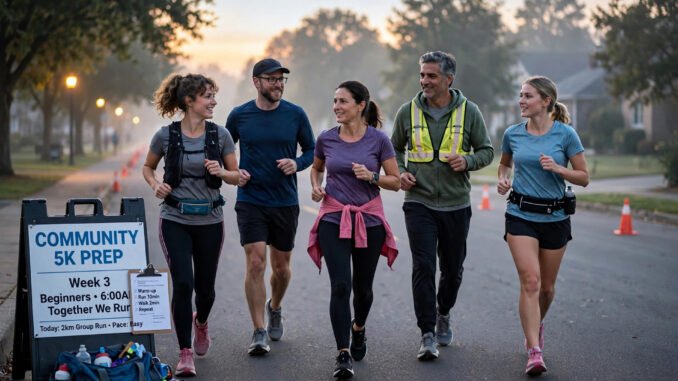
Somewhere between “I should get in shape” and race day lies a beautifully achievable goal: the 5K. At 3.1 miles, it is long enough to demand real training and short enough that a complete beginner can finish one in 8–10 weeks. It is also the most waste-proof fitness goal in existence — you need shoes, a plan, and consistency. Everything else the running industry sells you is optional.
This guide shows the best way to train for your first 5K without wasting money: a week-by-week plan, the gear that matters (and the gear that does not), how to handle the mental wall at week five, and what race day actually feels like.
Why the 5K Is the Perfect First Goal
The 5K sits in a sweet spot of exercise science. Training for it builds the aerobic base that the CDC recommends — 150 minutes of moderate activity weekly — while the race itself delivers the psychological payload of a finish line, a medal, and a time to beat next year. Unlike marathons, 5K training never requires 15-mile Sunday runs that devour weekends; unlike gym memberships, it costs nothing after shoes.
The research on beginner runners is encouraging: previously sedentary adults who follow a structured 8–10 week walk-run program improve their cardiovascular fitness by 15–20% and typically finish their first 5K in 30–40 minutes. Walking parts of it is completely normal — at most community 5Ks, a third of finishers walk significant portions. If you are starting from zero activity, our guide to exercise for beginners who hate the gym is a good mindset warm-up first.
The 8-Week Plan (Walk-Run to Finish)
Three sessions per week, each 25–40 minutes. Walk briskly for 5 minutes to warm up and 5 minutes to cool down every session.
Weeks 1–2: Build the habit
Alternate 1 minute jogging / 2 minutes walking for 20 minutes. Goal: finish feeling like you could do more. Soreness in the first two weeks is normal; sharp pain is not.
Weeks 3–4: Extend the run
2 minutes jogging / 1 minute walking for 25 minutes. Add a fourth day of pure walking (30 min) if recovery allows.
Weeks 5–6: The breakthrough
5 minutes jogging / 1 minute walking for 30 minutes. Week 5 is where most beginners quit — the novelty fades before fitness arrives. Expect it, schedule around it, and keep showing up. This is also the week to try a continuous 15-minute jog once, just to prove you can.
Weeks 7–8: Sharpen and taper
Run 25–30 minutes continuously twice a week, with one shorter easy session. In race week, cut volume in half, sleep well, and trust the training. You are ready.
Throughout: keep easy days genuinely easy (conversational pace), increase total weekly time by no more than ~10%, and take an extra rest day whenever in doubt — missed runs do not ruin training, but injuries do. For the bigger picture of weekly activity targets, see how much exercise you need each week.
Gear: Spend $150, Skip Everything Else
Buy: Proper running shoes fitted at a running store ($130–$180). This is the entire gear budget and the only purchase that prevents injuries. Maybe: Moisture-wicking socks ($12–$15 for three pairs) — cotton socks cause blisters; this is the cheapest comfort upgrade in running. Skip: GPS watches (your free phone app tracks distance), heart-rate chest straps, energy gels (you do not need fuel for runs under an hour), compression gear, and “recovery” gadgets. A phone armband ($15) completes the kit. Total sensible spend: under $200, mostly the shoes you will wear for months.
Do not buy carbon-plated racing shoes for your first 5K. They are built for experienced runners chasing seconds, cost $200–$275, and increase injury risk for beginners whose form is not ready for them.
Fueling, Hydration, and the Week-Before
For training runs under an hour: eat a normal meal 1–2 hours before (banana and toast is the classic), drink water normally through the day, and eat normally after. No special diet required. Race week: do not try new foods, new shoes, or new routines — “nothing new on race day” is the oldest rule in running because violating it ruins more races than undertraining does. The night before, eat a normal carb-leaning dinner you have eaten before, lay out your clothes and bib, and get to bed at a normal hour.
Race morning: wake 2–3 hours before the start, eat your practiced breakfast, arrive 45 minutes early, jog 5–10 minutes easy plus a few strides to warm up, use the portable toilets early (the lines are legendary), and line up toward the back if you plan to walk — you will pass people, which feels great.
The Mental Game: Getting Through Week 5
The physical plan is simple; the mental plan is the real training. Three tactics that work: Shrink the session. On days you dread running, commit to just the 5-minute warm-up walk — you will almost always continue, and if not, a walk still counts. Run-walk without shame. Jeff Galloway’s method has carried thousands of beginners to finish lines; walking is strategy, not failure. Find one accountability anchor — a friend, a local running club’s beginner group (most are free), or a training app’s social features. And remember the American Heart Association’s framing: every session is a deposit in cardiovascular health that pays compound interest for decades, whether or not it feels heroic at mile two.
On the eternal question of modality, walking versus running for weight loss breaks down the trade-offs — but for 5K training specifically, the run-walk blend gives you both.
Conclusion
Training for your first 5K without wasting money is beautifully simple: follow an 8-week walk-run plan three days a week, buy fitted shoes and skip every other gadget, eat normally, expect week five to test your resolve, and show up on race day with nothing new. Eight weeks from now you will own a finish-line memory, a fitter heart, and proof that you can build a hard thing from nothing — for less than the cost of two months of a gym membership you would not have used.
Frequently Asked Questions
How long does it take a beginner to train for a 5K?
Eight to ten weeks of walk-run training, three sessions per week, takes most sedentary beginners from zero to finishing 3.1 miles. Already-active beginners may need only 5–6 weeks.
Can I walk during a 5K race?
Absolutely. Walking portions of a 5K is completely normal — a large share of community-race finishers walk, and run-walk is a legitimate race strategy used even by experienced runners.
What should I eat before running a 5K?
A normal, familiar meal 1–2 hours before: banana and toast, oatmeal, or similar. Nothing new on race day. For runs under an hour, no special fueling is needed.
Do I need expensive gear to train for a 5K?
No. Fitted running shoes ($130–$180) are the only important purchase. Your phone tracks distance free; skip GPS watches, gels, and compression gear for your first race.
What is a good first 5K time for a beginner?
Most beginners finish between 30 and 40 minutes. But the only time that matters for your first 5K is finishing — set a time goal for the second one.
Leave a Reply