
The down payment is the tallest wall between renters and homeowners: 20% of a $450,000 house is $90,000, a number that makes most first-time buyers close the tab. But the wall is lower than it looks. You do not need 20% — the median first-time buyer puts down far less — and the strategies that actually work have nothing to do with extreme frugality TikToks and everything to do with systems, assistance programs, and honest math.
This guide shows the best way to save for a house down payment without wasting money: how much you really need, where to keep the savings, the programs that shrink the target, and the timeline math for getting there.
How Much Do You Actually Need?
Kill the 20% myth first. In 2026, the typical first-time buyer puts down 6–8%. On a $400,000 home, that is $24,000–$32,000 — still serious money, but a fundamentally different project than $80,000. Loan options: FHA loans require as little as 3.5% down with a 580+ credit score. Conventional loans go down to 3% for qualified first-time buyers. VA loans (eligible veterans) and USDA loans (eligible rural areas) require 0% down.
The trade-off of small down payments is private mortgage insurance (PMI) — typically 0.5–1.5% of the loan annually until you reach 20% equity. On a $380,000 loan, that is $160–$475/month. PMI is not “wasted money” the way influencers claim; it is the price of buying years earlier, during which your home may appreciate and your rent payments stop building someone else’s equity. Run both scenarios honestly instead of treating 20% as religion. The Consumer Financial Protection Bureau’s homebuyer tools let you model down payment scenarios with real numbers.
Set the Target and the Timeline
Work backward. Target down payment ($30,000) + closing costs (2–5% of price: $8,000–$20,000 on $400,000) + a 3-month emergency buffer separate from the house fund = your real number, often $45,000–$55,000 for that $400,000 home. Divide by your monthly savings capacity to get the timeline. Saving $1,200/month? Roughly 3.5 years. That timeline is the plan — everything below serves it.
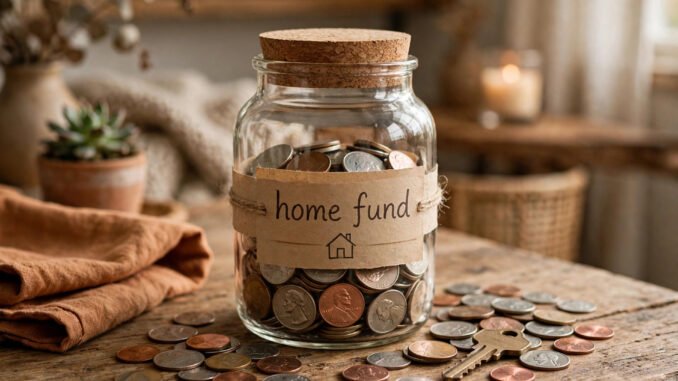
Automate the transfer for the day after payday into a dedicated high-yield savings account (currently paying ~4–5% APY in 2026 — meaningfully better than checking). Name the account “House Fund.” Behavioral research is clear: labeled, separate, automated accounts get raided far less than a general savings pool. Keep this money out of the stock market — a 3-year horizon is too short for equity volatility, and a 20% market dip the year you planned to buy is catastrophic. High-yield savings or Treasury bills only.
Programs That Shrink the Mountain
Before grinding for years, check what you qualify for — billions in assistance go unclaimed annually:
State and local down payment assistance
Nearly every state runs first-time buyer programs offering grants or forgivable second loans of $7,500–$25,000+. These are income-capped and often require a homebuyer education course (usually free online, 4–8 hours). Search “[your state] first-time homebuyer down payment assistance” — this single search is the highest-ROI half hour in the entire homebuying process.
Employer assistance
An increasing number of employers offer down payment matching or grants ($2,500–$10,000) as a retention benefit. Check your benefits portal — most employees never look.
Gift funds and family loans
Lenders allow documented gift funds from family for down payments (with a gift letter; requirements vary by loan type). If family help is available, formalize it early — last-minute large deposits trigger underwriting scrutiny.
Also verify the total purchase math beyond the down payment — our breakdown of home inspection costs covers one of the smaller-but-real line items buyers forget, and HUD’s homebuyer resources list approved counseling agencies that walk first-time buyers through assistance programs for free.
Accelerating Without Burnout
Bank the raises: Direct half of every raise to the house fund automatically — the same mechanism that defeats lifestyle inflation accelerates the down payment. Windfall protocol: Tax refunds, bonuses, and side income split 70/20/10 (house fund / emergency fund / fun). Cut with a scalpel, not a chainsaw: One or two big wins (refinancing a car loan, dropping to one car, a cheaper apartment for two years) beat fifty tiny deprivations you will abandon. Earn more, briefly: A defined 12-month sprint of overtime or freelancing aimed solely at the house fund is psychologically sustainable in a way that open-ended frugality is not. Our guide to building a budget you actually stick to keeps the sprint structured.
Do not waste money on: “house hacking” courses, crypto speculation with the down payment fund, or raiding retirement accounts (the 10% early-withdrawal penalty plus taxes usually destroys the math — the first-time homebuyer IRA exception caps at $10,000 and still owes income tax).
Down Payment Mistakes That Cost Buyers Thousands
Waiting for 20% while rents rise: In appreciating markets, waiting three extra years to reach 20% can mean the home you wanted costs $40,000 more — wiping out the PMI you “saved.” Model the trade with real local appreciation rates, not rules of thumb. Keeping the fund in checking: At ~4–5% APY, a high-yield savings account earns $2,000+ yearly on a $45,000 balance versus essentially zero in checking. That is free money for ten minutes of setup. Draining the emergency fund for the down payment: Arriving at closing with zero reserves turns the first broken water heater into credit card debt. Keep three months of expenses separate, always. Ignoring the credit score lever: A 40-point score improvement can cut your mortgage rate by 0.25–0.5%, saving tens of thousands over the loan — often worth delaying the purchase by six months to achieve. Check your reports, dispute errors, and pay down card balances before you start rate shopping.
Rent vs. Buy Sanity Check
Saving for a down payment assumes buying beats renting for you. It usually does if you will stay 5–7+ years, your market’s price-to-rent ratio is reasonable, and your job is stable. It often does not if you might move in two years (transaction costs eat the gains), or if renting an equivalent place costs far less than the mortgage would. Run the New York Times rent-vs-buy calculator with honest inputs before committing years of saving — the down payment is only worth it if the purchase is.
Conclusion
Saving for a house down payment without wasting money means: target 6–8% (not 20%), add closing costs and an emergency buffer to get the real number, automate monthly transfers into a labeled high-yield savings account, check state assistance programs and employer benefits before assuming you are on your own, and accelerate with raises and defined earning sprints rather than joyless deprivation. Keep the fund out of the market, out of crypto, and out of reach. Three focused years beats ten distracted ones.
Frequently Asked Questions
How much down payment do first-time buyers really need?
The typical first-time buyer puts down 6–8%. FHA loans allow 3.5% with a 580+ score; conventional loans go to 3% for qualified buyers; VA and USDA loans can require 0%.
Where should I keep my down payment savings?
In a high-yield savings account or Treasury bills — safe, liquid, and currently earning ~4–5%. Do not invest down payment money in stocks or crypto; the timeline is too short for that volatility.
What is down payment assistance?
State, local, and nonprofit programs offering grants or forgivable loans ($7,500–$25,000+) to first-time buyers, usually income-capped and requiring a homebuyer education course. Billions go unclaimed each year.
Is PMI a waste of money?
Not necessarily. PMI (0.5–1.5% of the loan annually) is the cost of buying with less than 20% down — often worth it to stop paying rent years earlier and start building equity. It drops off once you reach 20% equity.
Should I pause retirement savings to save for a house?
Generally no — at minimum, keep contributing enough to capture any employer 401(k) match (free money). Direct new savings toward the house fund rather than cannibalizing retirement.
Leave a Reply