
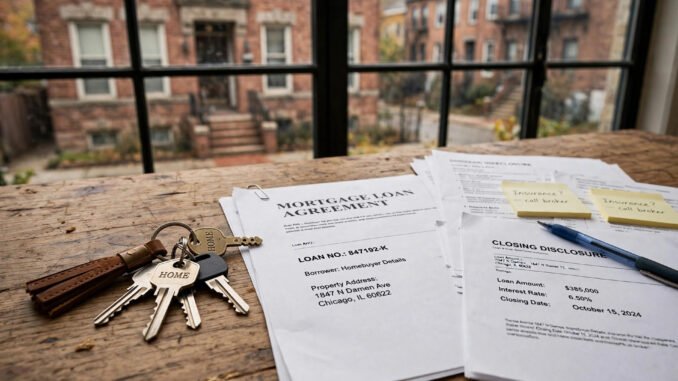
For years, the fixed-rate mortgage was the default answer in America: lock your rate, know your payment, sleep well. But with rate volatility defining the 2020s, adjustable-rate and variable mortgages have crept back into the conversation — and Chicago buyers are asking whether the old default still makes sense. The choice between fixed and variable mortgage rates is really a question about how much risk you want to rent from the bond market, and the answer depends on numbers most buyers never calculate.
This guide breaks down what choosing between fixed and variable mortgage rates really costs in Chicago, Illinois in 2026: how each loan type works, the true dollar difference under realistic rate scenarios, and a decision framework based on how long you will actually keep the loan.
How Each Loan Type Works (Without the Jargon)
Fixed-rate mortgages
A 30-year fixed-rate mortgage locks one interest rate for the entire loan term. In early 2026, Chicago buyers with good credit are seeing 30-year fixed rates roughly in the 6.25–6.75% range. Your principal-and-interest payment never changes — inflation erodes it in real terms over time, which is part of why fixed loans build wealth so reliably. The 15-year fixed (roughly 5.5–6% in 2026) has higher payments but dramatically lower lifetime interest.
Adjustable-rate mortgages (ARMs)
An ARM offers a lower introductory rate fixed for an initial period — commonly 5, 7, or 10 years (5/1, 7/1, 10/1 ARMs) — then adjusts annually based on a benchmark index plus a margin. In 2026, a 7/1 ARM might start around 5.5–5.9%, roughly 0.75–1 percentage point below the 30-year fixed. After the fixed period, the rate can adjust within caps (typically 2% per adjustment, 5–6% lifetime). That initial discount is real money — but it is rented, not owned.
The Consumer Financial Protection Bureau’s mortgage resources offer excellent plain-language explainers of ARM mechanics, including how to read the adjustment caps in your loan disclosure — required reading before signing anything variable.
The Real Dollar Math: A Chicago Example
Take a $400,000 home in Chicago — close to the metro median in 2026 — with 20% down ($80,000), leaving a $320,000 loan:
30-year fixed at 6.5%: Monthly principal and interest = ~$2,022. Total interest over 30 years = ~$408,000. Total paid = ~$728,000.
7/1 ARM at 5.75%: Monthly P&I during the fixed period = ~$1,867 — saving ~$155/month, or ~$13,000 over seven years. If rates stay flat at adjustment, you keep winning. But if the rate adjusts to the lifetime cap (~10.75% in a worst case), the payment could jump to ~$2,900+ — a $1,000/month shock.
That $13,000 in early savings is the entire bet: you are wagering that you will sell, refinance, or pay down significantly before year seven, or that rates will be flat-to-down at adjustment. Historically, the median American homeowner moves or refinances within 7–10 years — which is exactly why the 7/1 ARM’s fixed window aligns with real behavior. But “median” is not “you”: if this is your forever home in Lincoln Square, the fixed rate’s certainty is worth more than the ARM’s discount.
Run your own numbers with Freddie Mac’s mortgage calculators and current rate data before deciding — national averages move weekly, and Chicago pricing tracks them closely.
Chicago-Specific Factors That Change the Math
Property taxes: the hidden second mortgage
Cook County has among the highest effective property tax rates in the nation — Chicago homeowners commonly pay $6,000–$10,000+ annually on a $400,000 home, and reassessments can spike bills. Your mortgage payment is only part of housing cost; when taxes already inject volatility into your monthly outlay, many Chicago buyers prefer the one thing they can lock down — the loan rate — to be fixed. Factor taxes into every affordability calculation, and pair the decision with a budget you can actually stick to that includes the full PITI (principal, interest, taxes, insurance).
Condo assessments and HOA risk
A huge share of Chicago housing stock is condos, where monthly assessments ($300–$800+ in many buildings) can rise unpredictably after special assessments. Like property taxes, this argues for minimizing the variables you can control — another quiet point for fixed rates among condo buyers.
Illinois closing costs and breakeven
Refinancing an ARM later is not free: Illinois closing costs run 2–5% of the loan amount. If your ARM strategy depends on refinancing before adjustment, price that refinance into the plan — a $320,000 refinance at 3% costs ~$9,600, which erases most of the ARM’s early savings unless rates drop meaningfully.
A Decision Framework (Answer These Honestly)
1. How long will you keep this loan? Under 7 years with high confidence (job relocation likely, starter home) → ARM’s discount is attractive. 10+ years or uncertain → fixed. 2. Could you afford the worst-case adjusted payment? If the lifetime-cap payment would break you, do not take the ARM regardless of the teaser rate. 3. What is the rate spread? If the ARM discounts less than 0.5% off the fixed rate, the savings rarely justify the risk. At 1%+ discounts, the math gets interesting. 4. Do you itemize and benefit from mortgage interest deduction? Higher fixed-rate interest means larger deductions — a modest offset worth modeling with a tax pro. 5. How is your cash flow cushion? ARMs demand a bigger emergency fund to absorb adjustment shocks; make sure your monthly cash flow can handle the worst case, not just the teaser.
Also consider the hybrid middle path: a 15-year fixed. The payment is higher (~$2,615 on $320,000 at 5.75%), but you build equity at roughly triple the pace of a 30-year loan and pay ~$150,000 in total interest instead of ~$408,000. For Chicago buyers with strong incomes buying below their means, it is often the best wealth-building choice of all.
Mistakes Chicago Buyers Make With This Choice
Choosing on monthly payment alone. The ARM’s lower payment feels like savings; it is actually deferred risk. Compare total cost over your realistic holding period, not month one. Ignoring the caps. Many buyers never read the adjustment caps in their disclosure. Know your worst case before you sign. Assuming they will refinance. Refinancing requires rates to cooperate, your home to appraise, and your credit to hold up — three assumptions that failed simultaneously for millions in 2008. Forgetting the inspection. Rate shopping is exciting; the unsexy stuff protects you. Our breakdown of what a home inspection costs before buying covers the few hundred dollars that routinely save Chicago buyers thousands. And HUD’s homebuyer guidance is a solid neutral checklist for the whole purchase process.
Conclusion
Choosing between fixed and variable mortgage rates in Chicago comes down to a trade: the ARM offers roughly $13,000 in savings over seven years on a typical $320,000 loan, in exchange for payment-shock risk after the fixed period. Take the ARM only if you will confidently sell or refinance within the fixed window, can afford the worst-case adjusted payment, and the rate discount exceeds ~0.75%. Everyone else — especially buyers facing Cook County’s hefty property taxes and condo assessment volatility — should take the 30-year fixed and buy certainty. Either way, run the numbers for your actual holding period, read the caps, and never let a teaser rate decide for you.
Frequently Asked Questions
What is the difference between fixed and variable mortgage rates?
A fixed-rate mortgage locks one rate for the whole term; your payment never changes. An adjustable-rate mortgage (ARM) offers a lower rate fixed for an initial period (5–10 years), then adjusts periodically based on market indexes, within contractual caps.
How much can an ARM save versus a fixed-rate mortgage?
On a $320,000 Chicago loan in 2026, a 7/1 ARM at ~5.75% saves roughly $155/month ($13,000 over seven years) versus a 30-year fixed at 6.5% — but exposes you to potentially large payment increases after year seven.
Is an ARM risky in 2026?
It depends on your time horizon and the caps. ARMs are reasonable if you will sell or refinance within the fixed period and can afford the worst-case adjusted payment. They are risky as a bet that rates will fall.
What are typical closing costs for refinancing in Illinois?
Refinancing closing costs in Illinois typically run 2–5% of the loan amount — around $6,400–$16,000 on a $320,000 loan. Factor this into any plan that depends on refinancing an ARM before it adjusts.
Should Chicago condo buyers choose fixed or ARM?
Most should lean fixed. Condo assessments and Cook County property taxes already add volatility to monthly housing costs, so locking the mortgage rate removes the largest remaining variable.
Leave a Reply