
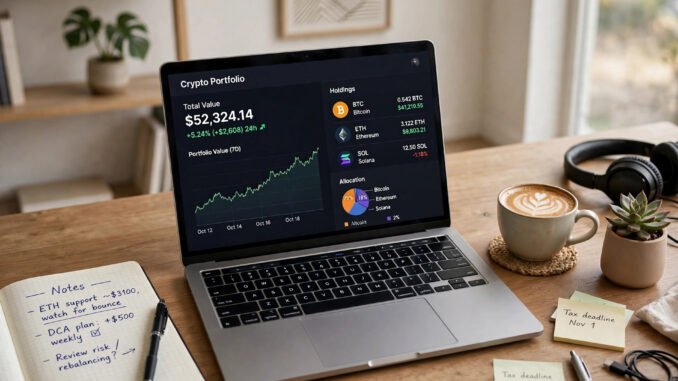
Every crypto bull run mints the same cautionary tale: the beginner who put everything into three hyped altcoins, watched the portfolio crater 80%, and concluded crypto is a scam. The problem was never crypto — it was concentration. Diversifying across altcoins safely is the difference between surviving volatility and being destroyed by it. But diversification in crypto does not work the way it does in stocks, and doing it wrong (twenty random micro-caps) is worse than not diversifying at all.
This guide gives beginners a practical framework for diversifying across altcoins without wasting money: what diversification actually means in crypto, how to structure a portfolio by risk tiers, position-sizing rules that protect you, and the mistakes that turn “diversified” into “diluted.”
Why Crypto Diversification Is Different
In stocks, diversification works because different sectors genuinely move independently. In crypto, almost everything is correlated to Bitcoin — when BTC drops 20%, most altcoins drop 30–50%. Studies of crypto market structure consistently show altcoin-Bitcoin correlations of 0.7–0.9 during sell-offs. That means holding ten altcoins does not protect you the way holding ten stocks across sectors does.
So what does diversification actually buy you in crypto? Two things: idiosyncratic risk reduction (one project’s failure — a hack, a rug pull, a regulatory action — does not wipe you out) and exposure to different narratives (layer-1s, DeFi, infrastructure, each with distinct adoption drivers). You are diversifying against project-specific disasters, not against market-wide crashes. Understanding that distinction keeps expectations honest.
Before allocating a dollar, internalize the Investor.gov guidance on crypto assets: crypto investments carry exceptional risk, most fail, and you should never invest money you cannot afford to lose. That is not boilerplate — it is the base assumption your entire diversification plan rests on.
The Core-Satellite Framework for Beginners
The safest beginner structure is core-satellite: a large, boring core plus small, deliberate satellites.
The core (60–80% of your crypto allocation)
Bitcoin and Ethereum. These two assets have the longest track records, the deepest liquidity, the most institutional adoption, and — critically — they are the assets most likely to survive a multi-year bear market. Every altcoin diversification strategy should be built on top of this foundation, not instead of it. A beginner with 70% BTC/ETH and 30% alts is already more diversified than most crypto portfolios.
The satellites (20–40%, split across 3–6 positions)
This is where altcoins live. Split the satellite portion across different categories, not just different coins: one large-cap layer-1 (e.g., Solana), one DeFi blue chip, one infrastructure/data project, maybe one layer-2 scaling token. One position per category. Two tokens doing the same thing is not diversification — it is duplication.
Cap each satellite at 5–10% of your total crypto portfolio. This is the position-sizing rule that makes diversification safe: if any single altcoin goes to zero (and some will), you lose a single-digit percentage, not your portfolio. The SEC’s investor education materials on speculative assets reinforce this principle — concentration in speculative assets is the fastest route to ruin.
How to Choose Altcoins Worth Diversifying Into
Within each category, filter ruthlessly. A beginner-friendly checklist:
Survival filters (eliminate 90% of tokens)
Age: Prefer projects that survived at least one full bear market (2+ years old). Most altcoins die in their first bear market. Liquidity: The token should trade on multiple major exchanges with real daily volume — if you cannot sell $1,000 without moving the price, you do not own an investment, you own a trap. Real usage: Look for measurable on-chain activity — active addresses, transaction fees, total value locked — not just social media hype. Tokenomics: Check the unlock schedule. A token with 70% of supply still locked and vesting to insiders is a future sell-pressure time bomb.
Red flags that disqualify instantly
Anonymous teams with no track record, guaranteed-return promises, heavy influencer promotion with no technical substance, and “partnership” announcements with unnamed companies. Any one of these is a walk-away signal. For a deeper method on vetting individual tokens, security hygiene matters too — our guide to setting up two-factor authentication is essential reading before you hold any crypto, since exchange account takeovers are a leading cause of beginner losses.
Rebalancing: The Discipline That Locks In Gains
Diversification decays without rebalancing. In a bull run, your 5% Solana position becomes 25% of your portfolio — congratulations, you are concentrated again. Set a calendar reminder: quarterly, trim positions that have grown beyond their target allocation back to size, and redistribute to underweight positions (or to your BTC/ETH core).
This feels wrong — you are selling winners — but it is the mechanical version of “buy low, sell high.” It also forces profit-taking into strength rather than panic-selling into weakness. Keep a simple spreadsheet: target percentages, actual percentages, rebalance date. Fifteen minutes a quarter.
One caution: rebalancing triggers taxable events in the US. Selling crypto at a gain is a capital-gains event even if you immediately buy another crypto. Track every trade; tax software like CoinTracker or Koinly ($49–$199/year) pays for itself at tax time. And be aware that phishing attacks spike around tax season — knowing whether your email was part of a data breach is a smart periodic check for anyone holding crypto.
What Safe Diversification Does NOT Mean
It does not mean holding 20+ coins. Beyond 6–8 positions, each new coin adds complexity without meaningfully reducing risk — and most beginners cannot research 20 projects properly. Under-diversified across categories with deep research beats over-diversified across tickers with none.
It does not mean equal weighting. Putting 10% into Bitcoin and 10% into a micro-cap is not diversification; it is a bet disguised as a portfolio. Weight by conviction and risk: largest positions in the most established assets.
It does not mean diversifying across exchanges instead of assets. Holding the same token on three exchanges protects against exchange failure (worth doing for large amounts via self-custody instead) but does nothing for portfolio risk.
It does not protect against bear markets. In a real crypto winter, diversified altcoin portfolios still fall 70–90%. Diversification protects against single-project failure. Only position sizing — keeping crypto a small fraction of your total net worth — protects against market-wide drawdowns. If crypto is more than 5–10% of your investable assets as a beginner, you are not diversified at the level that matters most.
The Costs: What Diversification Actually Costs You
Done right, diversification is nearly free. Spot trading fees on major US exchanges run 0–0.6% per trade; rebalancing quarterly across a handful of positions costs a few dollars a year. The real costs to watch: spread and slippage on low-liquidity altcoins (another reason to stick to liquid tokens), network withdrawal fees if you move assets to self-custody (Ethereum gas fees vary wildly — move during low-congestion hours), and taxes on rebalancing trades. What wastes money is not diversification but churn — constantly rotating between hyped tokens racks up fees and taxable events while adding zero safety.
Many beginners also wonder whether crypto can become a genuine income stream. A sober look at the most profitable side hustles in 2026 puts speculative crypto returns in context against income you can actually control.
Conclusion
Diversifying across altcoins safely comes down to a simple framework: a 60–80% core in Bitcoin and Ethereum, satellites capped at 5–10% each across genuinely different categories (not different tickers doing the same thing), ruthless survival filters before buying anything, quarterly rebalancing to prevent winners from reconcentrating you, and crypto kept to a small slice of your overall finances. Skip the 20-coin portfolios, the equal weighting, and the churn. Diversification does not make crypto safe — nothing does — but it converts the risk of total ruin into the risk of manageable losses, which is the entire point.
Frequently Asked Questions
How many altcoins should a beginner hold?
Three to six altcoins across different categories, on top of a Bitcoin/Ethereum core. More than eight positions adds complexity without meaningful risk reduction for beginners.
What percentage of my portfolio should be in altcoins?
Keep altcoins to 20–40% of your crypto allocation, with no single altcoin exceeding 5–10%. And keep your total crypto allocation to 5–10% of your investable assets as a beginner.
Does diversification protect against crypto bear markets?
No. Altcoins remain highly correlated with Bitcoin during sell-offs, so diversified portfolios still fall hard in bear markets. Diversification protects against individual project failures; only small overall position sizing protects against market-wide crashes.
Should I diversify across exchanges too?
For security, consider self-custody (a hardware wallet) for significant holdings rather than spreading across exchanges. Exchange diversification does not reduce portfolio risk — it only addresses exchange-failure risk, which self-custody handles better.
How often should I rebalance my crypto portfolio?
Quarterly is plenty for beginners. Rebalance when positions drift significantly from targets — trim winners back to size and redistribute. Remember that each sale is a taxable event in the US.
Leave a Reply