
Every spring, garden centers fill with roses in full bloom, and every spring, beginners wonder the same thing: is now actually a good time to start growing roses, or should I wait for some better moment? Here is the honest answer: roses are far more forgiving than their fussy reputation suggests, and the “perfect time” matters less than picking the right type of rose and planting it correctly. But timing does affect how much babysitting your first roses need — so let us get specific about when to plant, what to plant, and how to avoid the classic beginner mistakes.
The Short Answer: Plant in Spring or Fall, Not Summer
Roses establish best when planted in mild weather. In most of the US, that means two windows: early spring (after the last frost, when soil is workable) and early fall (about six weeks before the first hard frost). Spring planting is the most beginner-friendly because the plant has the entire growing season to establish roots before winter.
Should you wait if it is currently midsummer? If garden centers are selling potted roses in active growth, you can still plant in summer — you will just need to water deeply and consistently for the first month, and provide afternoon shade in hot climates for the first two weeks. The USDA Plant Hardiness Zone Map is the single most useful tool for timing: it tells you your zone, which determines both your planting window and which rose varieties will survive your winters. If you have never gardened before, our guide to the best plants for beginners with no gardening experience is a good warm-up read.
Bare-root vs. potted: what beginners should buy
Bare-root roses (sold dormant in late winter/early spring, looking like sticks in a bag) are cheaper ($15–$25) and establish vigorously, but they must be planted during dormancy. Potted roses ($25–$50) can be planted any time the ground is workable and are more forgiving for beginners because you can see what you are getting. For your first roses, buy potted.
Choose Forgiving Roses, Not Fussy Ones
The reason roses have a difficult reputation is hybrid tea roses — the classic long-stemmed florist type. They are gorgeous and they are divas: prone to black spot, needy about pruning, and demanding about feeding. Beginners should start with shrub roses instead.
The beginner-proof shortlist
Knock Out® roses: The most-planted landscape rose in America for a reason. Disease-resistant, blooms from spring to frost with almost no deadheading, tolerates neglect. Available in red, pink, yellow, and white.
Drift® roses: Low-growing groundcover roses, perfect for borders and small spaces. Same easy-care genetics as Knock Outs in a compact 2-foot mound.
David Austin English shrub roses: For fragrance lovers. More care than Knock Outs but far easier than hybrid teas, with old-rose scent and repeat blooming. ‘Gertrude Jekyll’ and ‘Olivia Rose Austin’ are reliable starters.
Climbing roses: ‘New Dawn’ (pale pink, vigorous, shade-tolerant) is the classic beginner climber for fences and arbors. Note: climbers need 2–3 years to look impressive — patience is the input.
The American Rose Society maintains variety ratings and regional guidance that can confirm which cultivars perform best in your specific area — worth a look before you buy.
Planting: The 30 Minutes That Determine Everything
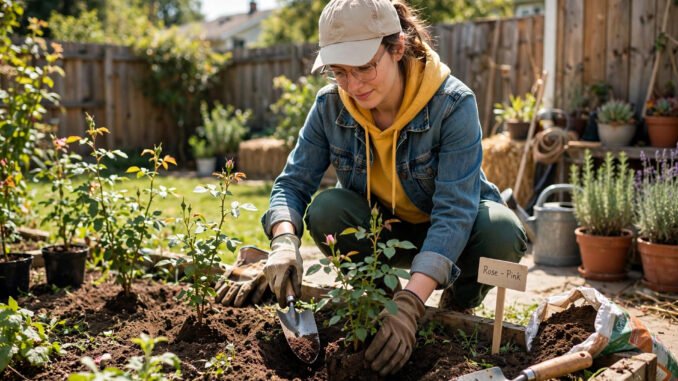
Most rose failures trace back to planting day, not to anything the gardener did later. Get these right:
Location
Roses need at least six hours of direct sun daily — morning sun is ideal because it dries dew quickly, reducing fungal disease. They also need air circulation; do not cram them against a wall. And keep them away from tree roots that will steal water and nutrients.
The hole
Dig a hole twice as wide as the pot and just as deep. In heavy clay soil (common across much of the US), dig wider and mix the backfill with compost — never plant a rose in a clay “bathtub” where water pools around the roots. For grafted roses, position the graft union (the knobby bump on the stem) 1–2 inches below soil level in cold climates, at soil level in warm ones.
Water and mulch
Water deeply at planting — a full 5-gallon bucket — then mulch with 2–3 inches of bark or wood chips, keeping mulch a few inches from the stem. Deep, infrequent watering (a good soak twice a week) builds deep roots; daily sprinkles build shallow, fragile ones.
The Only Maintenance That Actually Matters
Beginners drown in rose-care advice. In year one, only four things matter:
1. Water consistently
New roses need about an inch of water per week. Stick your finger 2 inches into the soil — if dry, water deeply. Established roses (year two onward) are surprisingly drought-tolerant.
2. Feed simply
One application of granular rose fertilizer in spring when leaves emerge, and one in early summer. That is it for year one. More fertilizer does not mean more flowers — it means weak, disease-prone growth.
3. Deadhead lightly (or don’t)
Removing spent blooms encourages reblooming on most varieties — snip just above the first five-leaflet leaf. But self-cleaning varieties like Knock Outs drop spent blooms on their own. If deadheading feels like a chore, plant self-cleaning types and skip it.
4. Prune once a year, in late winter
The pruning mystique is overblown. In late winter, cut out dead wood (brown, brittle stems), crossing canes, and shape the plant by cutting back about a third. Sharp, clean pruners; angled cuts above outward-facing buds. Fifteen minutes per bush, once a year.
If you want to expand beyond roses into easy landscaping, see our ideas for low-maintenance landscaping for a front yard — roses pair beautifully with ornamental grasses and evergreen shrubs.
Diseases: Prevention Beats Treatment
Black spot, powdery mildew, and rust are the big three fungal issues. The beginner strategy is entirely preventive: choose disease-resistant varieties (this solves 80% of problems before they start), water at the base rather than overhead, give plants space for airflow, and clean up fallen leaves in autumn since fungi overwinter in debris. If black spot appears, remove affected leaves promptly and apply neem oil — but honestly, with resistant varieties and good siting, many beginners never spray anything.
Japanese beetles are the main insect pest in much of the US. Hand-pick them into soapy water in the morning when they are sluggish. Avoid beetle traps — they attract more beetles to your yard than they catch.
What Roses Cost (and How Not to Waste Money)
A realistic first-year budget: 3 potted shrub roses ($75–$150), a bag of compost ($8), mulch ($15), granular fertilizer ($12), and basic pruners if you do not own them ($20). Under $200 total for a bed that blooms for decades — roses are perennials that can live 20+ years. The money-wasting moves: buying hybrid teas as a first rose, buying tiny mail-order bands that take three years to amount to anything, and purchasing every specialty “rose care” product on the shelf. Soil, sun, water, and one fertilizer cover it.
Conclusion
So: is now a good time to start growing roses, or should you wait? If it is spring or fall, start now — those are the ideal windows. If it is summer, you can still plant potted roses with attentive watering. Only winter dormancy is a true “wait.” Pick disease-resistant shrub roses instead of fussy hybrid teas, plant them in six hours of sun with a properly dug hole, water deeply but infrequently, and prune once a year. Do that and your first roses will not just survive — they will bloom from spring to frost and make you wonder why anyone ever called them difficult.
Frequently Asked Questions
What is the easiest rose for a complete beginner?
Knock Out® shrub roses. They are disease-resistant, bloom continuously without deadheading, tolerate imperfect soil and watering, and survive with minimal pruning — the most forgiving rose you can buy.
Can I grow roses in containers?
Yes. Choose compact varieties (Drift® roses or patio roses), use a pot at least 15 gallons with drainage holes, and water more frequently than in-ground roses since containers dry out faster. Container roses need winter protection in zones below 6.
How much sun do roses need?
At least six hours of direct sunlight daily, with morning sun preferred. Roses in too much shade bloom poorly and suffer more fungal disease.
When should I prune my roses?
Once a year in late winter or very early spring, before new growth starts. Remove dead and crossing wood and cut back about one-third of the plant’s height.
Do roses need a lot of fertilizer?
No. One application of granular rose fertilizer in spring and one in early summer is plenty for the first year. Over-fertilizing produces weak growth that attracts pests and disease.
Leave a Reply