
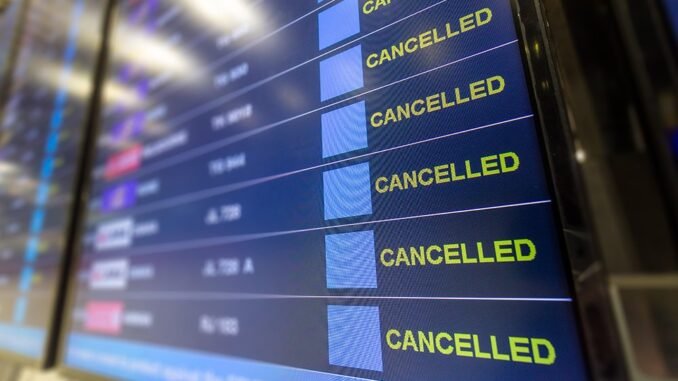
The gate agent just said the words no traveler wants to hear: “This flight has been cancelled.” Your stomach drops. Everyone around you is standing up at once, phones out, panic rising. Here’s what I wish someone had told me the first time: the next 15 minutes determine whether you’re home tonight or sleeping on a terminal floor. If you’re asking what should I do if my flight gets cancelled at the airport, here’s the exact playbook — in priority order — from someone who’s been through it a dozen times.
Deep breath. Don’t join the customer service line yet. Do this instead.
What Should I Do If My Flight Gets Cancelled at the Airport? The First 15 Minutes
Minute 0–5: Get in every queue simultaneously
- Open the airline’s app immediately. Rebooking options often appear in the app before the gate agent announces anything. Many cancellations auto-rebook you — check what they gave you; it’s often terrible (a 6 AM two-stop when a 9 PM direct exists). You can usually change it free in the app.
- Call the airline while walking to the service desk. Phone agents and gate agents see the same inventory — whoever you reach first wins. Use the elite/credit-card line if you have one (shorter waits). Put it on speaker and keep refreshing the app.
- Join the physical line too. Three channels competing = fastest resolution. The line looks hopeless; it moves faster than you think, and in-person agents have the most power (meal vouchers, hotel bookings, creative rerouting).
- Check partner airlines. If you’re on United, search American/Delta/Southwest options too — then ask the agent to rebook you on them. US airlines can endorse tickets to competitors (they often won’t volunteer to; ask specifically).
Minute 5–15: Know your rights before you negotiate
- US DOT rule: cancelled flight = full refund owed. If the airline cancels (any reason) and you choose not to travel, you’re entitled to a cash refund — not a voucher, not credit — including for nonrefundable tickets. This is federal law. If rebooking options are awful, take the refund and buy what works.
- Airline-controllable vs. weather: if the airline caused it (mechanical, crew, scheduling), US carriers’ customer service commitments (published on the DOT dashboard) promise meals, hotels, and rebooking. Weather/ATC cancellations: the airline owes rebooking but not hotels/meals (though asking politely sometimes works).
- EU flights (EU261): if departing the EU (any airline) or arriving in the EU on an EU carrier, cancellations within 14 days of departure trigger €250–€600 cash compensation plus care (meals, hotels) — on top of rebooking/refund. This is real money; claim it.
- Never accept the first voucher offer if a refund serves you better. Vouchers expire and restrict; cash doesn’t.
Getting Rebooked Smart
- Ask for specific flights: “Can you put me on the 7:30 PM to Denver connecting to the 10 PM to Seattle?” Agents rebook faster when you do the research. Use Google Flights to find options, then feed them to the agent.
- Consider nearby airports: cancelled to LAX? Ask about Burbank, Long Beach, Orange County. Cancelled to JFK? Check Newark, LaGuardia. Flexibility multiplies options.
- Split the party if needed: two seats on the 6 PM beats four seats on tomorrow’s 6 AM. You can reunite at home.
- Ask about the “flat tire rule”: unofficial, but agents sometimes rebook misconnected passengers on later flights without fees — politeness makes it happen.
- Lounges: if you have access (credit card, day pass $50–$60), the lounge agents rebook with zero line and the comfortable chairs beat the terminal floor if you’re stuck overnight.
If You’re Stuck Overnight
- Get the hotel voucher at the airport — don’t leave without it (airline-caused cancellations). Ask about meal vouchers in the same breath. If they claim “weather” and you suspect otherwise, ask for the specific reason in writing.
- No voucher? Book yourself: last-minute hotel tactics — HotelTonight, front-desk negotiation. Keep every receipt; claim reimbursement later (airline-controllable cancellations).
- Essentials kit: the airport shop charges $25 for a toothbrush — keep a mini kit in your personal item always (toothbrush, deodorant, phone charger, change of underwear). This is the cancelled-flight survival kit.
- Notify the other end: hotel, rental car, people meeting you. Most hotels waive no-show fees for documented flight cancellations — call, don’t just no-show.
After: Claims and Compensation
- Document everything: screenshot the cancellation notice, save boarding passes, photograph receipts. Claims without evidence die quietly.
- File for EU261 if applicable — airline websites have claim forms; third-party services (AirHelp) take 25–35% commission, so file direct first.
- Credit card trip protection: Chase Sapphire, Amex Platinum, and similar cards cover trip delay ($500+ for 6–12+ hour delays: hotels, meals, essentials). File with receipts — this is the coverage most travelers forget they have.
- Complain effectively: DOT complaints (transportation.gov/airconsumer) get airlines’ attention — carriers must respond formally. A calm, factual DOT complaint resolves more than ten angry tweets.
- Travel insurance: trip interruption/delay benefits stack here — another reason coverage matters.
Prevention: Before Your Next Flight
- Book the first flight of the day — it can’t be delayed by earlier cascading problems, and rebooking options are widest.
- Avoid tight connections (under 60 min domestic, 2 hrs international) and the last flight of the day (no backup options).
- Nonstop beats connections — every connection is a cancellation opportunity.
- Download the airline app + enable notifications — you’ll often know about cancellations before the gate announcement.
The Cancellation-Proof Itinerary (Prevention System)
The best cancellation strategy happens before you book. Flight selection: first flight of the day (can’t inherit earlier delays), nonstop over connections (every connection is a failure point), and avoid the last flight of the day (no rebooking options when it cancels). Airline selection: on routes served by multiple carriers, prefer the airline with the most daily frequencies — six daily flights means six rebooking options; one daily flight means you’re stuck overnight.
Connection padding: 90+ minutes domestic, 3 hours international. Tight connections save an hour when they work and cost a day when they don’t — the math never favors tight. The backup flight: before traveling, note the next 2–3 flights on your route (any airline). When cancellation hits, you feed specific flight numbers to the agent instead of asking “what’s available?” — it’s dramatically faster. Travel day buffers: never schedule the unmissable event (wedding, cruise departure, job interview) on arrival day. Arrive a day early for anything that matters; the hotel night costs less than the disaster. Insurance: for expensive trips, trip-interruption coverage turns a cancellation from a financial hit into an inconvenience. Cancellations are weather — you can’t prevent them, but you can build a house that stands in the storm.
The Bottom Line
Flight cancelled? App + phone + physical line simultaneously, know your refund rights (cash, not voucher, by federal law), ask agents for specific alternate flights including competitors and nearby airports, get hotel/meal vouchers before leaving, document everything, and claim EU261/credit-card benefits after. The 15-minute sprint determines the outcome — then it’s just paperwork. And next time: first flight out, nonstop, app notifications on.
Leave a Reply