
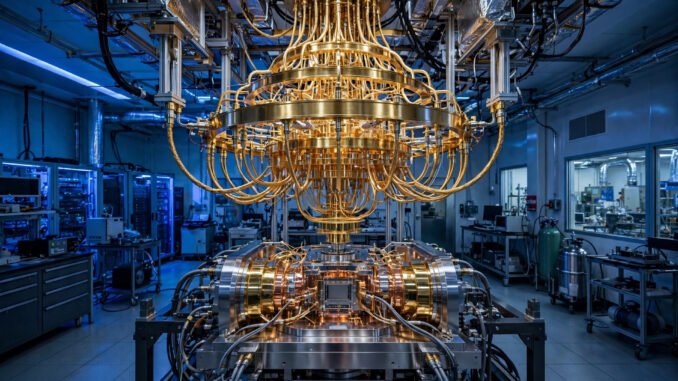
Quantum computing is the technology everyone has heard of and almost nobody understands. Headlines promise it will “crack all encryption” or “solve problems in seconds that take supercomputers millennia,” and then, in the same breath, admit that practical quantum computers might still be years away. What is actually going on? This guide answers the keyword question directly: what quantum computing basics are, and how the machine actually works — from the qubit to the algorithm — in plain language with real machines and real numbers from 2026.
You won’t need a physics degree. You will need about fifteen minutes and a willingness to let go of how ordinary computers think. By the end, you’ll understand superposition, entanglement, and why quantum computers are spectacular at some problems and useless at others.
Start With the Bit: What Quantum Computing Replaces
A classical computer thinks in bits: switches that are either 0 or 1. Everything your laptop does — streaming video, running spreadsheets, browsing the web — is billions of these switches flipping in elaborate choreography. Quantum computing doesn’t make the switches faster. It replaces them with something stranger: the qubit.
A qubit is a quantum object — often an electron, an ion, or a tiny superconducting circuit cooled to near absolute zero — that can be 0, 1, or a blend of both at once. That blend is called superposition, and it is the entire engine of quantum computing. If a bit is a coin lying flat showing heads or tails, a qubit is a coin spinning in the air: until it lands (until it is measured), it is in a sense both.
The catch: two qubits don’t just double the blends. They multiply them. With n qubits in superposition, a quantum computer can represent 2ⁿ states simultaneously. Fifty qubits can, in principle, represent over a quadrillion states at once. This is the source of every “exponential” claim you have ever read — and the source of every exaggeration, too, as we’ll see.
Entanglement: The Spooky Glue
Superposition alone isn’t enough. The second quantum ingredient is entanglement: a connection between qubits so deep that measuring one instantly determines the state of the other, no matter how far apart they are. Einstein famously called it “spooky action at a distance,” and he didn’t like it — but a century of experiments, culminating in the 2022 Nobel Prize in Physics, confirmed it is real.
In a quantum computer, entanglement lets qubits work as a team. An algorithm can arrange that wrong answers cancel each other out (through interference, like noise-canceling headphones) while the right answer gets amplified. This is the trick behind quantum speedups: not trying every answer at once, as pop-science articles often claim, but orchestrating interference so the correct answer emerges loudly from the noise.
How a Quantum Computer Actually Runs: The Three Steps
Here’s the actual workflow of a quantum computation, stripped of mystique:
Step 1: Initialize and superpose
Engineers cool the qubits (in superconducting machines like IBM’s and Google’s, down to about 0.015 Kelvin — colder than deep space) and put them into superposition with precisely timed microwave pulses. Each pulse is a rotation of the qubit’s quantum state, like aiming the spinning coin.
Step 2: Apply quantum gates
Just as classical computers use logic gates (AND, OR, NOT), quantum computers use quantum gates that rotate and entangle qubits. A quantum algorithm is a choreographed sequence of these gates — typically thousands of operations designed so that interference amplifies the right answer. IBM’s quantum platform lets anyone run such circuits on real hardware through the cloud, which is how students and researchers experiment today.
Step 3: Measure and repeat
Measurement collapses each qubit to 0 or 1 — the spinning coin lands. A single run gives one sample from a probability distribution shaped by the algorithm. So the machine runs the circuit thousands of times and tallies the results. The most frequent outcome is the answer. This is why quantum computers are probabilistic machines: they don’t compute the answer, they coax it out of statistics.
What Quantum Computers Are Actually Good At
This is where honesty matters. Quantum computers will not make your spreadsheets faster or your games prettier. They excel at a narrow set of problems with deep mathematical structure:
Optimization. Finding the best solution among astronomically many options — delivery routes, financial portfolios, factory schedules. Companies like D-Wave have sold annealing machines for this niche for over a decade.
Simulation of nature. Molecules are quantum systems, so quantum computers can simulate chemistry that classical machines can only approximate. Drug discovery and materials science (better batteries, more efficient fertilizers) are the most-cited prize targets. In 2026, researchers are running genuinely useful quantum chemistry calculations on the largest machines, though still at research scale.
Certain cryptography-adjacent math. Shor’s algorithm can factor large numbers exponentially faster than known classical methods — the famous threat to RSA encryption. But it needs millions of stable, error-corrected qubits; today’s largest machines have around a thousand noisy ones. The threat is real but distant, which is why NIST finalized post-quantum encryption standards in 2024 well ahead of need.
The Real Bottleneck: Noise and Error Correction
If you remember one technical fact about quantum computing in 2026, make it this: qubits are extremely fragile. Heat, vibration, even cosmic rays can disturb a superposition — a problem called decoherence. Today’s machines are “noisy intermediate-scale quantum” (NISQ) devices: impressive, but error-prone.
The fix is quantum error correction: spreading one logical, reliable qubit across many physical qubits so errors can be detected and fixed. The overhead is brutal — estimates suggest thousands of physical qubits per reliable logical qubit. The race of the 2020s, still running in 2026, is to demonstrate error correction that actually helps rather than adding more noise than it removes. Google’s 2024 result showing error rates dropping as code distance grew was a genuine milestone, but the road to a million-qubit fault-tolerant machine remains long.
This is the honest timeline: useful quantum advantage for narrow problems is arriving now; broad, fault-tolerant quantum computing is a 2030s story. Anyone selling you certainty about dates is selling something.
How to Actually Learn More (Hands-On)
The beautiful thing about 2026 is that quantum computing is learnable by doing. IBM’s free Qiskit textbook runs in a browser; Microsoft and Amazon offer cloud access to real devices. You can write a five-line program, submit it to an actual quantum processor, and get real measurement statistics back.
And the conceptual skills transfer. Learning to think in probabilities and write precise instructions pays off across technology — much like learning to write better prompts to get useful AI answers, or experimenting with free AI image generators for beginners. The future belongs to people comfortable directing strange new machines.
Conclusion: A New Kind of Machine, Not a Faster Old One
Quantum computing basics come down to three ideas: qubits holding blended states through superposition, entanglement letting those states interfere toward the right answer, and measurement sampling the result. The machine is not a faster laptop — it is a fundamentally different instrument, brilliant at specific problems and pointless for everything else. Now when the headlines shout, you’ll know exactly what they’re talking about — and what they’re exaggerating.
Frequently Asked Questions
What is a qubit in simple terms?
A qubit is the quantum version of a computer bit. While a classical bit is definitively 0 or 1, a qubit can exist in a blend (superposition) of both until measured. Qubits are typically built from superconducting circuits, trapped ions, or photons, and linked together through entanglement.
How does a quantum computer actually work?
It prepares qubits in superposition, applies a sequence of quantum gates that create interference amplifying the correct answer, then measures the qubits thousands of times. The most common measurement result is the computation’s answer. It is a probabilistic process, not a deterministic one.
Will quantum computers replace regular computers?
No. Quantum computers are specialized accelerators for specific problem types (optimization, quantum simulation, certain cryptography math). Classical computers will remain better, cheaper, and more practical for virtually all everyday computing indefinitely.
Can quantum computers break Bitcoin or bank encryption today?
Not even close. Breaking RSA-2048 would require millions of error-corrected qubits; the largest 2026 machines have on the order of a thousand noisy physical qubits. Standards bodies are nonetheless migrating to quantum-resistant encryption as prudent preparation.
How can a beginner try quantum computing for free?
IBM’s Qiskit platform offers free browser-based tutorials and cloud access to real quantum processors. Microsoft Learn also has a free quantum computing learning path. You can run your first real quantum circuit within an hour, no physics background required.
Leave a Reply