
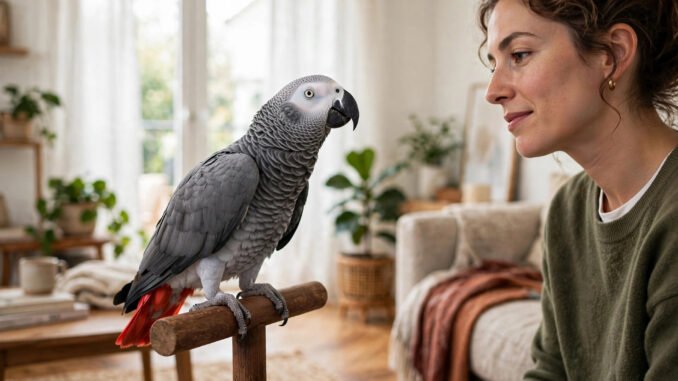
Somewhere between the third and thirtieth repetition of “hello,” every parrot owner asks the same question: how long does training a parrot to talk actually take before you see real results? The honest answer frustrates beginners: anywhere from a few weeks to over a year — and some parrots never talk at all, which is completely normal and not a training failure. Talking isn’t a trick you install; it’s a social behavior that emerges when the conditions are right. Here’s the realistic timeline and the method that actually produces results.
First, the Truth About Which Parrots Talk
Species matters enormously — more than training method. African greys and Amazon parrots are the renowned talkers, often developing vocabularies of dozens to hundreds of words. Budgies (parakeets) can learn surprising numbers of words despite their size. Cockatiels whistle tunes more readily than they speak. Conures, caiques, and many others may learn a few words or none — they’re no less intelligent, just less vocally inclined toward human speech.
Individual variation within species is huge. Two African greys with identical training can differ wildly — one chatting in context by age two, the other silent at five. Sex, personality, early socialization, and sheer individual inclination all play roles science doesn’t fully understand. The critical beginner mindset: train for communication and bonding, treat speech as a bonus. A parrot that never says a word but steps up happily, plays, and trusts you is a complete training success.
Age note: young birds (under 1–2 years) are generally most receptive, but older birds absolutely can learn — it just takes longer. And contrary to myth, you don’t need to get a baby; adult rehomes learn speech fine.
The Timeline: What “Real Results” Looks Like at Each Stage
Weeks 1–4: Foundation, zero speech expected
The first month isn’t about talking at all — it’s about trust. A parrot that doesn’t trust you won’t vocalize for you; parrots speak socially, to flock members they feel bonded with. Results to expect: the bird takes treats from your hand, steps up comfortably, relaxes in your presence (fluffed feathers, grinding beak — a contentment signal), and starts making its natural vocalizations (chirps, whistles, chatter) around you. If your parrot is already doing this, you’re ahead.
Months 2–4: The first mimicry window
With daily speech training, many receptive parrots produce their first recognizable word attempts in this window — often garbled, mumbled, or practiced quietly when they think no one’s listening (parrots famously rehearse under their breath). The classic first words: their name, “hello,” “good bird,” “pretty bird” — short, high-frequency, emotionally charged words.
What “results” look like here: the bird clearly attempting human speech sounds — babbling with speech-like cadence, repeating sound patterns. This is the stage where beginners either get encouraged (it’s working!) or discouraged (it’s been two months and he just mumbles). The mumbling IS the result. It’s the foundation.
Months 4–8: Vocabulary building
Receptive birds typically develop a small functional vocabulary here: 5–20 words or phrases, often used in context (saying “hello” when you enter, “night-night” at bedtime). Contextual use is the real milestone — it means the bird connects the sound to the situation, not just mimicking blindly. This is also when many parrots start combining words in novel ways (“wanna go night-night?”), which never ceases to delight.
Months 8–18: Fluency (for the gifted)
Strong talkers — particularly African greys, Amazons, and exceptional budgies — continue expanding indefinitely. Greys have demonstrated vocabularies exceeding 100 words with contextual and even seemingly cognitive use (the famous Alex studies by Dr. Irene Pepperberg showed conceptual understanding, not just mimicry). But this tier is the exception, not the expectation. Most pet parrots plateau at a charming handful of phrases — and that’s a wonderful outcome.
The Method That Actually Works
1. Talk to the bird, not at it. Narrate your day, greet enthusiastically, label everything. Parrots learn the speech they hear in emotional, social contexts — which is why they learn “hello!” (excited greeting) faster than “please pass the salt” (flat recitation). Training sessions of 10–15 minutes, 2–3 times daily, beat hour-long drills.
2. Repetition with enthusiasm. Pick 2–3 target words. Say them clearly, excitedly, in context — every time you enter the room: “HELLO, [name]!” Every time you offer a treat: “want a TREAT?” Exaggerated intonation works; parrots key on emotional prosody.
3. Train at the bird’s vocal times. Most parrots are chattiest in the morning and evening (dawn/dusk chorus instinct). Training during natural vocal periods is dramatically more effective than midday sessions when the bird wants to nap.
4. Reward any speech-like attempt instantly. The mumbled almost-word gets the biggest reaction and the best treat. You’re shaping successive approximations — rewarding each step closer to the target. Never laugh at failures in a way that startles; do celebrate attempts.
5. Use recordings sparingly. Looping recordings can help (many owners play target phrases during the day), but live social interaction teaches far faster. A recording is a supplement, never the method.
6. One person, one phrase, consistency. Everyone in the household should use the same words for the same situations. Five people saying “hi,” “hello,” “hey there,” and “what’s up” teaches none of them well.
Lafeber Pet Birds’ veterinarian-reviewed training resources and the AVMA’s bird care guidance both emphasize social-based training over rote drilling — the science backs the conversational method.
What Slows Training Down (Beginner Traps)
Training a scared bird. Fear shuts down vocal learning completely. If the bird isn’t hand-tame and relaxed, speech training is premature — build trust first, always.
Inconsistency. Training enthusiastically for a week, then forgetting for a month. Parrots learn from daily social exposure; sporadic effort produces sporadic results.
Too many target words. Beginners try to teach twenty phrases at once. The bird learns none well. Two or three targets until they’re solid, then add.
Punishing “wrong” sounds. Screaming, scolding, or reacting dramatically to unwanted vocalizations often reinforces them (any attention is attention). Ignore unwanted sounds; reward desired ones.
Expecting a timeline. The parrot doesn’t know about your six-week goal. Pressure and frustration leak into your tone, and parrots read tone exquisitely. Relaxed, playful trainers get talking birds; intense, deadline-driven trainers get silent ones.
It’s worth noting the commitment honestly: parrots live 20–80 years depending on species, need hours of daily interaction, and are among the most demanding pets in existence. If you’re still choosing, low-maintenance pets for apartment living offers necessary perspective — parrots are magnificent, and they are the opposite of low-maintenance. And for the travel question every bird owner eventually faces, finding pet-friendly hotels when road tripping covers traveling with animals generally.
Conclusion
How long does training a parrot to talk take before you see real results? First mumbling attempts in 2–4 months for receptive birds, a small contextual vocabulary by 4–8 months, and genuine fluency — for the gifted few — developing over the first year or two. But the deeper answer is that speech is a byproduct of the real project: building a trusting, communicative relationship with one of nature’s most intelligent animals. Train conversationally, reward every attempt, respect the bird’s timeline, and define success as communication — not performance. The parrot that greets you with a mumbled, imperfect “hello” after four months of work has given you something no timeline can measure.
Frequently Asked Questions
How long does it take to teach a parrot to talk?
Typically 2–4 months for first word attempts in receptive species, 4–8 months for a small contextual vocabulary. Some parrots never talk — which is normal individual variation, not training failure. Species, age, trust level, and daily training consistency all affect the timeline.
Which parrots talk the best?
African greys and Amazon parrots are the most renowned talkers; budgies punch far above their size. Cockatiels tend to whistle rather than speak. Conures and many other species may learn a few words or none. Individual variation within species is enormous.
Can an older parrot learn to talk?
Yes. Young birds (under 1–2 years) are generally most receptive, but adult parrots — including rehomes — absolutely can learn speech. It typically takes longer, and the foundation of trust matters even more with birds that have unknown histories.
Do parrots understand what they’re saying?
Sometimes remarkably so. Most use words contextually (greetings on arrival, “night-night” at bedtime). Research with African greys (notably Dr. Irene Pepperberg’s work with Alex) demonstrated conceptual understanding — labeling objects, colors, and quantities — going well beyond mimicry.
Why won’t my parrot talk despite months of training?
Check the foundations: does the bird fully trust you? Is training daily and consistent? Are you training during natural vocal periods (morning/evening)? Are targets limited to 2–3 words? And accept the real possibility that your individual bird simply isn’t speech-inclined — many brilliant, bonded parrots never say a word.
Leave a Reply