
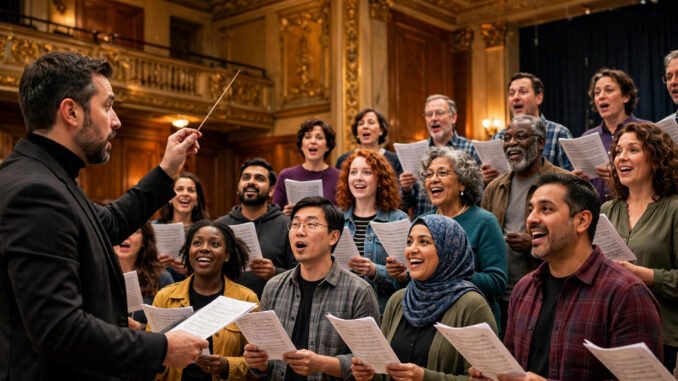
On your first night, you will stand in a hall with a folder of music you cannot quite read, surrounded by people who seem to know exactly when to breathe. By the third song, something kind happens: the voices around you carry your part, your ear finds its place, and you are singing in a harmony you could never have made alone. That is a community choir. It may be the cheapest joy in music. Many choirs ask for no audition at all, dues are often under $150 a season, and the room is full of people who were exactly as nervous as you on their first night.
A community choir is a volunteer ensemble of adults who gather each week to sing together under a director, and perform a few concerts across a season. Levels are mixed by design. One singer sang in school decades ago and has not sung since. The next has never sung outside the shower. A few read music fluently and quietly anchor their section. That mixture is not a flaw to apologise for. It is how the thing works: stronger singers lift the sound, newer singers bring numbers and energy, and the director shapes the whole into music no small group of experts could make on its own. For background on the form itself, the choir as an ensemble traces how these groups have worked for centuries.
The weekly reality: rehearsals and the season
A typical rehearsal runs about 2 hours, on one evening a week. Most choirs protect that slot fiercely, because one night a week is all they get. Arrive a few minutes early, find your seat in your section, and expect the evening to fall into three parts that soon feel familiar.
First come warm-ups, about 15 minutes of them. You will make silly sounds: sirens, lip trills, scales on nonsense words. They feel daft for one evening and sensible forever after, because they genuinely work. They wake up breath, range, and listening at the same time, and they give the whole room a shared, low-stakes start before any real music is asked for.
Next is sectional work. The choir splits into its voice parts, sopranos, altos, tenors, and basses, and each group drills its own line with patient repetition. This is where beginners learn fastest. Your part is played, sung around you, and repeated until it sits in your ear. Nobody expects you to arrive able to do this alone. The section exists so you do not have to.
The evening ends with full-choir run-throughs, where the director puts the parts together and sculpts the sound: a phrase softer here, a consonant together there, a breath taken as one body. This is the part people describe on the way home. Separate lines become a single sound, and your voice is inside it.
The season usually runs from September to May, with 2 to 4 concerts, plus occasional community appearances at festivals, fundraisers, and joint events with other groups. The deal you make in return is simple. Attend rehearsals consistently, because in a choir your absence is audible: a part with three singers sounds thin when one is missing. Practise lightly between rehearsals, about 30 minutes a week, using the practice tracks most choirs provide for each part. You are not asked for daily drills. You are asked to show up, listen, and learn your line a little at a time.
The money and the audition question
Costs stay low because the model is simple. Dues typically run $50 to $150 a season, hedged here as a typical range, and they cover the real expenses: printed music, venue hire, and an accompanist for rehearsals and concerts. Add the odd extra, such as a folder or a concert outfit you may already own, and the total often stays under $200 a year. Few weekly activities with this much life in them cost so little.
The audition question worries beginners most, and the answer is gentler than they fear. Many community choirs are fully non-auditioned: you sign up, you sing, you belong. Some hold a light placement sing, a few minutes alone with the director, singing a simple tune and matching a few notes. That is placement, not rejection. The director is working out which section suits your voice, so you start in the seat where you will succeed. A low voice sent to struggle with the soprano line helps nobody. A well-placed beginner settles in weeks.
The other fear is reading music. Many members cannot read it well, and directors expect that. Sections learn by ear, with practice tracks for each part, and notation becomes familiar slowly just by following along each week. If you want to understand what your voice is doing as it learns, a short read on the technique of singing covers breath, range, and voice types in plain terms. You do not need it before you join. Join first. Understanding follows singing, not the other way round.
Am I good enough is therefore the wrong question, and every director knows it. The right questions are: can you roughly match a pitch when it is played and sung around you, and will you come each week? If the answer to both is yes, or even a hopeful probably, you are the person community choirs are built for. Voices blend. That blending is forgiving by design, and it is why a room of ordinary singers can sound, together, far better than ordinary.
Step 1: Search for your choir
Start close to home, because a weekly rehearsal must survive dark evenings and busy weeks. Search online for community choir plus your town, and check choir directories, library noticeboards, and community listings. Church and school halls often host groups that advertise mostly by poster and word of mouth, so look offline as well as on a screen.
The same local listings that carry fairs, classes, and weekend events often carry choir intakes too, so the methods in how to find local events happening in your city work well for this hunt. Make a short list of two or three choirs within an easy trip. Note their rehearsal night, because that single fact rules groups in or out more honestly than any description of their repertoire.
Step 2: Visit a rehearsal before joining
Most choirs welcome visitors early in a season. Ask by email, arrive a little early, and sit where the director suggests, usually inside your likely section so you can feel the part around you. You may be given music and invited to join in for the warm-ups and any songs the choir already knows. Sing quietly until you find your feet. Everyone remembers doing the same.
Listen for a director who teaches, not just conducts. A good community director explains how to make a sound, fixes problems with humour, and gives sections the repetitions they need without shaming anyone. Watch the room, too. Do people look glad to be there? Do experienced singers help the person next to them find the page? That culture will be your weekly home for months, and it matters as much as the music list.
Step 3: Join at a season start
September and January intakes are the easiest doors. The whole choir is learning new music together, section leaders expect new faces, and nobody is the only person who does not know the songs. Mid-season joins do happen, especially in friendly non-auditioned groups, so ask rather than assume. But if a season start is near, take it. Starting together is a real advantage for confidence.
At joining, expect simple admin: a form, your dues, a folder of music, and advice on concert dress. Ask how practice tracks are shared, who leads your section, and what happens if you must miss a week. The polite habit is to tell your section leader in advance when you can. In a small section, that warning lets the director plan the evening around the voices that will be there.
Step 4: Commit to the season
Put the rehearsal night and every concert date in your calendar the day you join. Treat the rehearsal as a fixed appointment, like a class you have paid for, which in a small way it is. The season is the unit of commitment. Choirs plan music, seating, and concert balance around the singers who said they would be there, and a fair trial of choir life needs a full season anyway. The first month is learning. The pleasure deepens once the music is familiar and your section feels like your people.
Build the light home habit early. Ten minutes with a practice track while you cook, twice a week, plus one short sit-down with the folder, covers the roughly 30 minutes a week most choirs hope for. Sing your line quietly if the house is asleep. The goal is not perfection. It is arriving on rehearsal night with last week’s work still in your ear, so the evening builds instead of restarting.
What you get beyond the music
The obvious gain is musical. Many adults describe choir as the music education they never got, delivered joyfully at seasonal-dues prices. You learn rhythm, harmony, breath control, and how a piece of music is put together, without a single exam. That learning is real, and it compounds season after season.
The quieter gains keep people for years. A weekly structure in the calendar that is neither work nor errand. A new social circle across ages and jobs, united by one shared task. A reason to stand up straight, breathe deeply, and concentrate fully on something beautiful for two hours. Research on group singing links it with mood and a sense of connection, reported here as findings rather than promises, and most singers need no study to recognise the lift they feel on the drive home.
So pick the choir within easy reach, visit a rehearsal this month if the season allows it, and give it one full season before you judge. Bring a pencil, a bottle of water, and a voice exactly as it is. The room has been waiting for its missing part, and it may well be yours.
Leave a Reply