
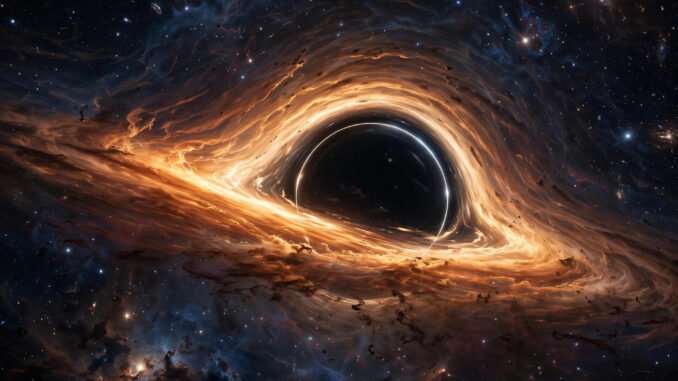
A region of space where gravity is so strong that nothing — not even light, the fastest thing in the universe — can escape. That’s a black hole, and it’s the most extreme object physics has ever described. As a complete beginner, black holes sound like science fiction, but they’re real, we’ve photographed them, and the basic ideas are genuinely understandable without any math. Here’s black holes explained in simple terms — what they are, how they form, and what we’ve actually learned about them.
The Core Idea: Escape Velocity Gone Mad
Every object has an escape velocity — the speed you’d need to break free of its gravity. Earth’s is about 25,000 mph (that’s why rockets are so powerful). The Sun’s is much higher. A black hole is what happens when so much mass is packed into such a small space that the escape velocity exceeds the speed of light — 670 million mph, the universe’s absolute speed limit. Since nothing can go faster than light, nothing escapes. Not matter, not radiation, not information. That’s the whole concept: gravity wins so completely that exit becomes physically impossible.
The boundary where escape becomes impossible is called the event horizon — often described as the black hole’s “surface,” though it’s not a physical surface at all. It’s a mathematical boundary: cross it, and every possible path leads inward. There’s no dramatic wall or warning sign — an astronaut falling through a large black hole’s event horizon wouldn’t feel anything special at the crossing. The weirdness is all in what the horizon means: a point of no return written into the geometry of spacetime itself.
How Black Holes Form (Stellar Collapse)
The most common type — stellar-mass black holes — forms when a massive star dies. Here’s the life story: stars spend their lives in a balance — gravity crushing inward, nuclear fusion pushing outward. When a star more than ~20 times the Sun’s mass exhausts its fuel, fusion stops, and gravity wins instantly. The core collapses in seconds. The outer layers rebound off the collapsing core and explode outward as a supernova — one of the most violent events in nature — while the core crushes down past every known stopping point.
What stops collapse for smaller stars: electron pressure makes white dwarfs; neutron pressure makes neutron stars (a teaspoon of neutron star would weigh billions of tons). But above ~2–3 solar masses of core remnant, no known force can resist — collapse continues to a singularity, a point where our current physics says density becomes infinite and the equations break down. That breakdown isn’t a failure of the universe — it’s a signpost saying “new physics needed here,” and it’s why black holes sit at the frontier of theoretical physics.
The Types: Not All Black Holes Are Equal
Stellar-mass black holes (3–100x the Sun’s mass): the corpses of massive stars, scattered through galaxies. The Milky Way likely contains millions. We detect them when they pull gas from companion stars — the gas heats to millions of degrees and glows in X-rays before vanishing past the horizon.
Supermassive black holes (millions to billions of solar masses): monsters lurking at the center of essentially every large galaxy, including ours. Sagittarius A* — the Milky Way’s central black hole — packs 4.3 million solar masses into a region smaller than Mercury’s orbit. How supermassives grew so large is still an active mystery; they seem to have existed surprisingly early in cosmic history.
Intermediate-mass black holes (hundreds to hundreds of thousands of solar masses): the long-hypothesized missing link — increasingly confirmed by gravitational-wave detections of mergers building up through this range.
Primordial black holes (hypothetical, possibly tiny): could have formed in the Big Bang’s extreme conditions rather than from stars — a candidate explanation for some dark matter, though unconfirmed.
What We’ve Actually Seen (The Evidence)
Black holes are black — they emit no light — so we see them by their effects. And the evidence has become spectacular:
2015 — Gravitational waves: LIGO detected ripples in spacetime from two black holes colliding 1.3 billion light-years away — the first direct detection, confirming a century-old Einstein prediction and opening an entirely new way of observing the universe. Dozens of mergers have been detected since, including the 2019 signal from a 142-solar-mass merger — the first solid intermediate-mass detection.
2019 — The first photograph: the Event Horizon Telescope (a planet-sized virtual telescope made by linking radio observatories worldwide) imaged the shadow of the supermassive black hole in galaxy M87 — a glowing ring of superheated gas around a dark central shadow, 55 million light-years away. It looked exactly like Einstein’s equations predicted.
2022 — Our own black hole, imaged: the EHT released the image of Sagittarius A*, the Milky Way’s central black hole — the same ring-and-shadow structure, 27,000 light-years away in our own galactic backyard.
2020 — The Nobel Prize: Roger Penrose (proving black holes are an inevitable consequence of general relativity), Reinhard Genzel and Andrea Ghez (three decades tracking stars orbiting our galaxy’s invisible central mass) — black hole science recognized at the highest level.
For ongoing coverage, NASA’s universe exploration pages track black hole discoveries as they happen, and the Event Horizon Telescope collaboration publishes the imaging science directly. And if the cosmic scale has sparked broader curiosity, the best sci-fi books to read this year offers the fictional explorations — many inspired directly by real black hole physics — while great science documentaries cover the human story of these discoveries.
The Mind-Bending Parts (Simplified)
Time slows near a black hole. Einstein’s relativity says gravity dilates time — clocks near a black hole tick slower relative to distant observers. At the event horizon, time (as seen from outside) effectively stops. This isn’t metaphorical; GPS satellites must correct for the same effect (much weaker) from Earth’s gravity.
Spaghettification. Falling feet-first into a stellar-mass black hole, the gravity at your feet would vastly exceed that at your head — stretching you into a long thin strand. (For supermassive black holes, the gradient at the horizon is gentler — you’d cross unharmed and only meet spaghettification deeper inside. Small comfort.)
Hawking radiation. Stephen Hawking showed that black holes aren’t perfectly black — quantum effects at the horizon cause them to slowly radiate energy and evaporate. For stellar-mass black holes this takes vastly longer than the universe’s age, so it’s theoretical rather than observable — but it created the famous “black hole information paradox” that still drives theoretical physics.
They’re not cosmic vacuum cleaners. The most common misconception: black holes don’t “suck” things in from across the galaxy. Outside the event horizon, a black hole’s gravity works like any mass — if the Sun were replaced by a same-mass black hole, Earth’s orbit wouldn’t change at all (we’d just freeze in the dark). You only fall in if you get close.
Why Black Holes Matter
Beyond the wonder, black holes are physics laboratories for the deepest questions: how gravity and quantum mechanics reconcile (they currently don’t — black holes are where the contradiction is sharpest), and what happens at singularities (where our equations break — the signpost to new physics). Every gravitational-wave detection and every EHT image is data for these questions.
Conclusion
Black holes in simple terms: places where so much mass collapsed into so little space that escape velocity exceeds light speed, bounded by an event horizon that’s a point of no return. They form from dying massive stars (stellar-mass) and lurk at galaxy centers (supermassive, including our own Sagittarius A*). We’ve photographed two, heard dozens collide via gravitational waves, and awarded Nobel Prizes for proving they’re real. They slow time, stretch matter into strands, and slowly evaporate via Hawking radiation — and they mark the exact boundary where Einstein’s relativity and quantum mechanics collide. You don’t need math to grasp the wonder: somewhere out there, gravity won so completely that even light can’t leave. And we can see its shadow.
Frequently Asked Questions
What is a black hole in simple terms?
A region where gravity is so intense that nothing — not even light — can escape. It forms when a massive star’s core collapses past the point where any known force can resist. The boundary of no return is called the event horizon; inside it, all paths lead inward to the singularity.
How do black holes form?
Most form when stars over ~20 times the Sun’s mass exhaust their fuel: fusion stops, gravity crushes the core in seconds, the outer layers explode as a supernova, and the core collapses past neutron-star density into a singularity. Supermassive black holes at galaxy centers formed through processes still being researched.
Have we actually photographed a black hole?
Yes — twice. The Event Horizon Telescope imaged the supermassive black hole in galaxy M87 in 2019 and our own galaxy’s Sagittarius A* in 2022. Both show the predicted glowing ring of hot gas around a dark central shadow — matching Einstein’s equations remarkably well.
Leave a Reply