
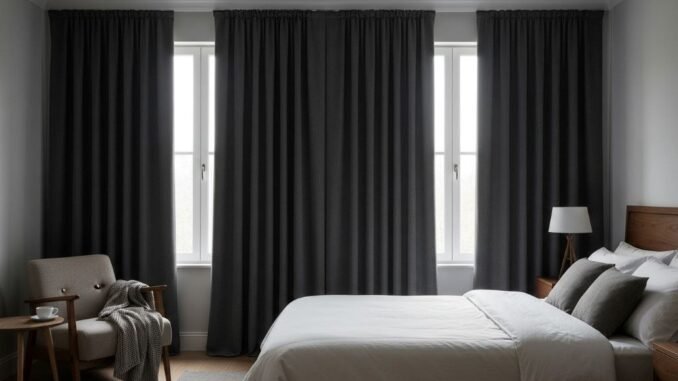
Most “blackout” curtains don’t. They dim the room, glow around the edges, and leave you wondering why the streetlight still paints stripes on your ceiling at midnight. Learning how to choose curtains that actually block out light means understanding that true darkness is 20% fabric and 80% installation — light leaks around edges defeat even the best material. As someone who’s blacked out three bedrooms (including one facing a parking lot floodlight), here’s what actually works.
Fabric: What Actually Blocks Light
- Triple-weave blackout fabric: the best option — three layers woven together (face fabric, black light-blocking core, backing). Blocks 99–100% of light, no rubbery coating to crack or peel, drapes like normal curtains, and often provides thermal insulation too. Look for “triple weave” specifically on the label.
- Foam-backed blackout: cheaper ($20–$40/panel), effective initially — but the foam cracks and flakes after 2–3 years of sun exposure and washing. Fine for a rental; not a long-term choice.
- “Room darkening” vs. “blackout”: not the same thing. Room-darkening blocks 90–95% (fine for living rooms); blackout should block 99%+. Check the label — marketing blurs this deliberately.
- Color myth: dark colors don’t block more light than light colors in true blackout fabric — the middle blocking layer does the work. A white triple-weave curtain blocks as much as a black one.
Installation: Where Darkness Is Won or Lost
This is the part everyone gets wrong. Light leaks around curtains, not through them:
- Mount high and wide: rod 4–6 inches above the window frame and 8–12 inches wider on each side. When closed, the curtain should cover wall, not just glass — this kills side leaks.
- Length to the floor (or sill, for deep sills): short curtains leak light underneath. Puddling 1–2 inches on the floor seals the bottom completely.
- Wrap-around (French return) rods: curved ends that bring the curtain back to the wall — eliminates the side gap entirely. The single best hardware upgrade for blackout ($25–$45).
- Overlap in the middle: one wide panel beats two narrow ones (no center gap); with two panels, ensure 4+ inches of overlap when closed. Magnetic curtain ties ($10) can seal the center seam.
- Top gap: light pouring over the rod? Add a pelmet/valance or mount the rod close to the ceiling with the curtain extending above the frame.
How Do I Choose Curtains That Actually Block Out Light? The Nuclear Options
- Blackout roller shade + curtains: the gold standard — a $30–$60 blackout roller mounted inside the frame seals the glass, curtains provide the edge coverage and looks. Combined = near-total darkness. This is what hotels do (sheers + blackout roller).
- Portable blackout panels ($25–$40 — suction-cup or Velcro): for renters or travel — stick directly to the glass, zero light gaps. Ugly but ruthlessly effective.
- Window film: static-cling blackout film ($15–$25/window) — total darkness, but you lose the window entirely (no peeking out).
Measuring and Buying
- Width: total curtain width should be 2–2.5x the rod width for proper fullness — skimpy curtains leak light through stretched fabric.
- Budget: decent triple-weave blackout panels run $25–$50 per panel (NICETOWN, RYB HOME on Amazon are the value leaders). A standard window needs 2 panels: $50–$100 total.
- Test before committing: hold the fabric up to a bright light in the store (or check reviews mentioning light leakage). If you see pinpricks of light, it’s not true blackout.
- Washing: triple-weave is machine-washable; foam-backed is not (the foam disintegrates). Another reason triple-weave wins long-term.
The Sleep Foundation notes that even small amounts of light exposure disrupt melatonin and sleep quality — true darkness isn’t a luxury, it’s a health intervention. Triple-weave fabric, mounted high and wide with wrap-around rods, gets you there for under $100 a window. Your 6 a.m. self will thank you.
Blackout Curtain Mistakes to Avoid
- Buying “room darkening” expecting blackout: room-darkening blocks 90–95% — fine for living rooms, inadequate for sleep. True blackout = 99%+. Marketing blurs this deliberately — read the label, and check reviews for light-leakage complaints.
- Mounting the rod just wider than the window: light leaks around edges, not through fabric — a rod barely wider than the frame guarantees side gaps. Mount 8–12 inches wider per side and 4–6 inches above the frame.
- Two skimpy panels instead of full coverage: curtains need 2–2.5x the rod width in fabric for proper fullness — stretched-thin curtains leak light through the weave and leave a center gap. Fullness is functional, not decorative.
- Foam-backed for long-term use: the foam cracks and flakes within 2–3 years of sun and washing. Triple-weave fabric costs slightly more ($25–$50/panel) and lasts indefinitely — it’s machine-washable too.
Blackout Curtain FAQs
Do blackout curtains really block all light?
Triple-weave blackout fabric blocks 99–100% — but installation determines the result. Curtains mounted high, wide, and to the floor with wrap-around rods achieve near-total darkness. Skimpy mounting leaks light around every edge. 20% fabric, 80% installation.
What’s better: blackout curtains or blinds?
For true darkness: the combination. A blackout roller shade ($30–$60, mounted inside the frame) seals the glass; curtains handle edge coverage and aesthetics. Either alone leaks somewhere — together they’re the hotel standard for a reason.
Will blackout curtains help with heat/cold?
Yes, meaningfully — triple-weave curtains add a real insulating layer, reducing heat gain in summer and heat loss in winter around windows (the leakiest part of most rooms). They’re a legitimate energy upgrade, not just a sleep aid.
How do I make them work in a rental?
FAQs
What’s the difference between blackout and room-darkening curtains?
Blackout curtains block 99–100% of light; room-darkening (sometimes called dim-out) blocks most light but lets some through around the edges and through the fabric. For shift workers, migraine sufferers, or anyone serious about sleep, true blackout is the move. Room-darkening works fine for TV glare and general comfort. Check the product specs rather than trusting the name — marketing is loose with these terms, and “blackout” on a thin single-layer panel is often a stretch.
Why do my blackout curtains still let light in around the edges?
Light leakage almost always comes from the fit, not the fabric. Gaps at the sides, top, and bottom let light stream in no matter how opaque the material is. The fixes: mount the rod wider and higher than the window so the panel overlaps the wall generously, use a wraparound rod that curves back to the wall, and choose panels long enough to reach the floor or sill. A perfectly fitted mid-range blackout curtain outperforms an expensive one hung too narrow.
Do blackout curtains help with heat and noise too?
Yes, noticeably. The same dense, multi-layer construction that blocks light also insulates — blackout curtains can meaningfully reduce heat gain in summer and heat loss in winter, especially on older single-pane windows. Noise reduction is real but modest; they take the edge off street noise but won’t soundproof a room. If energy savings are part of your goal, look for curtains with a thermal backing, which adds another layer of insulation.
Can I make my existing curtains block more light?
You can get partway there. Blackout liners that clip or hook onto your existing panels are the easiest upgrade and work surprisingly well. Layering a second set of curtains — sheers plus a heavier panel, for instance — also helps. But if your current curtains are thin and the rod is mounted inside the window frame, you’ll hit limits. At some point the honest answer is that new, properly fitted blackout panels cost less than you’d expect and solve the problem completely.
Tension rods inside the frame (no drilling) + extra-wide panels for overlap, or portable blackout panels ($25–$40, suction-cup/Velcro directly to glass — zero light gaps, ugly but ruthless). Command-hook mounted wrap rods are another drill-free option.
Leave a Reply