
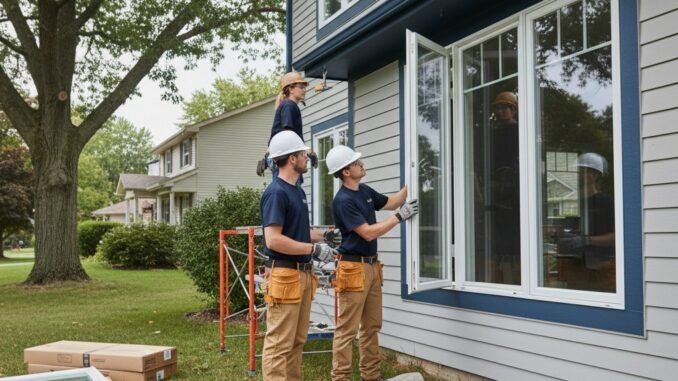
How much does it cost to install new windows in a house? The national range for a full-house replacement (10–15 windows) is $5,000–$15,000, or $300–$1,000 per window installed. Most homeowners pay around $500–$700 per window for quality vinyl replacements. It’s a big-ticket project, but new windows cut energy bills 10–25%, kill drafts, and return roughly 70% of cost at resale. Here’s the complete pricing picture.
Cost Per Window by Material
- Vinyl: $300–$700 installed. The value champion — energy-efficient, maintenance-free, and 70% of US replacements. Brands: Andersen 100 Series, Pella 250 Series, Milgard.
- Wood: $800–$1,500+ installed. Beautiful, traditional, but needs painting/staining maintenance. Best for historic homes.
- Wood-clad: $700–$1,200 installed. Wood interior, aluminum/fiberglass exterior — the look of wood with low exterior maintenance.
- Fiberglass: $600–$1,000 installed. Extremely durable, low expansion/contraction, paintable. The premium low-maintenance pick (Andersen 400 Series, Marvin Integrity).
- Aluminum: $400–$900 installed. Strong and slim-framed, but poor insulation — avoid in cold climates.
Full-Frame vs. Retrofit (Insert) Installation
This choice swings cost 30–50%:
- Retrofit/insert ($300–$700/window): new window slides into the existing frame. Faster (30–60 min/window), cheaper, no interior/exterior trim damage. Works when existing frames are solid and square.
- Full-frame ($500–$1,000+/window): entire old window and frame removed down to studs. Needed for rotted frames, major air leaks, or size changes. More labor, but fixes underlying problems and maximizes glass area.
Honest take: if your frames are in good shape, retrofit is the smart money. Full-frame is for damaged frames or when you want a different window style/size.
What Drives the Price Up
- Window style: double-hung and sliders are cheapest; casement, bay, bow, and picture windows cost 50–200% more.
- Glass packages: double-pane low-E is standard now; triple-pane adds $100–$200/window — worth it in very cold climates (zones 6–7), marginal elsewhere.
- Size and custom shapes: standard sizes are cheapest; arches, circles, and oversized units cost more and take longer.
- Second-story windows: add $50–$100/window for ladder/scaffold work.
- Lead paint: pre-1978 homes may need RRP-certified installers — adds cost but it’s federal law.
- Your market: labor in the Northeast and West Coast runs 30–50% above the Midwest/South.
How Much Does It Cost to Install New Windows in a House? Smart Shopping
- Get 3–4 quotes — and make sure they’re quoting the same window spec (U-factor, SHGC, air infiltration). A cheap quote on a cheap window isn’t a deal.
- Check the NFRC label: look for U-factor ≤0.30 (lower = better insulation) and climate-appropriate SHGC. ENERGY STAR certified is the baseline — the ENERGY STAR site lists qualified products by climate zone.
- Ask about the warranty: lifetime glass warranties are common; labor warranty (2–10 years) separates good installers from bad ones.
- Timing: late fall and winter are slow season — 10–20% discounts are common.
- Don’t replace all at once if budget’s tight: do the worst offenders (drafty, broken seals) first. There’s no rule saying all 15 happen the same day.
- Watch for the foggy-window tell: condensation between panes = failed seal = that window’s insulation is gone. Prioritize those.
Financing reality check: at $8,000 for 12 windows saving $300–$500/year on energy, the pure payback is 15+ years — but comfort, noise reduction, UV protection for furnishings, and resale value make it worthwhile well before that. Get the quotes, check the NFRC labels, and don’t let anyone sell you triple-pane in Texas.
Window Replacement Mistakes to Avoid
- Comparing quotes on price alone: a cheap quote on a cheap window (high U-factor, no low-E) isn’t a deal — it’s a drafty mistake you’ll live with for 20 years. Compare the NFRC label specs (U-factor, SHGC, air infiltration), not just dollars.
- Full-frame when retrofit would do: full-frame costs 30–50% more — justified for rotted frames or size changes, wasteful when existing frames are solid. An honest installer tells you which you need.
- Ignoring the installation warranty: the glass warranty (often lifetime) means nothing if the labor warranty is 90 days and the install leaks in year two. 2–10 year labor warranty separates good installers from bad.
- Replacing windows for energy savings alone: the payback is 15+ years on energy alone. Replace for drafts, failed seals, noise, and operability — the comfort and livability payoff is immediate and real.
Window Installation FAQs
How long does window installation take?
30–60 minutes per window for retrofit; 1–2 hours for full-frame. A full house (10–15 windows) typically takes 1–2 days with a crew. You’ll have open holes briefly — installers work one window at a time to minimize exposure.
What do U-factor and SHGC mean?
U-factor: insulation value — lower is better (look for ≤0.30). SHGC (Solar Heat Gain Coefficient): how much sun heat passes through — lower for hot climates (blocks heat), higher for cold climates (welcomes free solar warmth). Match both to your climate zone via ENERGY STAR guidance.
Should I get triple-pane windows?
Cold climates (zones 6–7): yes — the comfort and energy difference is meaningful. Moderate climates: usually not worth the $100–$200/window premium — high-quality double-pane low-E captures most of the benefit. Hot climates: spend the money on low SHGC instead.
Can I replace windows in winter?
Yes — and it’s often cheaper (10–20% off-season discounts). Installers work one opening at a time (15–30 minutes of exposure per window), so heat loss is minimal. Caulk needs 40°F+ to cure properly — reputable installers schedule accordingly.
The Retrofit Advantage Most People Miss
Here’s what window salespeople won’t emphasize: on a house with solid existing frames, retrofit (insert) installation delivers ~90% of the benefit (new glass, new seals, new operation) at 60–70% of the cost — and it’s done in half the time with zero trim damage inside or out. The cases genuinely needing full-frame: rotted frames, major air leaks around the frame itself, or changing the window size/style. Everything else? Retrofit. Get quotes for both methods from each installer — the price difference on 12 windows is often $2,000–$4,000, and you’ll know within one honest conversation which your house actually needs.
Leave a Reply