
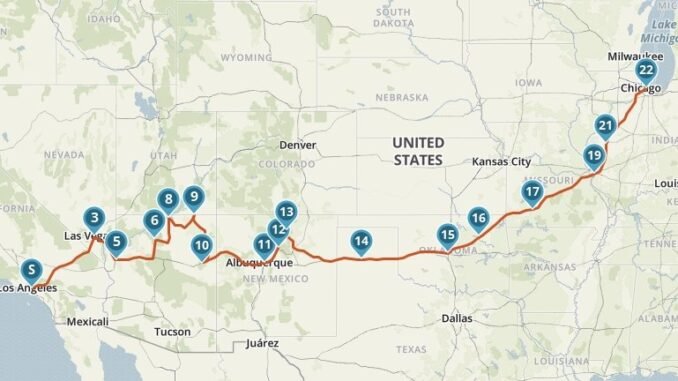
The American road trip is the great national art form — 2,000 miles of diners, desert sunsets, weird roadside attractions, and the specific joy of a gas station coffee at dawn in a state you’ve never seen. But the difference between an epic trip and an exhausting one is planning. If you’re asking how do I plan a road trip across the US with stops, here’s the full system: choosing your route, pacing it right, picking stops worth stopping for, budgeting honestly, and the logistics that prevent roadside misery.
Let’s start with the rule that governs everything: plan the skeleton, improvise the flesh. Book the non-negotiables (first night, national park lodges, any must-be-there dates); leave gaps for the roadside dinosaur museum you didn’t know you needed.
How Do I Plan a Road Trip Across the US With Stops? Choose Your Route
Classic routes worth considering
- Route 66 (Chicago → LA, ~2,400 mi): the legend — neon signs, vintage motels, Cadillac Ranch. 2–3 weeks ideal. More nostalgia than scenery in stretches, but the Americana is unmatched.
- Pacific Coast Highway (SF → LA, ~450 mi): the most beautiful drive in America, doable in 3–5 days. Big Sur alone justifies it.
- Blue Ridge Parkway (VA → NC, ~470 mi): 3–4 days of mountain overlooks, waterfalls, and small towns. Peak fall color is transcendent.
- The Southern Tier (coast to coast via the South): Nashville → Memphis → New Orleans → Texas → desert Southwest. Music, food, and landscapes — 2–3 weeks.
- The Northern Tier (Seattle → Chicago → Boston): Cascades, Glacier, Badlands, Great Lakes. Best in summer; 2–3 weeks.
- Build your own: pick 4–6 anchor destinations and connect the dots. Google Maps’ multi-stop routing handles up to 10 stops — the algorithm does the tedious part.
Pacing: the 4-hour rule
Limit driving to 3–5 hours per day (200–300 miles). More than that and you’re not road-tripping — you’re commuting across states. Arrive by mid-afternoon everywhere; mornings are for the road, afternoons for the place. Build in a zero-mile day every 4–5 days — a full day somewhere great with no driving. These rest days are what separate trips you remember fondly from endurance tests.
Picking Stops Worth Stopping For
Layer three types of stops:
- Anchor stops (1–2 days each): national parks, great cities, the Grand Canyon — the reasons for the trip. Book lodging ahead, especially parks (6–12 months for in-park lodges). Our national parks guide helps if kids are along.
- Discovery stops (2–4 hours): small towns, roadside attractions, state parks, famous diners. Find them via Roadtrippers.com, Atlas Obscura, or asking locals (“what shouldn’t we miss around here?” — the answers are always better than Google).
- Stretch stops (20 min): every 2 hours, get out. Scenic overlooks, quirky photo ops, the world’s largest ball of twine. These micro-stops prevent the highway trance and produce the trip’s best stories.
The ratio matters: if every stop is an anchor, you’ll be exhausted; if none are, you’ll wonder why you didn’t fly. Aim for 60% planned, 40% spontaneous — the best road trip memories are almost always unplanned.
Budget: The Real Numbers
For two people, $200–$300/day all-in is realistic mid-range:
- Gas: at 25 mpg and $3.50/gal, 300 miles = ~$42/day. Total cross-country fuel: $300–$500.
- Lodging ($100–$180/night): mix of motels, Airbnb, and the occasional splurge. Book anchors ahead; wing it elsewhere with HotelTonight.
- Food ($60–$100/day for two): diners, BBQ joints, taco trucks — road food is America’s great cuisine. Grocery breakfasts + one restaurant meal daily keeps costs sane.
- Attractions ($20–$40/day averaged): the $80 America the Beautiful pass covers all national parks for a year — buy it if visiting 3+ parks.
- Buffer 15%: tires, towing, the unplanned detour. Road trips without a buffer become stressful the moment anything goes sideways.
Logistics That Prevent Misery
- Car prep: oil change, tire check (including the spare), wiper fluid, coolant — a $100 pre-trip inspection beats a $800 desert tow. AAA membership ($60–$100/year) is the cheapest peace of mind in road-tripping.
- Pack the car kit: cooler with drinks and healthy road snacks, paper towels, trash bags, basic tools, jumper cables, flashlight, blanket, phone mounts + car chargers, printed backup directions (dead zones are real in the West).
- Apps: GasBuddy (fuel prices), iOverlander (free camping), Roadtrippers (stop discovery), Audubon/AllTrails (hikes), and offline Google Maps downloaded for rural stretches.
- Playlist + podcasts: download heavily — hours of no-service driving await. This is prime audio entertainment territory.
- Hotel strategy: book the first night and anchors; for in-between nights, decide by 3 PM daily. Small-town motels rarely sell out except near parks and events.
Desert and Mountain Driving: The Survival Guide
The most spectacular American road trips cross the emptiest landscapes — and empty landscapes demand respect. Desert driving (Southwest summer): carry one gallon of water per person plus extra coolant. If the temperature gauge climbs, turn off the AC and turn on the heater (it pulls heat off the engine — miserable but effective). Never leave the paved road without telling someone your route. Gas up at half a tank — stations can be 100+ miles apart in Utah, Nevada, and West Texas.
Mountain driving (Rockies, Sierras): downshift on descents instead of riding the brakes (brake fade on a 6% grade is terrifying and real). Watch for altitude effects — you’ll tire faster, water boils differently, and weather changes in minutes. Carry chains or know your rental’s policy in shoulder seasons. Wildlife: dawn and dusk are the danger hours for deer and elk, especially in the Rockies and Appalachians. If an animal runs out, brake firmly in your lane — swerving causes the rollovers. Phone dead zones: download offline maps for the entire rural West; they’re not optional there. The National Park Service trip planning guides cover park-specific driving hazards — check them for every park on your route. The empty stretches are the point of the trip; treat them with preparation, not fear.
The Bottom Line
Plan a US road trip with: a classic route (or 4–6 anchors connected by multi-stop maps), 3–5 hour driving days with a rest day every 4–5, layered stops (anchors + discoveries + stretch breaks), a $200–$300/day budget with 15% buffer, and a prepped car with AAA. Book the skeleton, improvise the flesh. The trip you’ll remember isn’t the one that went perfectly — it’s the one with the detour.
Leave a Reply