
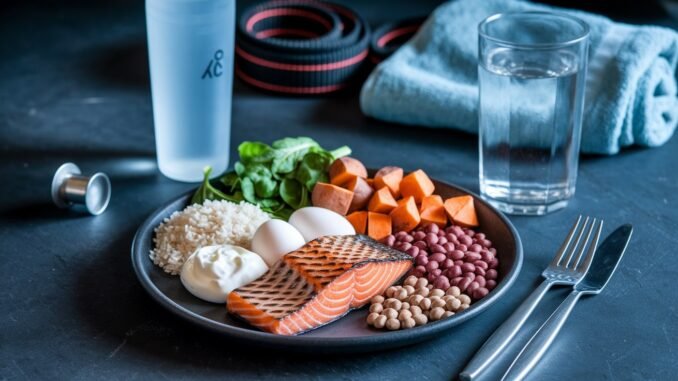
You crushed the workout. Now you’re standing in front of the fridge, starving, wondering if you need a $60 tub of recovery powder or if a sandwich will do. What should I eat after a workout to recover faster? The supplement industry has strong opinions (all of them expensive), but sports nutrition research is refreshingly simple: protein to repair, carbs to refuel, fluids to rehydrate, and timing that’s far more flexible than the old “30-minute anabolic window” myth suggested. I’ve dialed in my own post-workout eating over years of training, and the truth is gloriously boring.
Here’s what to eat, when to eat it, and what you can safely ignore.
What Should I Eat After a Workout to Recover Faster? The Two Priorities
Priority 1: Protein (20–40 Grams)
Exercise — especially strength training — creates microscopic muscle damage. Protein provides the amino acids to repair and build it back stronger. Research supports roughly 20–40 grams of quality protein after a workout, with the higher end for larger people and harder sessions. Leucine, an amino acid abundant in dairy, eggs, and meat, is the key trigger for muscle protein synthesis.
Excellent real-food options (no powder required):
- Greek yogurt (1 cup: ~20g protein) with berries and honey
- 3-egg omelet with cheese (~22g)
- Chicken breast sandwich on whole-grain bread (~35g)
- Tuna or salmon with rice (~30g)
- Cottage cheese (1 cup: ~25g) with fruit
- Chocolate milk (16 oz: ~16g protein plus ideal carb ratio — the most underrated recovery drink in existence, about $1)
- Protein shake (1 scoop whey: ~25g) — convenient, not magical
- Lentil or bean-based meal (~18g per cooked cup) for plant-based eaters — combine with grains for complete amino acids
Priority 2: Carbohydrates (Don’t Fear Them)
Carbs refill muscle glycogen — your muscles’ fuel tank. This matters most if you train hard, train long (60+ minutes), or train again within 24 hours. For a moderate 45-minute session, your next regular meal’s carbs are plenty. For endurance athletes and two-a-day trainers, aim for roughly 1–1.2g of carbs per kg of body weight in the hours after. Good sources: rice, oats, potatoes, fruit, bread, pasta. The post-workout window is genuinely the best time of day to eat carbs — your muscles are primed to soak them up rather than store them as fat.
Timing: The “Anabolic Window” Is Mostly a Myth
You’ve heard you must eat within 30 minutes or the workout was wasted. The research doesn’t support the panic: total daily protein intake matters far more than precise timing. That said, eating within 1–2 hours after training is sensible — you’re hungry anyway, and it kickstarts recovery. If you trained fasted (morning workout, no breakfast), eat sooner rather than later. If you ate a solid meal 2–3 hours before training, you’ve got even more flexibility. Practical rule: eat a real meal with protein and carbs within 2 hours of finishing. Done. No stopwatch needed.
Hydration deserves equal billing: weigh yourself before and after long or sweaty sessions if you’re serious — drink about 1.5x the weight lost in fluids over the next few hours. Water is fine for sessions under an hour; for longer efforts, add electrolytes (sodium especially). And this connects to the bigger picture of daily hydration needs — workout days just need more.
Sample Post-Workout Meals
- The classic: grilled chicken, rice, and vegetables — ~40g protein, plenty of carbs, endlessly customizable.
- The quick one: chocolate milk + banana — under $2, 5 seconds of prep, surprisingly evidence-backed.
- The breakfast trainer: oatmeal made with milk, topped with peanut butter and berries — ~25g protein.
- The plant-based: tofu stir-fry with rice and edamame, or a lentil-quinoa bowl — ~25g protein with complete aminos.
- The “I have no time”: Greek yogurt cup + granola bar + piece of fruit — eaten in the car, totally fine.
If you’re training consistently, zoom out: recovery nutrition is a daily pattern, not a single meal. Hitting roughly 0.7–1g of protein per pound of target body weight across the whole day, eating enough total calories (undereating sabotages recovery more than any supplement helps), and sleeping 7–9 hours will do more for your progress than any post-workout ritual. This fits into a sustainable eating system for busy schedules — batch-cooked proteins make post-workout meals effortless.
Supplements: What Helps, What’s Hype
- Creatine monohydrate (3–5g daily): the most evidence-backed sports supplement in existence. Cheap (~$20 for months), safe for healthy people, effective for strength and power. Timing doesn’t matter; daily consistency does.
- Whey/casein protein: convenient, not superior to food. Useful if you struggle to hit protein targets.
- Caffeine: genuinely performance-enhancing pre-workout, but that’s before, not after.
- BCAAs: largely redundant if you eat enough total protein. Skip.
- “Recovery blends” and test boosters: expensive marketing. Skip.
- Tart cherry juice: small but real evidence for reducing muscle soreness. Tasty, at least.
The American College of Sports Medicine’s nutrition guidance and the Journal of the International Society of Sports Nutrition position stands are the gold-standard references if you want the primary science.
What About Fasted Training?
Training on an empty stomach — popular with morning exercisers and intermittent fasters — changes the equation slightly. For moderate workouts under an hour, fasted training is fine for most people; your body has stored glycogen to draw on. But prioritize eating after: a fasted workout followed by delayed eating extends the recovery window unnecessarily. Aim to eat within an hour post-workout on fasted training days, with extra attention to protein (30–40g). If you feel dizzy, nauseous, or unusually weak training fasted, that’s your body voting — eat something small beforehand (a banana 30 minutes prior is enough). There’s no moral superiority in fasted training; it’s a scheduling convenience that works for some and sabotages others. And if you’re experimenting with intermittent fasting, aligning your eating window to open right after your workout solves the whole puzzle elegantly.
The practical takeaway: within 2 hours of training, eat a real meal with 20–40g protein and solid carbs, drink plenty of fluids, and don’t stress the stopwatch. Hit your daily protein target, sleep well, and save your money — the $60 recovery powder is selling you a more expensive version of chocolate milk.
Leave a Reply