
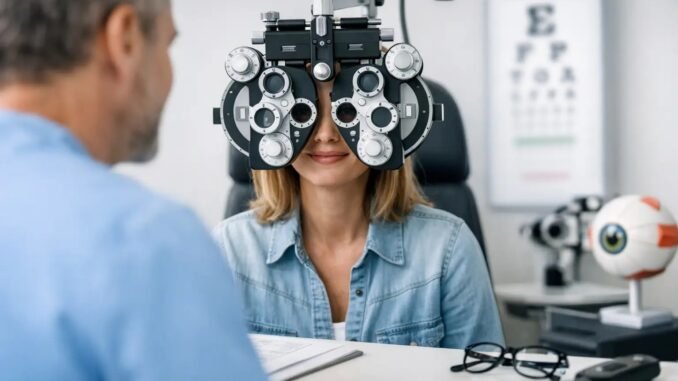
When was your last eye exam? If you’re squinting to remember, you’re not alone — vision care is one of the most neglected parts of adult health. We get our teeth cleaned twice a year and our cars serviced on schedule, but our eyes? “I’ll go when something’s wrong.” How often should I get my eyes checked as an adult? The answer depends on your age, your health, and your risk factors — and “when something’s wrong” is often too late, because the scariest eye diseases are painless and silent until they’ve already stolen vision.
Here’s the schedule eye doctors actually recommend, what happens at an exam, and the warning signs that mean “don’t wait for your next scheduled visit.”
How Often Should I Get My Eyes Checked as an Adult? The Age-Based Schedule
The American Optometric Association and the American Academy of Ophthalmology recommend:
- Ages 18–39, healthy, no symptoms: at least every 2 years. If you wear glasses or contacts, yearly — your prescription and eye health need monitoring.
- Ages 40–54: every 2 years at minimum. This is when presbyopia (the “arms getting too short to read” phase) typically arrives, and when early signs of eye disease start appearing.
- Ages 55–64: every 1–2 years. Risk of cataracts, glaucoma, and macular degeneration climbs.
- Age 65+: every year, no exceptions. At this stage, annual exams catch the diseases that cause most blindness in older Americans.
Get Checked Yearly (Regardless of Age) If You:
- Have diabetes — diabetic retinopathy is a leading cause of adult blindness, and it’s largely preventable with early detection
- Have high blood pressure
- Have a family history of glaucoma or macular degeneration
- Wear contact lenses (higher infection and corneal risks)
- Take medications with eye side effects (like steroids or certain arthritis drugs)
- Had eye surgery or an eye injury
- Work in a job with eye hazards
If managing a chronic condition is part of your life, it’s worth knowing how to choose a health insurance plan that covers vision well — many medical plans cover eye exams for diabetics even without separate vision insurance.
What Actually Happens at an Eye Exam
A comprehensive exam is about 30–45 minutes and completely painless. Expect:
- Visual acuity test — the classic letter chart.
- Refraction — “which is better, one or two?” to fine-tune your prescription.
- Eye pressure test — the puff of air (or a gentle probe) screens for glaucoma.
- Dilated retinal exam — drops widen your pupils so the doctor can examine your retina and optic nerve. Your vision will be blurry and light-sensitive for a few hours after; bring sunglasses and don’t plan to do detail work.
- Slit-lamp exam — a microscope check of the front of your eye for cataracts, dry eye, and corneal issues.
That dilated exam is the critical part people skip when they just get a quick vision screening at the DMV or a glasses shop. Screenings check how well you see; dilated exams check whether your eyes are healthy. Glaucoma, diabetic retinopathy, and macular degeneration all start silently — by the time you notice vision changes, damage is often permanent. Early detection is the entire game.
Warning Signs: Don’t Wait for Your Next Exam
Call your eye doctor promptly — or go to urgent care/ER — if you experience:
- Sudden vision loss in one or both eyes (emergency)
- Flashes of light with a shower of new floaters, or a dark curtain/shadow across your vision — possible retinal detachment (emergency, needs treatment within days)
- Severe eye pain, especially with headache, nausea, and halos around lights — possible acute angle-closure glaucoma (emergency)
- Double vision that doesn’t resolve
- Chemical splash — flush with water for 15+ minutes immediately, then seek care
- Gradual changes: increasing difficulty reading, night driving getting harder, colors looking washed out, straight lines looking wavy
Protecting Your Eyes Between Visits
Exams catch problems; daily habits prevent them:
- Wear UV-blocking sunglasses outdoors — cumulative UV exposure raises cataract and macular degeneration risk. You don’t need $200 designer shades; any pair labeled 100% UV protection (plenty under $20 at Target or Amazon) works.
- Follow the 20-20-20 rule for screens: every 20 minutes, look at something 20 feet away for 20 seconds. Screen time doesn’t damage eyes permanently, but it causes dryness and strain because we blink less.
- Don’t sleep in contacts unless they’re specifically approved for it — it multiplies infection risk.
- Eat for your eyes: leafy greens (lutein/zeaxanthin), oily fish (omega-3s), and colorful fruits and vegetables support retinal health. The AREDS2 supplement formula has solid evidence for slowing macular degeneration in people who already have it — ask your eye doctor if it applies to you.
- Control blood sugar and blood pressure — your eyes are downstream of both. This connects to knowing the early signs of diabetes before it affects your vision.
Cost concern? A comprehensive exam typically runs $100–$250 without insurance; retailers like Costco and Walmart often charge $70–$100. Many employers offer vision plans for a few dollars per paycheck, and community health centers frequently provide low-cost exams. The American Optometric Association’s exam guide details what comprehensive care includes, and the National Eye Institute explains why the dilated exam matters at every age.
Children’s Eye Exams: Don’t Forget the Kids
While we’re on the subject — children’s vision screening is just as important and even more neglected. The American Optometric Association recommends a first comprehensive eye exam at 6–12 months, another at age 3, one before first grade, then every 1–2 years through school. Kids rarely complain about vision problems because they don’t know what normal looks like — undetected vision issues get mislabeled as learning difficulties or behavior problems. Warning signs: squinting, sitting too close to screens, frequent headaches, rubbing eyes, tilting the head, or avoiding reading. Many states require vision screening for school entry, but screenings miss plenty — a comprehensive exam is the real deal. And with kids’ massive screen time, the 20-20-20 rule and outdoor time (linked to lower myopia risk) matter as much for them as for you.
The practical takeaway: every 2 years under 40 (yearly with glasses/contacts or risk factors), every 1–2 years from 40–64, yearly after 65. Don’t confuse a vision screening with a real dilated exam — and treat sudden vision changes, flashes with floaters, or severe eye pain as the emergencies they are.
Leave a Reply