
That viral photo of the celebrity in handcuffs. The video of a politician saying something outrageous. The “perfect” product photo on a sketchy website. In 2026, any of these could be AI-generated — and the fakes are getting good enough to fool most people at a glance. If you’re asking how do I know if a photo or video was made by AI, you’re asking one of the most important media-literacy questions of our time. The good news: AI content still leaves clues. Here’s how to spot them.
First, an honest caveat: detection is an arms race, and the generators are improving fast. No method below is foolproof, and the best fakes will fool experts. But most AI images and videos circulating online aren’t the best fakes — they’re quick generations with telltale flaws. Knowing what to look for catches the vast majority.
How Do I Know If a Photo or Video Was Made by AI? Check the Details
Hands, teeth, and anatomy
The classic tell, still relevant: AI struggles with fine anatomical detail. Look for:
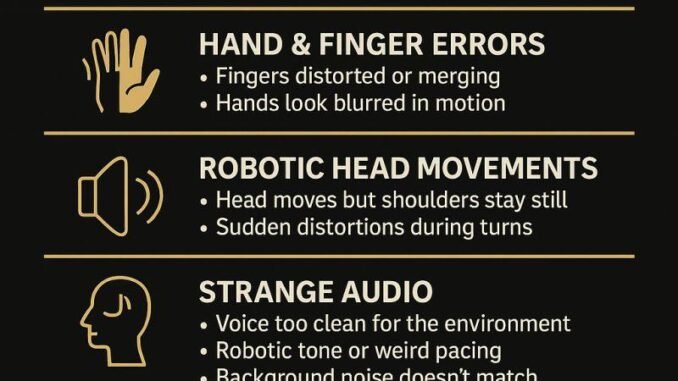
- Hands: Too many or too few fingers, merged fingers, weirdly long digits, hands melting into objects. Always zoom in on hands first.
- Teeth: Too many teeth, misaligned rows, teeth blending into lips.
- Ears and glasses: Asymmetrical ears, glasses with mismatched arms or lenses that don’t align, earrings that differ from each other.
- Background people: Faces in crowds that dissolve into smudges, bodies with impossible proportions.
Text and logos
AI mangles text. Signs, labels, book spines, t-shirt slogans, and brand logos in AI images often contain gibberish letterforms — shapes that look like letters but spell nothing. Real photos have readable (or naturally blurred) text; AI photos have confident nonsense.
Physics and logic errors
- Shadows pointing in inconsistent directions or missing entirely
- Reflections in mirrors, water, or glass that don’t match the scene
- Objects intersecting impossibly (a hand passing through a cup)
- Repeating patterns that break unnaturally (brick walls, fences, crowds)
- Hair that merges with backgrounds or has impossible flow
The “too perfect” look
AI images often have a distinctive over-polished quality: impossibly smooth skin, hyper-detailed everything-in-focus, cinematic lighting on mundane subjects, a certain waxy sheen. Real photography has imperfections — noise, motion blur, awkward compositions. When everything looks like a movie poster, be suspicious.
Video-Specific Clues
AI video is newer and glitchier than AI images. Watch for:
- Temporal inconsistency: Faces subtly morphing between frames, backgrounds shifting, objects appearing and disappearing.
- Unnatural movement: Hands moving strangely, walking gaits that look off, lip-sync that’s slightly wrong.
- Audio mismatches: Voice cloning is good but prosody (rhythm, emphasis) often feels flat or wrong for the emotional content.
- Blink rates and micro-expressions: AI faces sometimes don’t blink naturally or lack the micro-expressions real faces show.
Technical Verification Methods
When visual inspection isn’t enough:
- Reverse image search: Upload to Google Images or TinEye. If the “photo” appears nowhere else, or only on AI-gallery sites, that’s a signal. Real newsworthy photos usually have a traceable origin.
- Check metadata: Real camera photos contain EXIF data (camera model, settings, date). AI images typically have none or stripped metadata. (Note: social media strips metadata too, so absence alone proves nothing.)
- Look for watermarks and labels: Responsible AI tools (Adobe Firefly, others using C2PA standards) embed provenance info. The absence of provenance doesn’t prove AI origin, but its presence can confirm it. The Coalition for Content Provenance and Authenticity (C2PA) maintains the open standard behind these content credentials — worth knowing as platforms adopt it.
- AI detectors: Tools like Hive Moderation claim to detect AI images. Treat results as one signal among many — they’re probabilistic, not definitive.
- Source triangulation: For news images, check whether reputable outlets are running the same photo. A shocking image appearing only on random social accounts is a red flag regardless of AI involvement.
The Context Check (Most Important)
Honestly, the most reliable detection method isn’t technical — it’s critical thinking:
- Does it confirm what you already want to believe? The most-shared fakes are the ones triggering strong emotions. That’s by design (or by algorithmic accident).
- Who benefits from you believing this? Follow the incentive.
- Is the source credible? An established newsroom with editorial standards vs. an anonymous account created last month.
- Would this be reported elsewhere? Genuinely shocking real events get covered by multiple outlets. If only one source has the “photo,” wait.
Protecting Yourself and Others
Detection is only half the battle — response matters too. When you suspect a fake: don’t share it “just to ask if it’s real” (sharing spreads it regardless of your caption — screenshots of your debunk travel less far than the original). Report it on the platform. If it’s being used to defame, scam, or manipulate an election, report it to the relevant authorities — the FTC handles fraud-related fakes, and election officials handle election-related ones. And talk about it: media literacy is a herd immunity — the more people around you who pause before sharing, the less far fakes travel. Teach the hands-and-text check to your kids and parents; it takes 30 seconds and catches most fakes they’ll encounter.
For the creation side of this technology, see our guides on free AI image generators and AI photo editing — understanding how fakes are made helps you spot them. And for the bigger privacy picture, our AI chatbot privacy guide covers related risks.
Quick Answers: Spotting AI Fakes
What’s the fastest check for an AI image?
Zoom in on hands, teeth, and any text in the image. AI still mangles these most often — extra fingers, gibberish lettering on signs, mismatched earrings. Thirty seconds of inspection catches the majority of fakes circulating online.
Can AI detectors be trusted?
As one signal among many, not as verdicts. They’re probabilistic and improving, but they produce false positives and negatives. Combine detector results with reverse image search, source credibility checks, and the context test (who benefits from you believing this?).
The bottom line: zoom in on hands, teeth, and text; check shadows, reflections, and physics; look for the “too perfect” sheen; reverse-search the image; and above all, apply the context check — who posted it, why, and does anyone credible corroborate it? No single test is definitive, but combining visual inspection with source skepticism catches the overwhelming majority of AI fakes circulating today.
Leave a Reply