
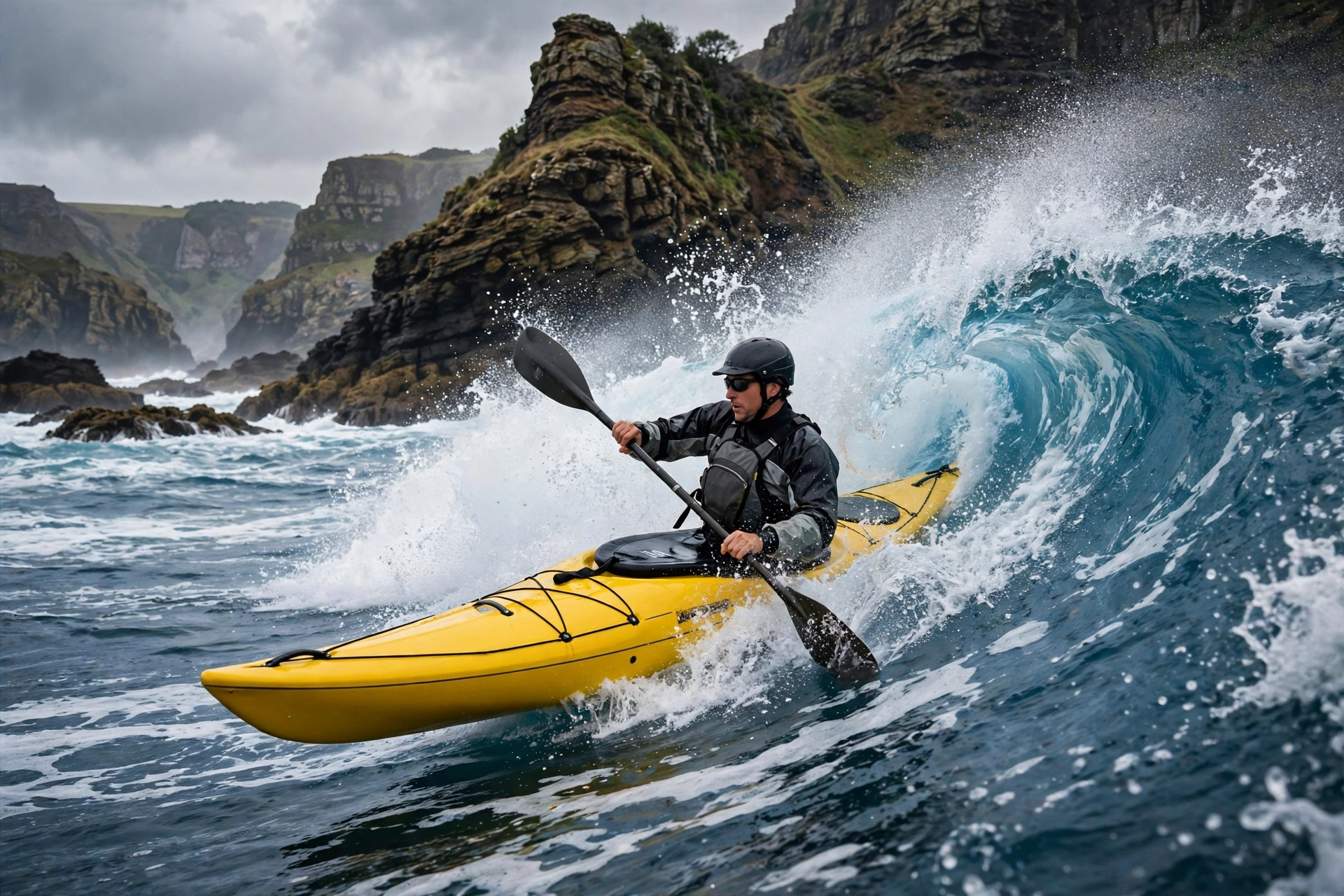
Riding an ocean wave in a kayak is one of the most thrilling things you can do on the water — part surfing, part paddling, entirely addictive. But walk into a kayak shop or browse online and you will face a wall of options: short boats, long boats, sit-on-tops, sea kayaks, whitewater boats. Choose wrong and your first surf session will be frustrating at best and unsafe at worst. This guide explains how to choose a kayak for ocean surf, from the types that work in waves to the features, sizing, and safety gear that matter most.
What Makes Surf Kayaking Different
Ocean surf demands things from a kayak that flat water never does. You need a boat that turns on a dime to stay on a wave’s face, accelerates quickly to catch waves, and lets you brace and roll when — not if — you wipe out. Long, straight-tracking touring kayaks are built for the opposite: going straight efficiently for miles. That is why the sport of surf kayaking has its own purpose-built designs, and why grabbing any old kayak for the surf zone is a recipe for a bad day.
The 4 Types of Kayaks People Use in Ocean Surf
1. Surf kayaks (purpose-built)
These are the real deal: short (usually 8 to 9.5 feet), with planing hulls, sharp rails, and fins — essentially surfboards you sit in. They are the most maneuverable option and the best choice if surf kayaking is your main goal. The trade-off: they are tippy for beginners and poor for paddling any distance.
2. Whitewater kayaks
Short, highly maneuverable river boats are a popular crossover choice for surf. Their planing hulls and edges handle waves well, and they roll easily. If you already own a whitewater boat, it will work in the surf. Downsides: they are slow on flat water and cramped for bigger paddlers.
3. Sit-on-top kayaks
Wide, stable, and self-draining, sit-on-tops are the friendliest option for beginners trying the surf. You will not get trapped upside down, and climbing back on after a wipeout is easy. They are less maneuverable than true surf kayaks and can be a handful in bigger waves, but for small, gentle surf they are ideal starters.
4. Sea (touring) kayaks
Long sea kayaks are built for open-water distance, not wave riding — and sea kayaks built for open water touring will feel stiff and unresponsive on a wave face. Experienced paddlers can surf them in a straight line, but they are a poor choice for learning. Keep them for the journey to the surf spot, not the surf itself.
Sit-On-Top vs. Sit-Inside for Surf
For most beginners, a sit-on-top is the smarter first surf boat: it is stable, you cannot get stuck inside it, and remounting in the surf zone is straightforward. A sit-inside surf or whitewater kayak offers far better control and wave-riding performance once you can roll reliably — but it demands a spray skirt, solid bracing skills, and comfort being upside down in breaking waves. Start sit-on-top; graduate to sit-inside when your skills justify it.
Key Features to Compare When Choosing
Kayak designs vary enormously — browsing kayak designs and hull types shows just how many variables exist. For surf, focus on these:
- Length: shorter is more maneuverable. True surf kayaks run 8 to 9.5 feet; beginner-friendly sit-on-tops for surf are usually 9 to 12 feet.
- Hull shape: flat, planing hulls skim across the wave face and turn fast. Rounded displacement hulls track straight and resist turning — avoid them for surf.
- Rocker: the upward curve of the bow and stern. More rocker keeps the ends from pearling (nosediving) into the wave.
- Rails and edges: hard, defined edges grip the wave face and let you carve turns. Soft, rounded hulls slide around unpredictably.
- Fins or skeg: surf kayaks use fins like surfboards for grip and drive. A retractable skeg helps sit-on-tops track on the paddle out.
- Volume: the boat must float you high enough to maneuver. Heavier paddlers need higher-volume boats — check manufacturer weight ranges and stay comfortably inside them.
- Outfitting: secure thigh braces, an adjustable backrest, and good footrests connect your body to the boat. In surf, a loose fit means no control.
- Weight: you will be carrying the boat across sand and through shore break. Lighter is better, within your budget.
- how to free dive deeper for beginners
Sizing: Getting the Right Fit
Fit matters more in surf than anywhere else, because you steer with your whole body. When trying a boat:
- Your thighs should contact the thigh braces firmly with knees slightly bent.
- Your feet should reach the footrests without fully straightening your legs.
- You should be able to rock the boat edge to edge using your hips.
- Check the manufacturer’s paddler weight range — being near the top of the range makes any boat sluggish.
As a rough guide: smaller paddlers (under 150 lbs) suit lower-volume surf kayaks around 8 feet; medium paddlers (150 to 190 lbs) fit standard 8.5 to 9-foot models; larger paddlers should look at high-volume designs or stable 10 to 12-foot sit-on-tops. When between sizes, the smaller, snugger boat almost always surfs better.
Safety Gear You Cannot Skip
The surf zone is the most dynamic place you can paddle, and it deserves respect. Never surf without:
- A PFD (life jacket) — always worn, always zipped. No exceptions.
- A helmet — your boat, your paddle, and the sandy bottom are all harder than your head. Surf kayakers wear helmets; be one of them.
- A paddle leash — losing your paddle in breaking waves ends your session and can endanger others.
- A wetsuit — matched to your water temperature. Cold-water shock is a real risk even for strong swimmers.
- A whistle — attached to your PFD for signaling in noisy surf.
- A buddy or group — never surf alone as a beginner. An experienced partner is your best safety device.
7 Beginner Tips for Your First Surf Sessions
- Start tiny. Your first sessions should be in gentle, knee-high whitewater near shore — not overhead beach break. Build up gradually.
- Learn to roll or remount first. Practice in flat water until recovering from a capsize is boring. In surf, you will capsize.
- Watch the spot before launching. Spend 15 minutes studying wave sets, rip currents, and where other surfers sit. Local knowledge prevents most trouble.
- Respect surf etiquette. Do not drop in on someone else’s wave. Wait your turn, stay clear of swimmers and board surfers, and give the peak to whoever is closest to it.
- Keep your paddle active. A low brace with the paddle blade flat on the water is your stability — passive paddlers swim.
- Lean into the wave, not away. When a wave hits you side-on, lean toward it and brace. Leaning away is how capsizes happen.
- Quit while you are ahead. Surf sessions are exhausting. Fatigue causes most late-session mistakes — head in while you are still having fun.
FAQs About Choosing a Kayak for Ocean Surf
Can I use a regular recreational kayak in the surf?
You can, but you will not enjoy it. Wide recreational kayaks are stable in flat water but unmaneuverable on waves, hard to remount in surf, and prone to filling with water. A sit-on-top designed with surf in mind is a far better starting point.
How much does a surf kayak cost?
Entry-level sit-on-tops suitable for gentle surf start around $300 to $600. Purpose-built composite surf kayaks run $1,000 to $2,000 or more. Buying used is a smart move — surf boats take abuse, and beginners outgrow their first boat quickly.
Do I need to know how to roll?
For a sit-on-top, no — you just climb back on. For a sit-inside surf or whitewater kayak, yes: a reliable roll (or at minimum a strong brace and a quick wet exit) is essential before you paddle into real surf.
Is surf kayaking dangerous?
It carries real risks — powerful water, collisions, and cold exposure — but with proper gear, instruction, small conditions, and experienced company, beginners manage those risks well. Take a lesson from a certified instructor before going solo.
You May Also Like
Prefer your challenges on dry land? Find out how long 18 holes of golf takes, or learn how to play pool — both reward patience, practice, and a steady hand.
Leave a Reply