
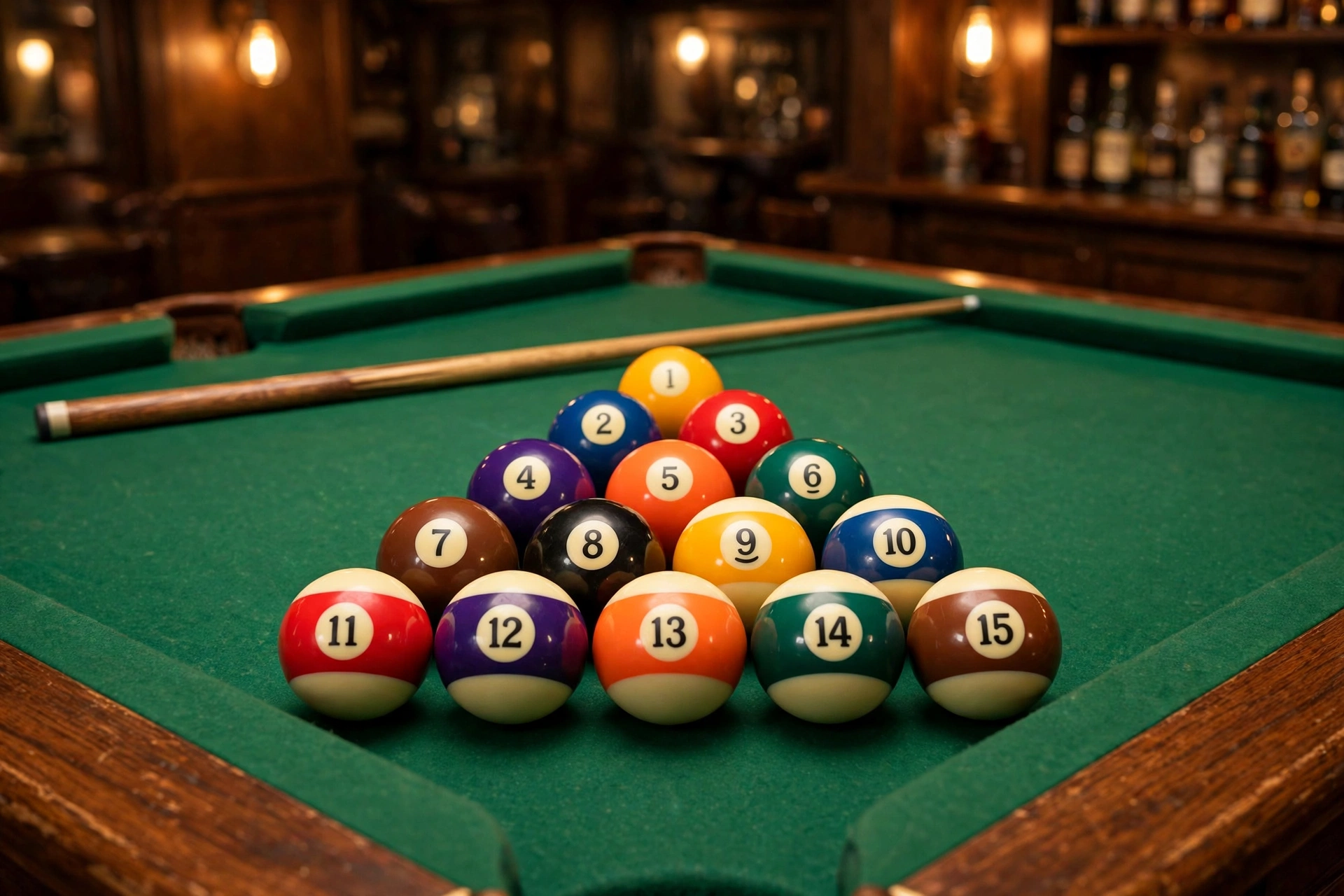
Walk into almost any bar, club, or game room and you will find a pool table — and a group of people having more fun than everyone else in the room. Pool looks effortless when good players do it, but here is the good news: learning how to play pool is genuinely easy. You can understand the rules in ten minutes and play your first real game tonight. Getting good takes longer, but that is part of the fun.
This guide covers everything a beginner needs: the equipment, how to set up the table, the basic rules of 8-ball (the most popular pool game in the world), how to hold the cue and aim, and practical tips that will make you noticeably better within a few sessions.
What You Need to Play Pool
Pool has beautifully simple equipment. You need:
- A pool table — with six pockets (four corners, two sides) and a cloth-covered slate surface. Standard tables are 7, 8, or 9 feet long.
- A cue stick — usually 57 to 58 inches long. House cues at bars are fine for beginners.
- Object balls — 15 numbered balls: solids 1 through 7, the black 8-ball, and stripes 9 through 15.
- A cue ball — the white ball you strike with the cue.
- A triangle rack — for arranging the balls at the start.
- Chalk — applied to the cue tip before shots to prevent miscues.
- how to set up pool balls
That is really it. Pool is one of several cue sports including snooker and carom billiards, but it is by far the most common one you will find in bars and homes.
The Basics: How a Game of Pool Works
The most popular pool game is 8-ball, played between two players or two teams. After the break, each side is assigned a group — solids (1 to 7) or stripes (9 to 15). You win by pocketing all of your group first, then legally pocketing the 8-ball. Pocket the 8-ball too early, or scratch while shooting at it, and you lose. Simple to understand, endlessly tricky to master.
How to Rack the Balls
A proper rack matters — a tight rack gives a fair, satisfying break. Here is how to rack for 8-ball:
- Place the triangle with its apex (front) ball on the foot spot — the marked dot near the far end of the table.
- Put the 1-ball at the apex (front of the rack).
- Put the 8-ball in the center of the rack (the third row’s middle).
- Place one solid and one stripe in the two back corners — one of each.
- Fill the remaining spots randomly with the other balls.
- Press the balls together tightly, then lift the rack straight up without disturbing them.
A loose rack scatters weakly and unfairly, so take ten seconds to get the balls touching. Your opponent will appreciate it.
The Break Shot: Starting the Game
The player who breaks places the cue ball anywhere behind the head string (the line near the end you break from). Then they strike the rack as hard as they can control. A good break:
- Hits the 1-ball (apex ball) squarely and dead center.
- Drives the cue ball forward with follow-through, not a jab.
- Keeps the cue as level as possible for maximum power transfer.
- Aims to pocket a ball and leave the cue ball near the center of the table.
If you pocket a ball on the break, you continue shooting — and in most casual rules, the table is still ‘open,’ meaning you can choose solids or stripes based on what the break gave you. If you pocket balls from both groups, pick the group with the better layout. Do not overthink it: a solid, controlled break beats a wild powerful one every time.
The Basic Rules of 8-Ball Pool
Bar rules vary from place to place, but these are the core rules nearly everyone follows:
- Open table after the break. Until someone legally pockets a called ball, either group is fair game.
- Call your shots. In friendly games, you should say which ball you are aiming at and which pocket it is going into. Accidental pockets usually do not count in stricter games.
- Hit your group first. The cue ball must contact one of your balls before anything else, or it is a foul.
- Keep shooting while you pocket. As long as you legally pocket one of your balls, you keep your turn. Miss, foul, or pocket nothing, and your turn ends.
- Common fouls: scratching (pocketing the cue ball), hitting the wrong group first, failing to hit any ball, knocking a ball off the table, or touching a ball with your hand or clothing.
- Ball in hand. After most fouls, your opponent gets ‘ball in hand’ — they can place the cue ball anywhere on the table. This is a huge advantage, so avoid fouls.
- The 8-ball. Only after clearing your group can you shoot at the 8-ball. Call the pocket. Pocket it legally and you win. Pocket it early, scratch on it, or knock it off the table, and you lose instantly.
These are simplified from the standardized rules of eight-ball, which tournament players follow. For bar games, agree on the key rules — called shots, ball in hand, and what happens on the 8-ball — before you start, and you will avoid most arguments.
How to Hold the Cue, Stand, and Aim
Good fundamentals make everything else easier. Here is the beginner setup that works:
Stance
Stand with your feet roughly shoulder-width apart, with your dominant foot slightly back. Lean forward from the hips so your head is over the cue. Your body should feel balanced and still — movement during the stroke is the enemy of accuracy.
Grip
Hold the cue lightly with your back hand, like holding a small bird — firm enough that it will not fly away, soft enough not to hurt it. A death grip creates tension that ruins your stroke. Most beginners grip far too tightly.
Bridge
Your front hand forms the ‘bridge’ the cue slides through. The simplest is the open bridge: lay your hand flat on the table, spread your fingers, and raise your thumb to form a V channel for the cue. Keep the bridge hand planted and still.
Aiming
Aim the cue ball at the exact spot on the object ball that will send it toward the pocket — imagine a straight line from the pocket through the object ball, and strike the point on the far side of that line. Beginners should start with straight, short shots and build up to angled ones. Keep your eye on the object ball (not the cue ball) during the final stroke.
The stroke
Pull the cue back slowly, pause briefly, then accelerate smoothly through the cue ball, following through several inches past contact. Think slow back, smooth through. Jerky, rushed strokes miss; smooth strokes pocket balls.
7 Beginner Tips That Actually Work
- Chalk before every shot. It takes two seconds and prevents miscues. Make it a habit from day one.
- Start with easy shots. Do not attempt hero shots. Take the simple pocket that is available and let the table come to you.
- Think one shot ahead. Before shooting, glance at where the cue ball will go after contact. Even basic position play separates beginners from total novices.
- Use less power. Most beginners hit everything far too hard. A soft, controlled shot pockets balls more reliably and leaves the cue ball where you want it.
- Practice the stop shot. Hitting the cue ball dead center so it stops where it contacts the object ball is the foundation of all position play.
- Keep your head still. Lifting your head to watch the shot is the number one cause of misses. Stay down until the ball drops.
- Play regularly, even briefly. Thirty minutes twice a week beats a four-hour session once a month. Muscle memory builds with repetition.
Common Beginner Mistakes to Avoid
- Gripping the cue too tightly — tension kills accuracy. Relax your back hand.
- Hitting too hard — power without control just scatters balls and scratches.
- Not chalking — miscues are embarrassing and avoidable.
- Standing up during the shot — stay down through the follow-through.
- Ignoring defense — when you have no good shot, play safe: leave the cue ball somewhere difficult for your opponent instead of attempting the impossible.
- Arguing about rules mid-game — agree on the rules before the first break.
Other Pool Games Worth Trying
Once you are comfortable with 8-ball, try nine-ball, a faster rotation game where you must hit the lowest-numbered ball first — it is quicker, more aggressive, and great for practicing position play. Cutthroat (three players, five balls each) and straight pool (call every shot, first to a set number of points) are also worth learning. Each game teaches different skills, and variety keeps practice interesting.
FAQs About How to Play Pool
How long does it take to learn pool?
You can learn the rules and play a real game in under an hour. Becoming a solid casual player takes a few months of regular play. Mastery, as with any cue sport, takes years — which is exactly why it stays interesting.
What happens if I scratch on the break?
In most casual rules, your opponent gets ball in hand behind the head string. In stricter rules, ball in hand anywhere. Agree on this before you play.
Do I have to call every shot?
In friendly bar games, calling the ball and pocket for anything non-obvious is enough. In league and tournament play, you must call each shot precisely. When in doubt, call it — it avoids arguments.
Can I play pool alone?
Absolutely. Solo practice — running racks, practicing position, drilling specific shots — is how good players are made. Many players say an hour of focused solo practice beats three hours of casual games.
You May Also Like
If you enjoy games that reward patience and strategy, you might like our guide on how long 18 holes of golf takes — another classic game where a calm mind beats raw power. For something more adventurous, see how to choose a kayak for ocean surf.
Leave a Reply