
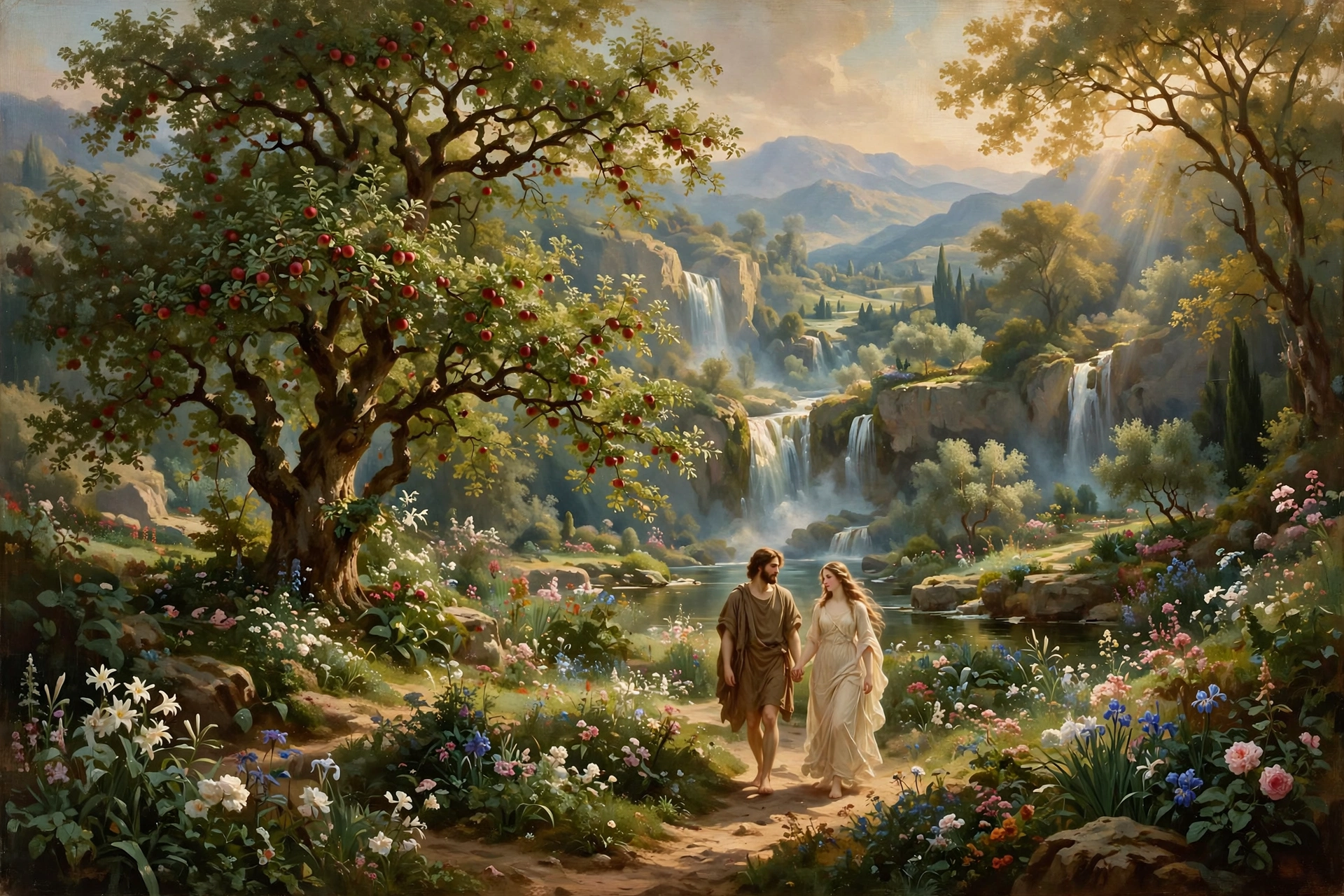
It’s the question every curious kid asks in Sunday school and every skeptic asks online: if humanity started with just Adam and Eve, how did they populate the Earth? Wouldn’t that require incest? Where did Cain’s wife come from? It’s a fair question — and religions, theologians, and scientists have all given it serious thought. Here’s what each perspective actually says.
The Question, Stated Plainly
The puzzle has three parts:
- If Adam and Eve were the first two humans, their children would have had to reproduce with each other (or with their parents) to continue the line.
- Genesis mentions Cain’s wife and the “land of Nod” — where did these other people come from?
- Modern genetics says a population founded by two people would face catastrophic inbreeding.
Each tradition handles these differently. Let’s take them in turn.
The Traditional Jewish and Christian Answer
Classical theology bites the bullet: yes, the first generations intermarried. The standard explanation, found in commentators from ancient rabbis to modern apologists:
- Adam and Eve had many children — Genesis 5:4 says Adam “had other sons and daughters” besides Cain, Abel, and Seth. With lifespans measured in centuries, they could have had dozens or hundreds of children.
- Sibling marriage was initially permitted because it was necessary. The prohibition against incest in Leviticus came much later, given specifically to the Israelites.
- Genetic problems weren’t an issue yet — the traditional argument is that the human genome was originally “perfect” and mutations accumulated over generations, so early inbreeding didn’t carry the risks it does today.
- Cain’s wife was his sister (or niece). Genesis simply doesn’t name every daughter — the text focuses on the male line, as ancient genealogies typically did.
This is the mainstream historical position of Judaism and most of Christianity. It’s internally consistent if you accept its premises about early human genetics and longevity.
The “Other People” Theory
Some readers — ancient and modern — argue Genesis itself hints at other humans beyond Adam’s family. The evidence they cite:
- Cain fears that “whoever finds me will kill me” (Genesis 4:14) — who is he afraid of, if only his parents exist?
- Cain builds a “city” (Genesis 4:17) — cities need populations.
- The “sons of God” and “daughters of humans” in Genesis 6 suggest a wider humanity.
Interpretations vary: some say Adam and Eve were the first covenant humans (chosen for a special relationship with God) rather than the first biological humans — a view held by a number of modern theologians and some Jewish commentators. In this reading, other human populations existed, and Adam’s line intermarried with them. This elegantly solves the genetics problem, though it raises its own questions about the text.
The Catholic Position
The Catholic Church teaches monogenism — that all humans descend from a single original pair — as theologically important for the doctrine of original sin. Pope Pius XII’s Humani Generis (1950) stated that Catholics cannot embrace polygenism (multiple original pairs) as it conflicts with original sin doctrine. The Church doesn’t officially specify the mechanics of how the first generations reproduced, leaving that to theological speculation along the traditional lines above.
The Islamic Perspective
The Quran affirms Adam and Hawwa (Eve) as the parents of humanity: “O mankind, fear your Lord, who created you from one soul and created from it its mate and dispersed from both of them many men and women” (4:1). Islamic tradition generally holds that Adam and Eve had many children — some accounts say each pregnancy produced twins, a boy and a girl — and that siblings married across twin-pairs (each marrying the twin of another pair, not their own twin) under divine permission for that time. The Islamic tradition around Adam preserves detailed narratives on this.
What Genetics Says
Population genetics is unambiguous: humanity did not descend from a single pair in the recent past. The evidence:
- Genetic diversity is too high. The variation in human DNA requires a founding population of thousands, not two. Estimates of the minimum viable human population generally land around 10,000 individuals.
- The “bottleneck” evidence: Humans did go through a population bottleneck roughly 50,000–100,000 years ago — possibly down to a few thousand individuals — but never two.
- Mitochondrial Eve and Y-chromosomal Adam: These real scientific concepts are often misunderstood. They refer to the most recent common ancestors through purely maternal and purely paternal lines — and they lived tens of thousands of years apart, not as a couple.
Scientists who are also believers handle this in various ways: reading Genesis as theological rather than scientific narrative, proposing the “federal headship” model (Adam as representative of early humanity), or the genealogical Adam models that reconcile a historical Adam with mainstream genetics. The overview of Adam and Eve across traditions is a good starting point for the full picture.
How Different Christians Reconcile This Today
- Young-earth creationists: Accept the traditional sibling-marriage account literally, with the “perfect genome” explanation for the lack of genetic consequences.
- Old-earth creationists: May accept the traditional account or lean toward the “other people” reading.
- Theistic evolutionists: Typically read the Genesis account as theological narrative about humanity’s relationship with God, not a genetics textbook — BioLogos and similar organizations explore these models in depth.
- Literary/framework readers: See Genesis 1–11 as ancient Near Eastern cosmology making theological points, not making scientific claims at all.
The Bottom Line
Traditional theology answers “sibling marriage, permitted then, with many unnamed children”; some traditions posit other human populations; genetics says the species never bottlenecked to two. Which answer satisfies you depends on how you read Genesis — as history, as theology, or as both. It’s one of those questions where the asking reveals as much as the answering.
For more on the biggest questions of faith, see how God became God and how to ask God for forgiveness — or explore a very different kind of deep time in how many extinction events Earth has survived.
The Population Genetics Math
To understand why geneticists are so confident, consider the numbers. Humans have roughly 3 billion base pairs of DNA, and any two unrelated people differ at about 1 in 1,000 positions — millions of differences. For all of that diversity to have arisen by mutation from just two founders a few thousand years ago, mutation rates would need to be hundreds of times higher than observed. Instead, the diversity pattern fits a founding population of roughly 10,000–15,000 individuals, consistent across multiple independent genetic markers: autosomal DNA, mitochondrial DNA, Y chromosomes, and X chromosomes all tell the same story. When four independent lines of evidence converge, scientists consider the question settled.
Why This Question Matters Beyond Trivia
This isn’t just an abstract puzzle — it sits at the intersection of faith and science where real people live:
- For believers in science: It’s a case study in how evidence constrains interpretation without necessarily destroying faith — many theologians have done serious work here.
- For religious educators: How you answer shapes whether young people see faith and science as enemies or dialogue partners. Dismissive answers lose people; thoughtful ones keep them.
- For the curious: It’s a window into how ancient texts work — what they were trying to say to their original audience versus what modern readers ask of them.
- For everyone: It’s a reminder that the deepest questions rarely have single-sentence answers, and that’s okay. Wrestling with them is the point.
Adam and Eve in Culture
Beyond theology and science, the first couple looms large in art and literature: Michelangelo’s Sistine Chapel frescoes, Milton’s Paradise Lost (which shaped the popular imagination more than Genesis itself), Mark Twain’s satirical Extracts from Adam’s Diary, and countless films and novels. The story endures because it’s really about all of us — innocence, temptation, consequence, and exile. Whatever you believe about its historicity, its cultural power is undeniable, and that power is why the population question keeps being asked millennium after millennium.
Reading Genesis on Its Own Terms
Biblical scholars emphasize that Genesis was written in an ancient Near Eastern context, engaging with — and subverting — the creation myths of Babylon and Egypt. Its original audience wasn’t asking genetics questions; they were asking “who is God?” and “who are we?” The text answers: God is one and good, humans bear divine image, and human choices have cosmic consequences. Whether those truths come packaged in history, parable, or something between is the question interpreters have debated for 2,000 years — and will keep debating. The debate itself is a sign of the text’s depth, not its weakness.
Leave a Reply